

Caregivers supporting someone with dementia typically focus their adaptive tool planning on physical mobility — grab bars, raised toilet seats, shower chairs. The cognitive dimension of daily task failure is underaddressed: the person with dementia may physically be able to pick up an object but may not reliably remember to use the tool they have, may use it incorrectly, or may become frustrated and abandon the task. Adaptive tool selection for dementia requires thinking about both physical capability and cognitive simplicity simultaneously.
Direct answer: for dementia-affected households, the most effective adaptive tools are those that require the fewest cognitive steps, are visually obvious, and do not require sequential instruction-following. The GrabbersTool Electric Jar Opener and Electric Can Opener replace multi-step manual processes with single-step activation. The GrabbersTool Reacher Grabber reduces dangerous floor-stooping that the person may not recognize as risky. The Standing Assist Tool provides a reliable physical cue for the sit-to-stand sequence when verbal reminders are no longer effective.
The Cognitive Dimension of Daily Task Failure in Dementia
Occupational therapists working with dementia patients distinguish between procedural and declarative memory loss. Procedural memory — how to do habitual tasks — is often preserved longer than declarative memory (names, recent events). This means a person with moderate dementia may still be able to make tea by habit but may not be able to learn how to use a new adaptive tool that requires a multi-step sequence.
Implications for adaptive tool selection:
- Familiar format preferred: tools that resemble what the person has used for decades are more likely to be adopted. An electric can opener that looks like a standard can opener is more intuitive than a novel design.
- Single-step activation: tools requiring one action (press button, release) are consistently better adopted than multi-step tools.
- Physical cues over verbal instruction: a standing assist tool positioned next to the chair provides a physical prompt — the person reaches for it naturally — whereas verbal reminders may not transfer.
- Reduce, do not add: the goal is to remove tasks from the cognitive load, not to add new tool-use skills to learn.
Specific Daily Tasks and Adaptive Approaches
Kitchen Tasks
Kitchen task failure in dementia commonly involves inability to open jars and containers (leading to abandonment of cooking) and difficulty with sequential tasks. Adaptive tools address the opening and access issues:
| Task | Dementia Challenge | Adaptive Solution |
|---|---|---|
| Opening jars | Multi-step grip, rotate, stabilize | Electric Jar Opener — one-button activation |
| Opening cans | Can opener mechanics require sequencing | Electric Can Opener — automatic stop at completion |
| Bottle tops | Grip and twist coordination may be lost | 5-in-1 Multi-Opener — lever-based, minimal learning |
| Picking up dropped items | Stooping may be forgotten as a fall risk | Reacher Grabber — kept visible and accessible |
Electric opener specifications — compatible lid sizes, weight, activation mechanism, automatic shutoff — are detailed on the product pages. These are the specifications most relevant to assessing ease of use for a person with dementia. View jar opener specifications
Mobility and Sitting
The sit-to-stand transition is a high-fall-risk moment in dementia because the person may not reliably recall that they need to pause and stabilize before walking. A Standing Assist Tool positioned at the chair provides the physical intermediate step: the person grips the rail, completes the stand, and is stable before moving. The physical object provides what verbal reminders cannot — a reliable, consistent environmental cue.
Object Retrieval From Floor
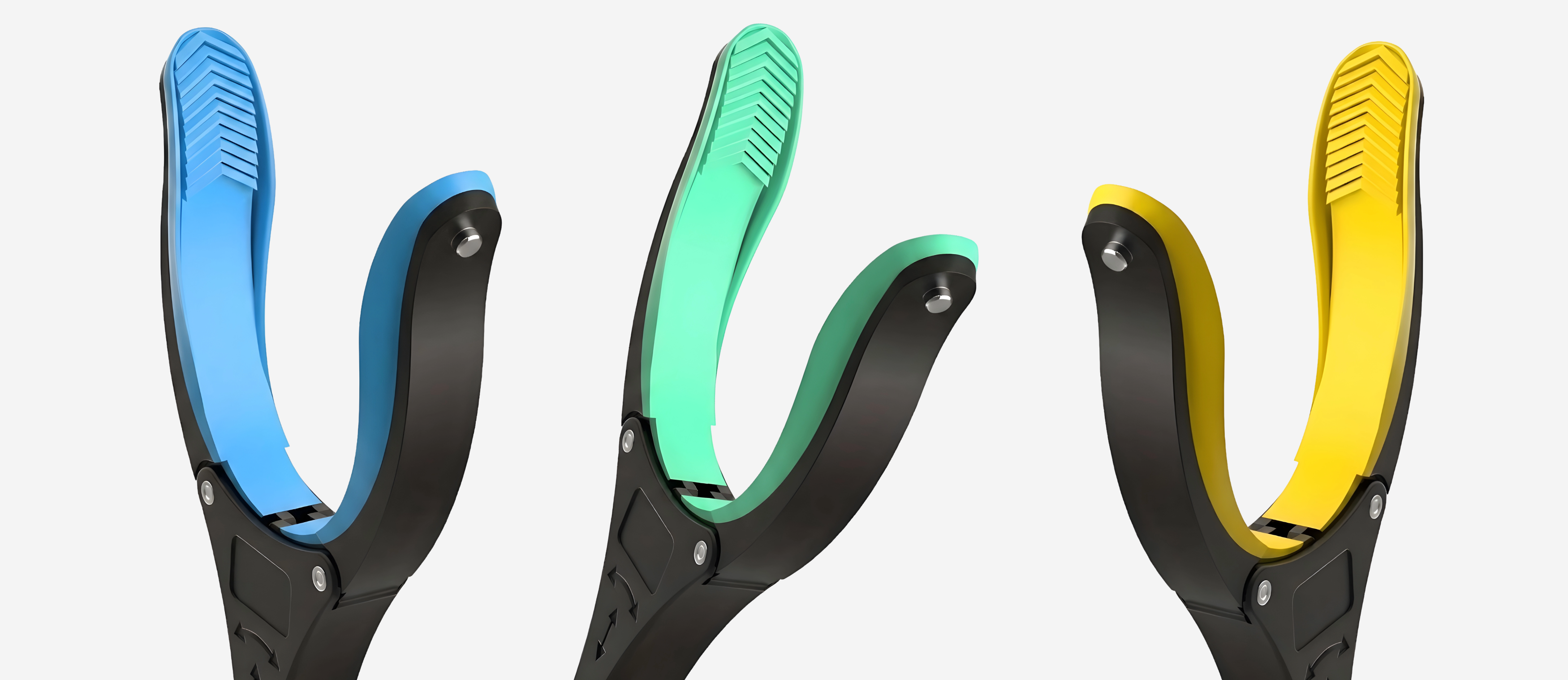
Stooping to pick up dropped objects is one of the more dangerous mobility events for older adults regardless of dementia status. In dementia, the additional risk is that the person may not recognize that the stoop-and-rise creates dizziness or instability. A reacher grabber tool positioned visibly near common sitting areas — with the jaw end pointed outward and accessible — can be used without needing to remember where it is or make a decision to retrieve it.
GrabbersTool correspondence from caregivers of dementia patients consistently identifies the reacher grabber simplicity — no buttons, no complex grip mechanism, squeeze handle and release — as key to adoption in this population.
Caregiver Considerations
Tool placement is a daily task. In households where the person with dementia may move or misplace tools, caregivers should designate fixed positions for each adaptive tool and return them to those positions consistently. The tool that is not in its designated spot when needed is not helpful.
Introduce tools before they are urgently needed. Introducing an electric jar opener after the person can no longer open jars, when the person resists the new device because it is unfamiliar, is a harder situation than introducing it earlier when it is a convenience rather than a necessity.
Supervised first use. Even simple tools benefit from one supervised use session where the caregiver demonstrates and the person with dementia performs the action. Procedural memory can encode this for future independent use.
See also: Caregiver Burnout: How Adaptive Tools Reduce Physical Strain and Aging Parent at Home: The Adaptive Tool Conversation You Need to Have.
Browse Easy Grip Kitchen Openers and Ergonomic Mobility for the full range of tools suited to dementia-affected households.


