

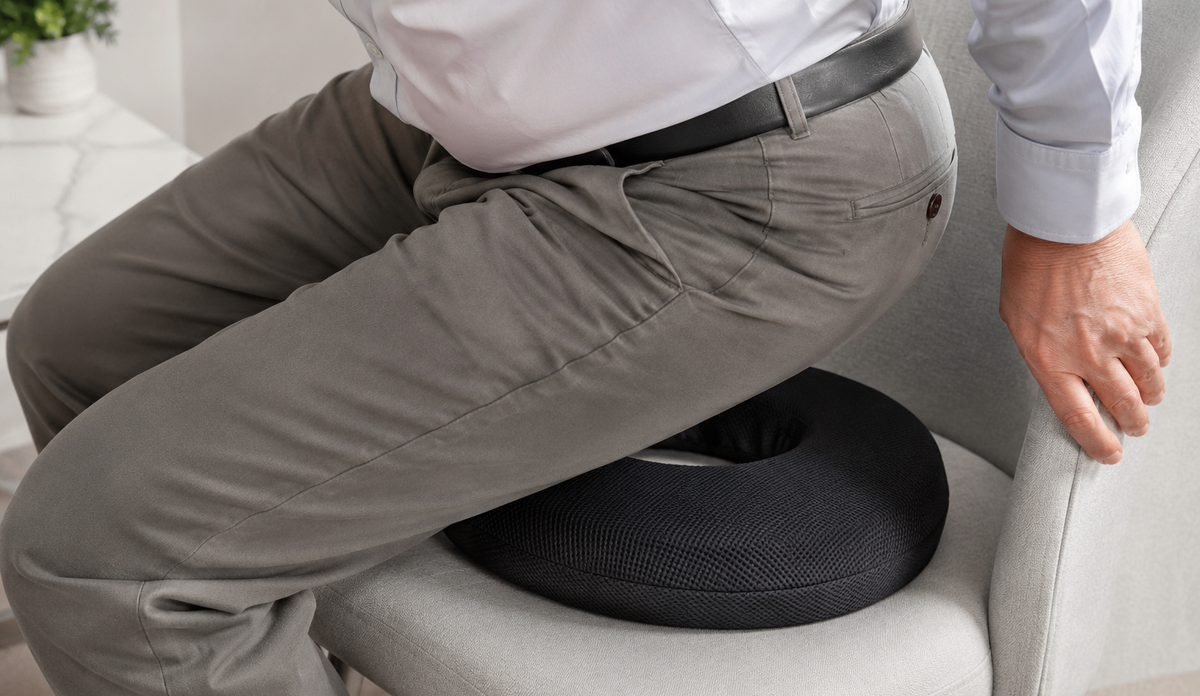
People rarely buy one seat cushion. They buy one, find it does not help, and buy a second of a different shape. The second one usually works, which suggests the first was not a bad cushion. It was the wrong tool.
Direct answer: A donut cushion removes contact with the tailbone entirely by leaving an open space beneath it. A wedge cushion, usually with a U-shaped cutout at the back, tilts your pelvis forward to change your sitting posture. Choose a donut when the problem is direct pressure on a sore spot. Choose a wedge when the problem is how you sit.
Quick Answer
Donut cushions suit localized soreness where any contact hurts, such as tailbone tenderness, hemorrhoid discomfort, or post-childbirth sitting. Wedge and U-cutout cushions suit posture-driven pain that builds over a long sitting session, such as lower back ache at a desk. If pressing directly on the spot is what hurts, choose a donut. If sitting still for an hour is what hurts, choose a wedge.
Key Takeaways
- A donut removes contact. A wedge changes angle. They are not interchangeable.
- The most common mistake is buying a donut for a posture problem, then concluding cushions do not work.
- Cushion diameter must match the chair seat, or the cushion tips at the edges and makes sitting worse.
- Firmness matters more than thickness. Soft foam collapses and puts you back on the seat.
- A cushion manages comfort while sitting. It does not address why the pain started.
What each shape actually does
The donut, or ring cushion
A ring cushion has a fully open center. When you sit, your weight is carried on your thighs and sit bones around the ring, and the area in the middle touches nothing at all. That is the entire mechanism, and it is a good one when the problem is that a specific spot cannot tolerate any pressure.
The trade-off is that load concentrates on the ring itself. If the ring is too narrow or too soft, you feel the edge instead, and some people find their thighs go numb during very long sessions.
The wedge and the U-cutout
A wedge is thicker at the back and thinner at the front, which tilts the pelvis forward and reduces the tendency to slump into a rounded lower back. Many wedges add a U-shaped cutout at the rear, which relieves the coccyx while still supporting it from the sides.
The trade-off is that the tailbone is not fully unloaded. For acute, sharp tenderness, a partial cutout can still be too much contact.
Side by side
| Donut / ring | Wedge or U-cutout | |
|---|---|---|
| Mechanism | Removes contact under the center | Tilts the pelvis, partially relieves the coccyx |
| Best for | Localized soreness, hemorrhoid discomfort, post-childbirth sitting | Posture-related lower back ache, long desk sessions |
| Pain pattern it suits | Hurts the moment you sit down | Builds up over 30 to 60 minutes |
| Weight distribution | Thighs and sit bones | Whole seat, angled forward |
| Weakness | Edge pressure on long sessions | Coccyx still makes some contact |
Use one question to decide: does it hurt the instant you sit down, or does it build up while you sit? Instant pain is a contact problem, and a donut solves contact problems. Gradual pain is a posture problem, and a wedge solves posture problems.
Size is the specification people ignore
Diameter matters more than most buyers expect. A cushion wider than the flat area of your chair seat will overhang the edges, and it will rock or tip when you shift your weight. On a dining chair or a car seat that is genuinely unsafe rather than merely uncomfortable.
Measure the flat seat area of the chair you sit in most, not the widest chair you own. The GrabbersTool Donut Cushion comes in 11.8 inches for dining chairs, car seats, and narrower office chairs, and 13.8 inches for wide armchairs, recliners, and sofas.
The complete size breakdown, cover material, and washing instructions are on the Donut Cushion product page.
Firmness beats thickness
A thick cushion made of soft foam compresses under body weight within minutes, and once it bottoms out you are effectively sitting on the chair again with a warm layer in between. A thinner, firmer cushion that holds its structure delivers more relief over an hour than a plush one that collapses.
This is why the honest test of a seat cushion is not how it feels in the first ten seconds. It is how it feels at minute forty.
Practical mistakes that make good cushions fail
- Sitting too far forward. If the open center is not positioned under the tailbone, the cushion does nothing. Sit back deliberately, then adjust.
- Using it on a soft sofa. A ring cushion needs a firm base. On a deep, soft couch the whole assembly sinks and the ring loses its shape.
- Leaving it in the car in summer. Repeated heat cycling accelerates foam breakdown.
- Washing the foam core. Wash the cover only. Soaked foam does not recover its structure.
- Expecting it to fix the cause. A cushion makes sitting tolerable. It does not treat the injury, the inflammation, or the posture habit underneath.
When sitting is only part of the problem
Tailbone pain rarely arrives alone. If sitting hurts, the movements around sitting usually hurt too, and those are worth solving separately.
- Getting up from a low chair loads the hips and lower back at the worst angle. A standing assist tool gives a stable push-off point so you are not levering off a soft armrest.
- Bending to pick things up is the movement people avoid most while their tailbone is sore. A reacher grabber tool removes the bend entirely.
- Putting on shoes and socks requires either bending forward or crossing a leg, and both are uncomfortable. A long-handle shoe horn and a foot funnel let you stay upright.
- Bathing safely matters if pain is making you unsteady. Our guide on whether non-slip bath mats actually prevent falls covers what works and what does not.
If recovery from surgery is the reason you are sitting differently, our recovery kit checklist maps out which aids matter in which week.
Frequently asked questions
Are donut cushions good for hemorrhoids?
Many people use a ring cushion because it keeps the seat from pressing on a sensitive area, which makes sitting more comfortable. It is a comfort cushion rather than a treatment, and it does not address the underlying condition. Speak to a doctor about treatment.
Can I use a donut cushion after childbirth?
People commonly do, because sitting directly on a firm chair can be painful in the early weeks. Ask your midwife or doctor first, particularly after a perineal tear or an episiotomy, since guidance varies by individual case.
How long can I sit on a ring cushion?
There is no fixed limit, but any single position becomes uncomfortable eventually. Standing and moving every 30 to 45 minutes does more for tailbone pain than any cushion, and the cushion makes the sitting between those breaks tolerable.
Does a donut cushion work in a car?
Yes, on a firm car seat, provided the cushion is not wider than the seat base. Check that it does not raise you so high that your head position or your view over the wheel changes.
Can I use one at a desk all day?
You can, but if your pain builds gradually over the day rather than hitting the moment you sit, a wedge is likely the better shape for you. Some people keep a donut for flare-ups and a wedge for ordinary days.
Should I see a doctor about tailbone pain?
Yes, if the pain is severe, persistent beyond a few weeks, follows a fall, or is accompanied by numbness or changes in bowel or bladder function. This article is general educational information, not medical advice.
The short version
Ask when it hurts. If sitting down is the painful moment, you need contact removed, and a donut does that. If the hour is what hurts, you need your angle changed, and a wedge does that. Buying the right shape first saves you the second purchase.
Written by GrabbersTool Editorial. GrabbersTool designs practical independence tools for everyday tasks. This article is general educational information and is not medical advice.


