

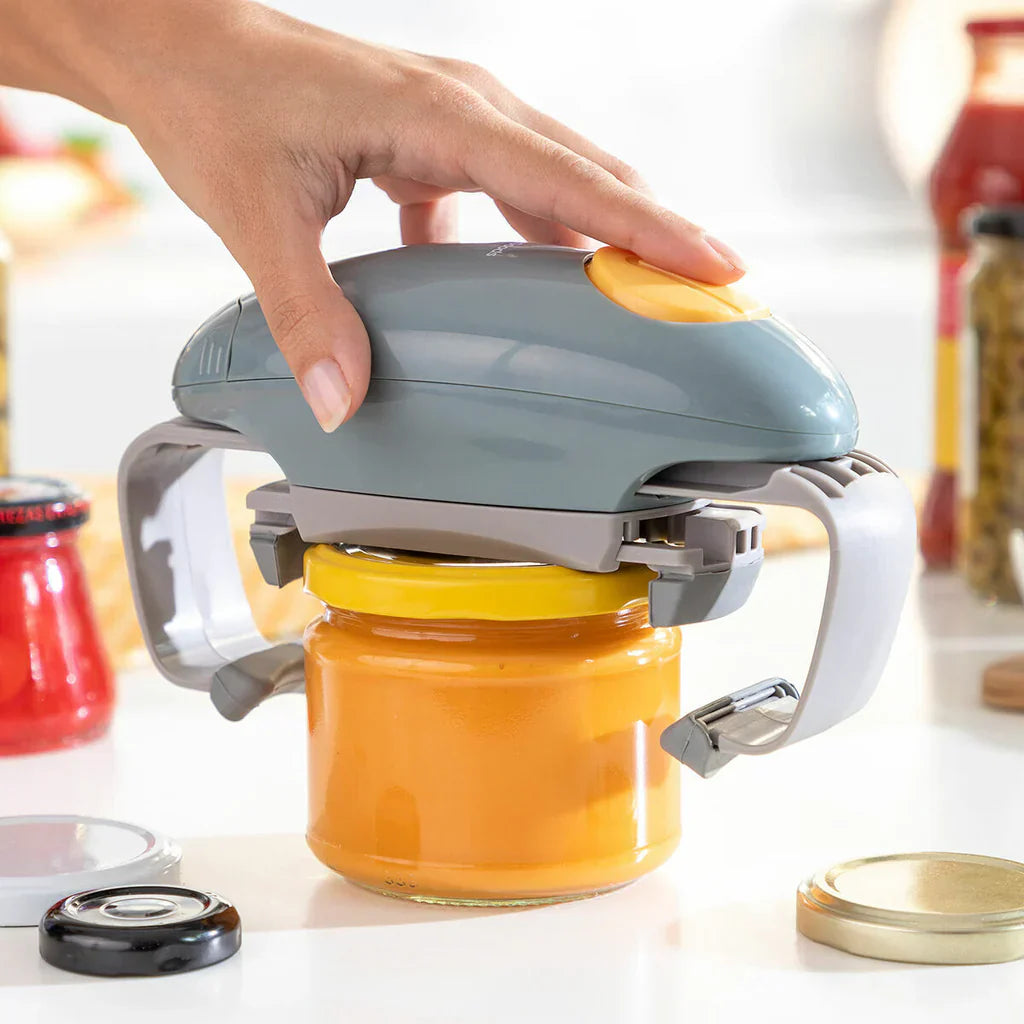
Total elbow arthroplasty (TEA) carries a restriction that distinguishes it from other joint replacements and that significantly affects long-term daily function: a lifetime maximum lifting load of approximately 5 pounds (2.3 kg) with the operative arm. This is not a temporary post-surgical restriction -- it is a permanent functional limit imposed by the mechanical design of elbow prostheses, which are not built to withstand the repetitive heavy loads that the native elbow tolerates. Five pounds is roughly the weight of a full 32-ounce jar, a 12-ounce can plus liquid, or a standard kitchen pot with a modest amount of water. Every kitchen task involving the operative arm must respect this load limit permanently, not just during recovery.
Direct answer: for total elbow arthroplasty, the adaptive kitchen strategy is two-part: eliminate heavy lifting tasks from the operative arm entirely (substituting the non-operative arm for weight-bearing), and use electric tools that minimize the force required from the operative arm for lighter kitchen tasks. The GrabbersTool Electric Jar Opener requires only that the operative arm steady the jar (well under 5 lb) while the motor provides the rotation force. No torque through the elbow from the operative arm is required.
TEA Lifetime Load Limit and Kitchen Task Assessment
| Kitchen Task | Elbow Load (Approximate) | TEA-Safe Approach |
|---|---|---|
| Full grocery bag carry (operative arm) | Exceeds 5 lb -- prohibited lifetime | Non-operative arm only; wheeled cart for grocery transport |
| Jar opening (manual, resistance) | Torque force through elbow -- variable but high during stuck lids | Electric Jar Opener -- motor provides torque, no elbow torque from patient |
| Can opening (manual lever) | Moderate grip and lever force through elbow | Electric Can Opener -- button press only, minimal elbow loading |
| Pot of water (full, 2 quarts) | Exceeds 5 lb -- prohibited lifetime | Fill pots at the stove with pitcher; use lightweight cookware |
| Item retrieval from floor (bending) | Weight of item plus awkward elbow angle | Reacher Grabber -- trigger pull, minimal elbow force for light items |
Electric opener weight and force requirements are detailed on the product pages. View Electric Jar Opener specifications.
TEA Recovery Phase and Long-Term Management
The early post-TEA recovery period (typically 6 weeks) involves acute restrictions beyond the lifetime load limit: the arm is splinted, grip is restricted, and the elbow is immobilized in a position designed to protect the cement-and-prosthesis interface during early healing. During this acute phase, the adaptive strategy is the same as for shoulder replacement: one-limb electric kitchen tool operation. After the acute phase, the operative arm returns to lighter tasks -- within the lifetime 5-pound limit. At this point, the electric opener continues to serve its purpose: jar opening is precisely the kind of elbow-torque-loading task that can exceed the safe limit unexpectedly when a stuck lid suddenly releases with the patient exerting maximum force. The electric opener prevents this torque spike permanently.
Rheumatoid Arthritis and TEA: Bilateral Considerations
Total elbow arthroplasty is most commonly performed for rheumatoid arthritis, which affects multiple joints. RA patients who undergo TEA often have involvement in the contralateral elbow, wrists, and hands as well. This makes the compensatory strategy (using the non-operative arm for heavy tasks) less reliable: the non-operative arm may itself have grip and strength limitations from RA. For bilateral RA with TEA, the electric kitchen tool approach is essential on both sides: the operative arm is restricted by the 5-pound limit, and the non-operative arm may be restricted by RA. Neither arm can manage manual jar or can opening reliably. See also: Rheumatoid Arthritis Hands: Adaptive Tools for Grip Loss and Fatigue.
Occupational Therapy and TEA Functional Assessment
The 5-pound lifetime restriction for TEA requires a formal functional reassessment of all daily activities -- not just kitchen tasks. Occupational therapists who work with post-TEA patients develop individualized activity modification plans that identify which tasks require adaptation, which can be performed without modification, and which must be permanently delegated. GrabbersTool adaptive kitchen tools address the container-opening and floor-retrieval categories that consistently appear on TEA modification lists. An OT familiar with the patient is the appropriate source for complete adaptation planning. See also: OT Assessment Guide: Evaluating Adaptive Tool Needs for Daily Living.
Browse Easy Grip Kitchen Openers and Reacher Grabber Tools.


