

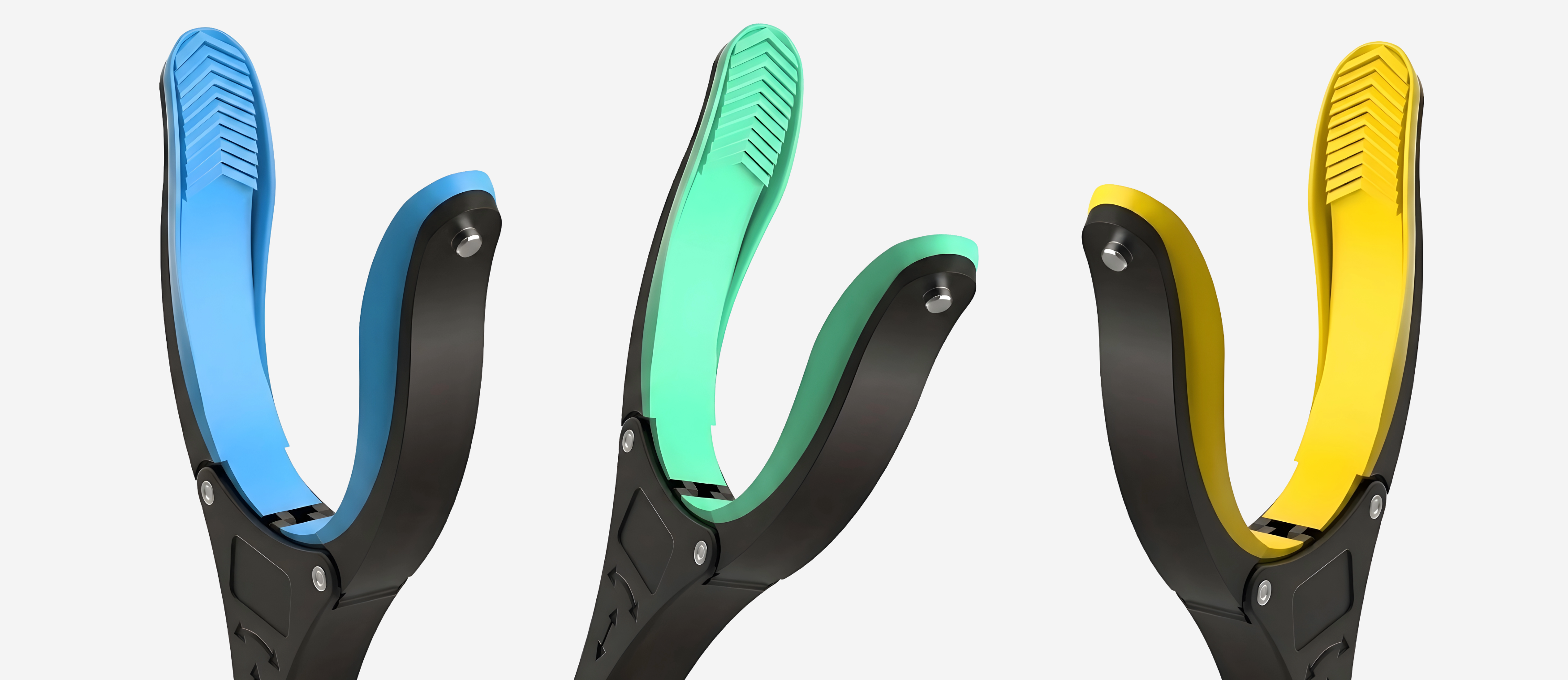
Osteoporosis generates a risk pattern that most adaptive tool guides do not address directly: the danger is not primarily limited range of motion or grip weakness -- it is fall risk combined with bone fragility. A fall that produces a bruise in a healthy 40-year-old produces a hip fracture in a person with severe osteoporosis. The adaptive tools that matter most for osteoporosis are the ones that reduce bending, reaching, and the small losses of balance that precede falls. GrabbersTool works with customers who have osteoporosis not because they cannot grip -- many have normal grip strength -- but because stooping to the floor or reaching above shoulder height destabilizes balance in ways that become dangerous with fragile bones.
Direct answer: for osteoporosis, the primary adaptive tools are the GrabbersTool Reacher Grabber (eliminates floor-level bending that destabilizes balance), the Walking Cane (provides the third point of contact that prevents falls during ADL tasks), and the Electric Jar Opener and Electric Can Opener (eliminate the bracing-against-resistance that can stress vertebrae already weakened by osteoporotic compression).
The Osteoporosis Fall-Fracture Cascade
The clinical literature on osteoporosis-related fractures documents a well-established cascade: fall leads to fracture, fracture leads to immobility, immobility leads to further bone density loss, further bone density loss increases fracture risk from smaller falls. Hip fractures, in particular, carry significant morbidity in older adults with osteoporosis. The adaptive tools that interrupt this cascade are those that reduce fall probability at its source -- the bending, reaching, and balance-compromising activities of daily home life. GrabbersTool customers who have osteoporosis and begin using a reacher consistently report that their occupational therapists had recommended the tool as a fall-prevention intervention, not merely a convenience.
Adaptive Tools by Fall-Risk Activity
| High-Risk Activity | Fall/Fracture Risk | Adaptive Solution |
|---|---|---|
| Picking up items from floor | Bending forward shifts center of gravity; return to upright is the fall moment | Reacher Grabber eliminates all floor bending |
| Overhead reaching (high shelves) | Head-tilt and arm extension destabilizes balance; falling backward onto spine | Reacher with overhead grip; reorganize storage to mid-level |
| Opening jars or bottles (bracing) | Whole-body bracing creates axial compression force on vertebrae | Electric Jar Opener; Electric Can Opener -- no resistance force required |
| Standing tasks on slippery surfaces | Kitchen and bathroom surfaces are highest fall-risk environments | Walking Cane at counter; non-slip floor mats |
| Chair-to-stand transitions | Propulsion from low surfaces risks forward stumble | Standing Assist Tool provides stable anchor point |
Full weight ratings and specifications for each tool are on the product page. View Walking Cane specifications.
Vertebral Compression Fractures and Adaptive Tools
Osteoporosis-related vertebral compression fractures (VCFs) are often asymptomatic -- many patients discover them incidentally on imaging taken for another reason. When symptomatic, VCFs produce back pain that limits forward bending tolerance. For patients with known VCFs or significant kyphosis from prior VCFs, the reacher becomes essential not only for fall prevention but for pain management: eliminating lumbar flexion reduces mechanical stress at the fracture site. The 43-inch reacher is particularly relevant for tall patients or for reaching further under furniture without bending. The GrabbersTool 43-inch Reacher specifications and recommended use cases are on the product page.
Osteoporosis and Medication Effects on Adaptive Tool Selection
Bisphosphonate therapy (alendronate, risedronate, zoledronic acid) is standard for osteoporosis management. These medications require specific administration posture (remaining upright for 30-60 minutes post-dose in most oral formulations) and can cause GI side effects that create additional fatigue. Corticosteroid-induced osteoporosis (CIOP), which occurs in patients on long-term systemic corticosteroids for rheumatic conditions, often co-exists with the underlying condition the corticosteroid treats -- meaning patients may have both the grip and range-of-motion limitations of rheumatoid arthritis and the fracture risk of CIOP. For these patients, the full adaptive tool kit (reacher, electric openers, walking cane, standing assist) addresses both layers of limitation simultaneously. See also: Rheumatoid Arthritis Comprehensive Adaptive Tools Guide.
Browse Reacher Grabber Tools, Ergonomic Mobility Solutions, and Easy Grip Kitchen Openers.


