

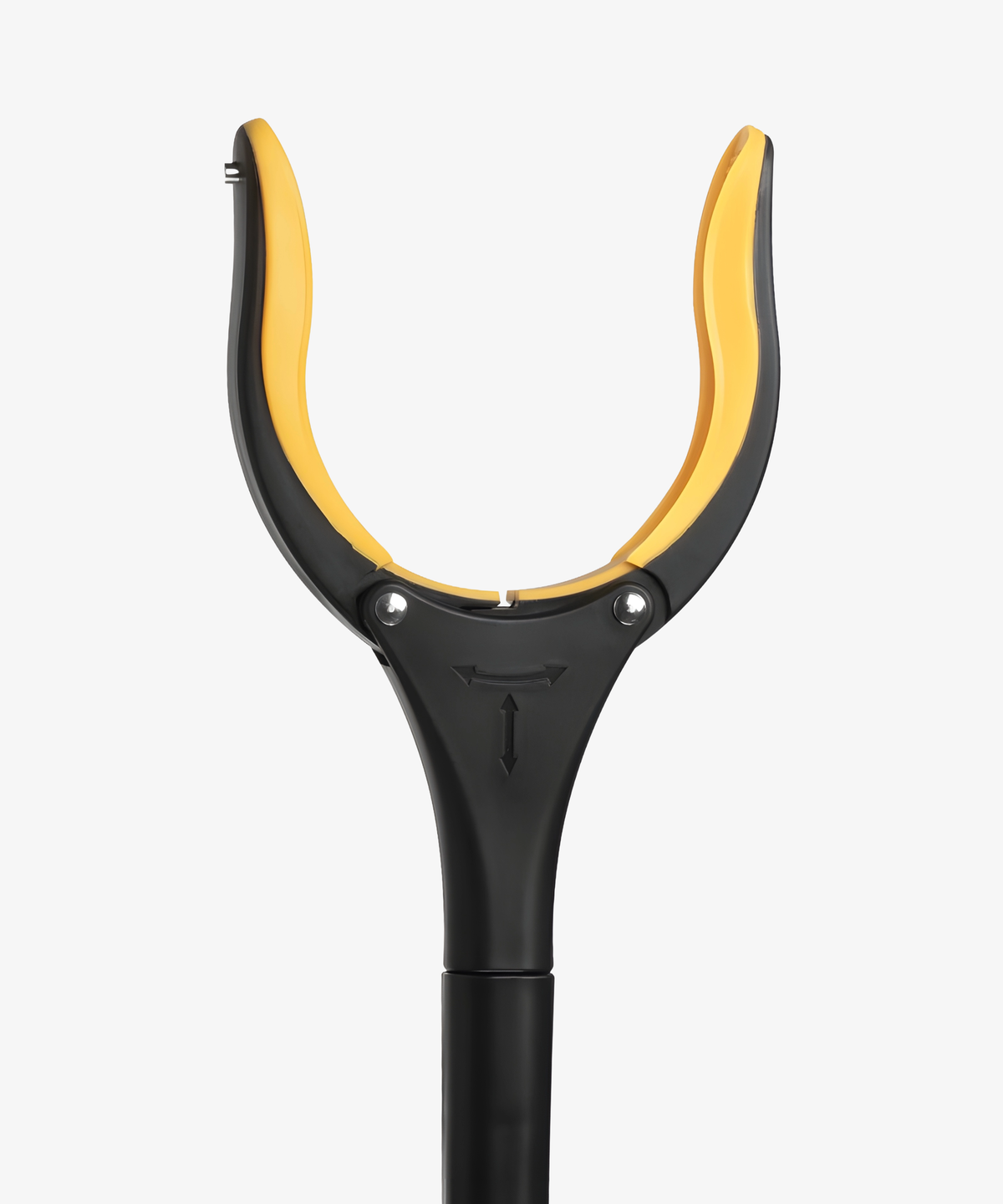
Ask someone who uses a reacher every day where the difficulty actually is, and the answer is rarely the top shelf. It is the two feet beside the chair — the remote on the far cushion, the phone that slid down beside the seat, the glass on a side table just past your fingertips. That zone is where independence is won or lost, and it is the zone a long reacher handles worst.
Quick Answer
A long reacher is difficult to use within about three feet of your body because the shaft has nowhere to go — it collides with the chair, your own legs, or the furniture beside you. For seated close-range retrieval, a 21-inch reacher is easier to aim and faster to use. A long reacher remains the right tool for reaching the floor away from the chair and for high shelves.
Key Takeaways
- Close-range reaching is the most frequent daily difficulty, not long-range reaching.
- A long reacher needs clearance behind your hand that a seated position does not give you.
- Short reachers let you keep your elbow close to your body, which is less tiring.
- Wheelchair users typically need both lengths for different zones.
- The right test is not "how far does it reach" but "can I use it without standing up."
Why a long reacher fails up close
To use a reacher you hold it near one end, which means the rest of the shaft extends backward past your hand. Standing in an open room, that is irrelevant. Sitting in an armchair, it is the whole problem: a 43-inch tool aimed at something two feet in front of you puts most of its length behind your hand, where the chair back, the armrest, or your own torso is.
The result is that you angle the tool rather than point it. The jaw arrives at the object sideways, the grip is less secure, and the movement takes two or three attempts instead of one. People solve this by leaning forward or standing — the exact motions the reacher was bought to prevent.
The zone each length covers from a seated position
| Target zone from your chair | Best length |
|---|---|
| On your lap, the armrest, or the cushion beside you | No tool, or 21 in |
| Side table, coffee table edge, floor directly beside the chair | 21 in |
| Floor two to four feet out, middle of the coffee table | 32 in |
| Floor across the room, shelves above shoulder height | 43 in |
Why elbow position matters more than people expect
Holding a long reacher out in front of you puts the load at the end of an extended arm. Holding a short one lets you keep your elbow near your ribs, where your shoulder does far less work. For anyone with shoulder pain, limited rotation, or reduced endurance, that difference decides whether a tool gets used twenty times a day or abandoned after a week.
It is the same reason a short-handled pan is easier to hold steady than a long-handled one with the same weight in it. The weight has not changed; the distance from your shoulder has.
Wheelchair users: two zones, two tools
Wheelchair use splits cleanly. Items on the lap, the side pouch, a tray, or the floor immediately beside the wheel are close-range work where a long reacher is unmanageable inside the chair's footprint. Items on the floor further out, on a counter, or on a shelf are range work where a 43-inch reacher is the standard answer because it extends reach without the user leaning out of the chair.
Leaning out is the part that matters. Reaching beyond the base of support from a seated position is a recognized fall and tipping risk, which is why occupational therapists prioritize tools that let the user stay upright and centered. Discuss the specific setup with your therapist, who can assess your chair, your reach, and your balance directly.
Setting up a chair so you need the reacher less
A reacher is one half of the solution; placement is the other.
- Put a side table on your stronger side, at armrest height rather than below it.
- Keep the reacher itself hooked on the chair arm, not leaning in a corner.
- Use a shallow tray or caddy so small items cannot roll out of reach.
- Keep the floor beside the chair clear, so anything dropped lands where you can get it.
- Charge the phone on the table, not on the floor behind the chair.
The tool described here
The Reacher Grabber Tool 21" is $29.99 and built for exactly this zone — one-piece, 360-degree rotating claw so you can meet the object at the angle the chair allows, silicone non-slip jaws for phones and glasses, and a magnetic tip for keys. For the floor further out, the Reacher Grabber Tool 32", and for seated long-range and overhead work, the Reacher Grabber Tool 43".
Frequently Asked Questions
Why is my long reacher hard to use while sitting?
Because the shaft extends backward past your hand, and in a chair that space is occupied by the chair back, the armrest, or your own body. You end up angling the tool instead of aiming it.
What length reacher is best for use from an armchair?
Around 21 inches for items beside the chair and on side tables. Add a 32-inch reacher if you also need things from the floor further out.
Should a wheelchair user buy a short or a long reacher?
Both, if the budget allows. A short one handles the lap, side table, and floor beside the wheel; a 43-inch one handles the floor further out and shelves without the user leaning out of the chair.
Is a short reacher less tiring to use?
Usually, because it lets you keep your elbow close to your body instead of holding a load at the end of an extended arm. The tool weight is similar; the strain on the shoulder is not.
Can a reacher be used while lying in bed?
A short reacher can, for items on a nightstand or the floor beside the bed. A long one is impractical lying down for the same clearance reason it is impractical in a chair.
How do I stop dropping things beside the chair in the first place?
Move the side table to your stronger side at armrest height, use a shallow tray so items cannot roll, and keep the floor beside the chair clear so anything that does fall stays within reach.
Written by GrabbersTool Editorial. General information about reaching aids, not medical advice. For seating, balance, and wheelchair setup, consult your occupational or physical therapist.


