

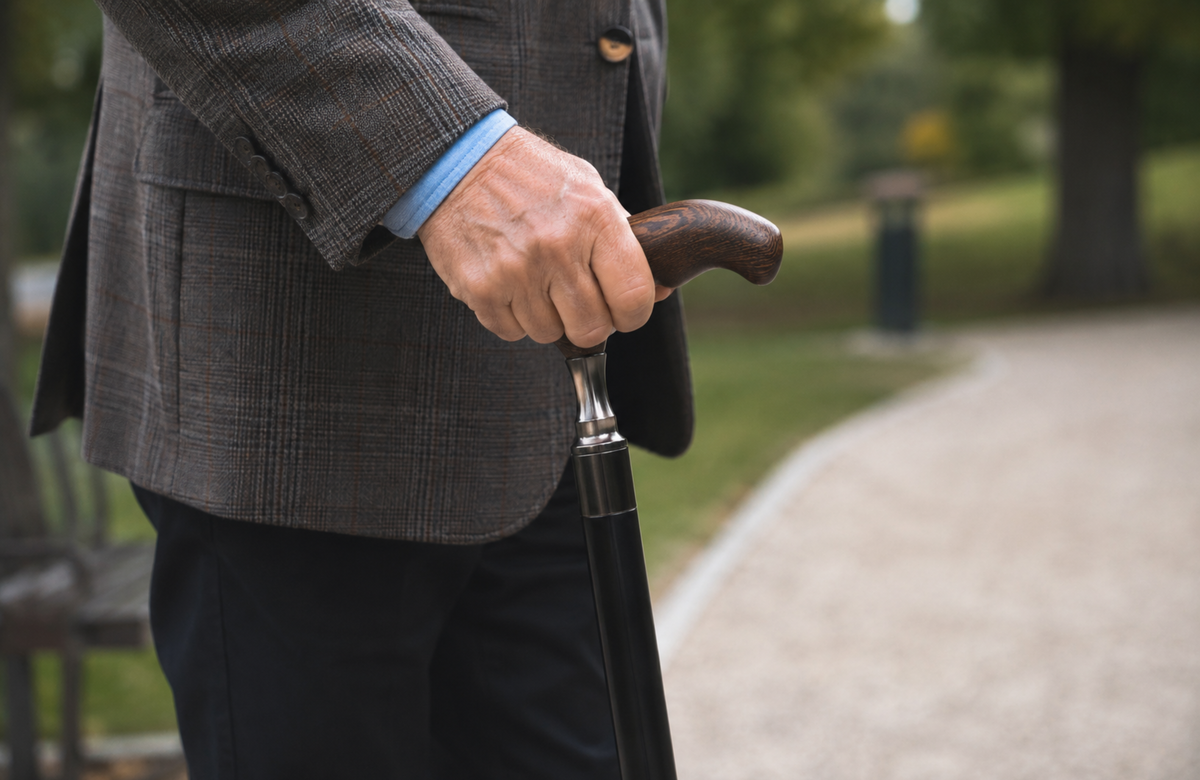
A walking cane is something you may carry for minutes, hours, or even an entire day. That means its weight is not just a number on a product specification sheet. For many older adults, how much a cane weighs can become an important part of how comfortable and convenient it is to use.
We were reminded of this by a customer in his 80s who shared a very straightforward observation with us: the weight of a cane really matters.
He told us that he had previously used a heavier walking cane, but eventually switched to carbon fiber canes because he wanted something more elegant and lightweight. His experience made us look at walking canes from a different perspective.
A cane does more than provide support. You also have to carry it, lift it, move it forward with every step, take it with you when you travel, and sometimes hold it for long periods.
That is why we believe cane weight deserves more attention.
Why Does Cane Weight Matter?
A walking cane may seem simple, but it is a tool that you repeatedly lift and reposition as you walk.
If a cane is heavier, you may notice that weight every time you pick it up, move it forward, place it beside you, or carry it when you are not actively using it.
For a younger, stronger person, a small difference in cane weight may not feel particularly important.
For an older adult who uses a cane throughout the day, however, convenience can become much more noticeable.
This is especially relevant when a cane is used for:
- Longer walks
- Shopping trips
- Travel and vacations
- Outdoor activities
- Walking around the neighborhood
- Moving between different surfaces
- Carrying the cane when sitting or standing
- Using the cane for extended periods
The goal is not simply to find the lightest cane possible.
The goal is to find a cane that provides the right combination of weight, strength, stability, fit, comfort, and portability.

Lightweight Does Not Have to Mean Fragile
One common assumption is that a lightweight cane must sacrifice strength.
Material choice makes a significant difference.
Traditional walking canes are commonly made from materials such as aluminum or steel. Carbon fiber offers another approach: a material known for combining low weight with high stiffness.
That is one reason carbon fiber has become popular in products where weight matters without wanting to give up a strong, rigid structure.
Our Carbon Cane uses premium 3K carbon fiber and weighs just 219 grams (7.7 oz).
That is the entire cane weight — not just the shaft.
The idea is simple:
Less unnecessary weight. More convenient everyday carrying.
How Heavy Should a Walking Cane Be?
There is no single cane weight that is right for every person.
A person's height, strength, balance, mobility needs, hand comfort, intended use, and the type of support required all matter when choosing a walking aid.
Instead of asking only:
“What is the lightest walking cane?”
it can be more useful to ask:
“What is the lightest cane that provides the features and stability I actually need?”
A cane should be comfortable to hold, correctly fitted to your height, and appropriate for the way you intend to use it.
If you use a cane for balance or mobility because of a medical condition or injury, a healthcare professional can also help determine which type of walking aid is appropriate for you.

Why Carbon Fiber Is Interesting for Walking Canes
Carbon fiber is particularly interesting for walking canes because it allows manufacturers to create a rigid structure without relying on a heavier material.
A carbon fiber cane can therefore be:
- Lightweight
- Rigid
- Easy to carry
- Compact for travel
- Adjustable
- Suitable for everyday walking
- Visually more refined than many traditional mobility products
For someone who wants a walking cane that feels more like a well-designed everyday product than bulky equipment, this can make a meaningful difference.
The Difference You Notice Every Day
Cane weight is not something you experience once.
You experience it repeatedly.
You pick up the cane.
You move it forward.
You place it down.
You lift it again.
You carry it into a restaurant.
You take it through an airport.
You put it in the car.
You walk through a park.
You carry it when you are not using it.
That repetition is why a difference that looks small on a specification sheet can feel much more significant in everyday life.
A lightweight cane can be particularly convenient for people who spend a lot of time walking or who frequently travel with their cane.
The Right Cane Height Matters Too
Weight is only one part of choosing a walking cane.
Fit matters.
A cane that is too long or too short can make walking less comfortable and may affect how you position your body while using it.
For a typical single-tip cane, Mayo Clinic recommends checking that the top of the cane aligns approximately with the crease of your wrist when your arm hangs naturally at your side. With the cane in use, the elbow should generally have a comfortable bend of about 15 to 30 degrees.
The important point is simple:
A lightweight cane still needs to be the right size.
Our Carbon Cane adjusts from 24.6 to 41.3 inches (62.5–105 cm), allowing users to adjust the height to their needs.
A Comfortable Handle Matters
Weight is felt through the hand.
That makes the handle an important part of the overall experience.
A well-designed handle should feel natural to hold and provide a secure grip without requiring unnecessary tension.
The GrabberTool Carbon Cane features an ergonomic cork T-handle designed to provide a comfortable hand fit while maintaining a clean, understated appearance.
For someone who spends a lot of time outdoors, the handle is just as much a part of the experience as the carbon fiber shaft.
Lightweight Canes for Travel
Travel is another situation where cane weight becomes particularly noticeable.
A cane may be easy to use while walking but inconvenient when you have to carry it through an airport, place it in a vehicle, store it in luggage, or take it with you throughout a trip.
A lighter, compact cane can make these situations easier to manage.
The GrabberTool Carbon Cane has a folded length of 24.6 inches (62.5 cm) and weighs 219 grams (7.7 oz).
That combination makes portability one of its intended advantages.
It is designed for everyday walking, travel, hiking, and outdoor activities.

What Our Customer Taught Us
The most interesting part of our customer's feedback was not simply that he preferred a lighter cane.
It was why.
He had already owned and used other walking canes. He had learned from experience that keeping track of a cane is part of everyday life. He had also discovered that the weight of the cane mattered enough to influence which cane he wanted to use.
His message was simple:
“I’m over 80 and the weight of the cane really matters.”
That sentence stayed with us.
It reminded us that product specifications are not just numbers.
A few ounces can affect what a person carries every day.
A handle can affect how a person grips the cane.
The length can affect how naturally the cane fits the user.
And the overall design can affect whether someone wants to take the cane with them wherever they go.
What to Look for in a Lightweight Walking Cane
If you are shopping for a lightweight walking cane for an older adult, consider more than the number on the scale.
1. Weight
Look for a cane that is light enough to carry comfortably while still offering the construction and stability appropriate for its intended use.
2. Height Adjustment
An adjustable cane can provide a more personalized fit. Make sure the adjustment range is suitable for the user's height.
3. Handle Comfort
The handle should feel comfortable and secure in the user's hand.
4. Construction
Consider the material and how the cane is constructed. Carbon fiber is one option for achieving a lightweight, rigid design.
5. Tip and Traction
The cane tip is the part that contacts the ground. It should be appropriate for the surfaces where the cane will be used and kept in good condition.
6. Portability
If the cane will be used for travel, consider its folded length, total weight, and how easily it can be stored.
7. Intended Use
A cane designed for everyday walking may not be appropriate for every mobility situation. Consider whether you need a cane primarily for balance, outdoor walking, travel, or another purpose.
Lightweight Does Not Mean “Less Cane”
A walking cane does not need to be heavy to feel substantial.
Modern materials allow manufacturers to approach cane design differently.
Instead of adding material simply to make a cane feel substantial, a lightweight design can focus on using the right material and construction where it matters.
For people who value portability, comfort, and a refined appearance, that can be an appealing alternative to traditional heavier walking canes.
Meet the GrabberTool Carbon Cane™
The GrabberTool Carbon Cane™ was designed around a simple idea:
A walking cane should provide support without making you carry unnecessary weight.
At 219 g (7.7 oz), the Carbon Cane combines a premium 3K carbon fiber body with an ergonomic cork T-handle and adjustable height.
Carbon Cane™ Specifications
- Material: Premium 3K Carbon Fiber
- Weight: 7.7 oz (219 g)
- Handle: Ergonomic Cork T-Handle
- Adjustable Height: 24.6–41.3 in (62.5–105 cm)
- Sections: 2
- Locking System: Reinforced External Lock
- Tip: Carbon Tungsten Steel
- Folded Length: 24.6 in (62.5 cm)
- Intended Use: Everyday Walking, Travel, Hiking & Outdoor Activities
It is lightweight enough to travel with, compact enough to store, and designed to look at home both outdoors and in everyday life.
The Takeaway
For an older adult, choosing a walking cane is about more than finding something that helps with walking.
It is something you may carry every day.
That makes weight, comfort, fit, portability, handle design, and construction worth considering together.
A heavier cane may work perfectly well for one person. Another person may strongly prefer a lightweight model.
As our customer in his 80s reminded us, sometimes the smallest detail becomes one of the most important ones.
When you use a cane every day, every gram comes with you.
That is why we made the GrabberTool Carbon Cane™ just 219 grams — to give everyday walking, travel, and outdoor adventures a lighter feel.


