

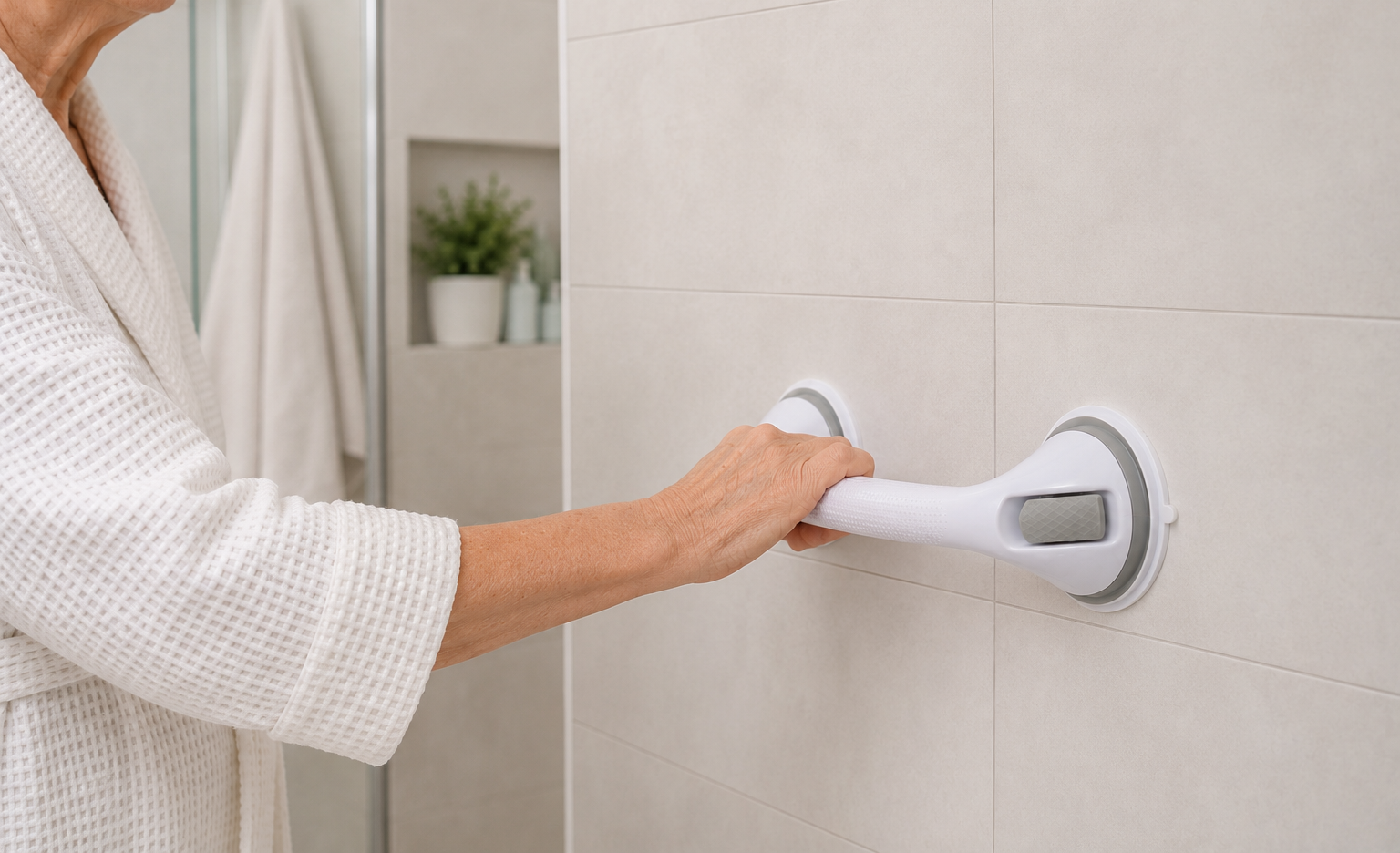
The most dangerous thing about a suction grab bar is that it looks exactly like a real one.
Direct answer: Suction grab bars are safe when used as balance aids, meaning something to steady yourself with as you change position. They are not safe as weight-bearing supports, meaning something that takes your body weight if you slip or that you pull yourself up on. A permanently mounted grab bar bolted into wall studs is a structural support. A suction bar is a temporary handhold. They serve different purposes, and no suction cup changes that.
Quick Answer
Use a suction grab bar for light steadying only, on clean, dry, smooth, non-porous surfaces such as ceramic tile or glass, never across a grout line, and check the suction before every single use. Use a permanently fixed grab bar anchored into studs or with an engineered wall anchor whenever you need support that will hold your weight. If you rent, travel, or cannot drill, a suction bar is a reasonable compromise, provided you treat it as what it is.
Key Takeaways
- Balance aid and weight-bearing support are two different products, and only one of them can stop a fall.
- Suction fails gradually and silently. It rarely announces itself before it lets go.
- Grout lines are the most common installation error, and they break the seal completely.
- Textured tub floors and walls cannot hold suction at all, no matter how strong the cup.
- Checking the bar before every use is not optional advice. It is the condition under which it is safe.
How suction actually works, and why it fails
A suction cup does not grip. It holds because air has been pushed out from underneath it, and the surrounding air pressure presses it against the surface. Anything that lets air creep back under the cup reduces that hold.
In a bathroom, four things do exactly that. Temperature changes make the trapped air expand and contract. Soap and shampoo residue creates a film that air travels along. Surface texture provides microscopic channels for air to enter. And time simply allows slow leakage.
The consequence is the important part: suction degrades gradually and gives almost no warning. A bar that held firmly yesterday may hold at half strength today and look identical. This is why every legitimate manufacturer instructs you to test the bar before each use, and why that instruction is not a formality.
Where a suction bar will and will not hold
| Surface | Holds? | Why |
|---|---|---|
| Smooth ceramic or porcelain tile, 5 x 5 in or larger | Yes | Flat and non-porous, cup seals fully within one tile |
| Glass shower panel | Yes | Perfectly smooth and non-porous |
| Smooth acrylic or fiberglass surround | Yes | Non-porous, though check for slight curvature |
| Across a grout line | No | The recess breaks the seal, air enters continuously |
| Textured or mosaic tile | No | Texture provides constant air paths under the cup |
| Painted or papered wall | No | Porous, and the cup can pull the finish off |
| Natural stone, concrete, brick | No | Porous and irregular |
Test any surface in ten seconds: wet a fingertip and drag it. If it squeaks and sticks, the surface is smooth enough. If it slides with a gritty feel, no suction product will hold there. The same test decides whether a suction bath mat will hold in your tub, for the same physical reason.
Installing one correctly
- Clean and dry both surfaces. The wall and the cup. Soap film on either one is the most common cause of failure.
- Position within a single tile. Both cups must sit entirely inside flat tile faces, clear of every grout line.
- Press and hold. Release the latches, press each cup flat, hold a few seconds to expel the air, then close both latches firmly.
- Test before trusting. Pull outward and push down. Shake it. If there is any movement at all, take it off, clean everything, and reinstall.
- Reposition periodically. Leaving a cup in one spot for months lets residue build under it.
The GrabbersTool Quick Grab Bar uses twin locking levers whose position shows at a glance whether the bar is engaged, which makes the before-use check a look rather than a guess. The full surface compatibility list and installation steps are on the product page.
When you need a permanent bar instead
Be honest about which situation you are in. Choose a fixed, professionally installed grab bar if any of these apply:
- You have fallen in the bathroom before, or you have come close.
- You need to pull yourself up rather than simply steady yourself.
- You have episodes of dizziness, sudden weakness, or unpredictable balance.
- The person using it might forget to check the suction, including anyone with memory impairment.
That last point is the one families miss. A suction bar is only as safe as the check performed before each use. If that check will not reliably happen, the product is not appropriate, regardless of how well it holds today.
Where suction bars genuinely make sense
They are not a bad product. They are a specific one.
- Travel. Hotel bathrooms have smooth tile and no grab bars, and you cannot drill into someone else's wall.
- Rentals. A landlord who will not permit drilling still leaves you needing something to hold.
- Visiting family. A bar that installs in a minute and leaves no trace makes a relative's bathroom usable for a weekend.
- Temporary recovery. After surgery, when the need may last six weeks rather than forever. Our recovery checklist maps which aids matter in which week.
- As a secondary handhold alongside a permanent bar, giving a second point of contact rather than replacing the first.
What else reduces bathroom falls
A bar addresses one risk factor. The bathroom presents several at once: a wet surface, a raised tub wall to step over, a body rotation mid-step, and often poor lighting.
- A non-slip bath mat addresses the surface underfoot, with the same smooth-surface requirement.
- A shower bench removes the standing requirement entirely, which no handhold can do.
- A standing assist tool helps with rising from a seated position outside the tub.
- A reacher grabber removes the bend when something is dropped, covered in our guide to retrieval in the bathroom.
- Better lighting costs almost nothing and is the most overlooked intervention of all.
For changes that need no construction, see how to adapt a bathroom without major renovation.
Frequently asked questions
Can a suction grab bar hold my body weight?
Treat the answer as no. It is designed to steady you, not to catch you. Do not use one to pull yourself up from a fall or as your only support when standing.
How often should I check it?
Before every use. Suction weakens invisibly, so a check yesterday tells you nothing about today.
Can I install one on the tub itself rather than the wall?
Only if that surface is smooth, flat, and large enough for the cup to seal entirely within it. Many tub rims are curved, and a curved surface will not hold.
Why did my grab bar fall off overnight?
Almost always one of three things: it was placed across a grout line, the surface or cup had soap film on it, or the room cooled and the trapped air contracted. Clean both surfaces thoroughly and reinstall within a single flat tile.
Are they suitable for someone who has already fallen?
No. A previous fall indicates the need for support that will hold weight, which means a permanently mounted bar and a conversation with a doctor or occupational therapist about what else the bathroom needs.
The short version
A suction grab bar is a handhold, not a lifeline. Used for steadying, on smooth tile, checked before every use, it is a sensible tool for rentals, hotels, and temporary needs. Asked to do the job of a bolted bar, it will eventually fail, quietly, at the worst possible moment.
Written by GrabbersTool Editorial. GrabbersTool designs practical independence tools for everyday tasks. This article is general educational information, not medical advice or a substitute for a professional home safety assessment.
Sources
- Centers for Disease Control and Prevention: Older Adult Falls, prevention guidance and home safety.
- Centers for Disease Control and Prevention, MMWR: Nonfatal Bathroom Injuries Among Persons Aged 15 Years and Older.
- National Institute on Aging: Fall-proofing your home.


