

Hypermobile Ehlers-Danlos syndrome and hypermobility spectrum disorders create an adaptive tool challenge that is the inverse of most mobility conditions: the joints move too much, not too little. Standard adaptive tool advice -- grip harder, push further -- is contraindicated for EDS. The goal is joint protection throughout every task: eliminating positions that load unstable joints, distributing force across larger surfaces, and completing tasks without subluxations or dislocations. GrabbersTool hears this distinction consistently from customers managing EDS, and it fundamentally changes which tools are appropriate and how they should be used.
Direct answer: for hypermobile EDS and hypermobility spectrum disorders, adaptive tools serve joint protection rather than just physical assistance. The highest-priority tools are those that eliminate pinch grip (which loads small unstable finger joints), provide whole-hand operation, and reduce the number of repetitive motions that accumulate microtrauma across a day. The GrabbersTool Electric Jar Opener, Electric Can Opener, and 5-in-1 Multi-Opener eliminate the high-torque pinch grip that is one of the most joint-stressing kitchen tasks for EDS.
Why EDS Requires a Different Adaptive Tool Framework
Most adaptive tool recommendations assume the limiting factor is strength or range of motion. In EDS, the limiting factor is joint stability. A hypermobile joint can move into positions that look like normal range of motion but are actually loading the joint in destabilizing ways. Gripping a jar lid with five fingertips applies concentrated force to metacarpophalangeal and interphalangeal joints that may sublux under that load. The task completes -- but with a joint cost.
EDS joint protection principles relevant to adaptive tool selection:
- Avoid end-range positions: tools that require fingers fully extended or flexed to end range increase instability risk
- Distribute force to larger joints: use palm, forearm, or shoulder where possible instead of fingers
- Reduce repetition: each repetition accumulates microtrauma -- electric tools that complete a task in one operation are preferable to manual tools requiring multiple rotations
- Avoid sustained grip: holding a grip position for extended time is more destabilizing than a brief grip; tools that do not require sustained holding are preferable
- Avoid high-torque tasks: jar and can opening require torque that directly loads wrist and finger joints
Kitchen: The Highest Joint-Risk Environment for EDS
Jar opening is one of the most commonly reported joint-injury tasks for EDS customers who contact GrabbersTool. The combination of grip force, torque, and sustained hold creates significant subluxation risk for metacarpophalangeal joints and wrists.
| Kitchen Task | Joint Risk for EDS | Adaptive Solution |
|---|---|---|
| Jar opening | High -- finger and wrist torque loading | Electric Jar Opener -- whole-jar clamping, one-button operation |
| Can opening | High -- sustained pinch grip rotation | Electric Can Opener -- hands-free operation after placement |
| Bottle and cap opening | Moderate -- pinch grip rotation | 5-in-1 Multi-Opener -- lever mechanism reduces finger loading |
| Retrieving dropped items | Moderate -- floor-level bending with instability | 32 inch Reacher Grabber -- eliminates floor bending |
| High-shelf reaching | Moderate -- shoulder overhead with instability | 43 inch Reacher Grabber -- reduces overhead reaching |
Electric opener models and full specifications -- including grip mechanism type and operation force required -- are on the product pages. View Electric Jar Opener specifications
Reacher Grabbers and EDS: Technique Considerations
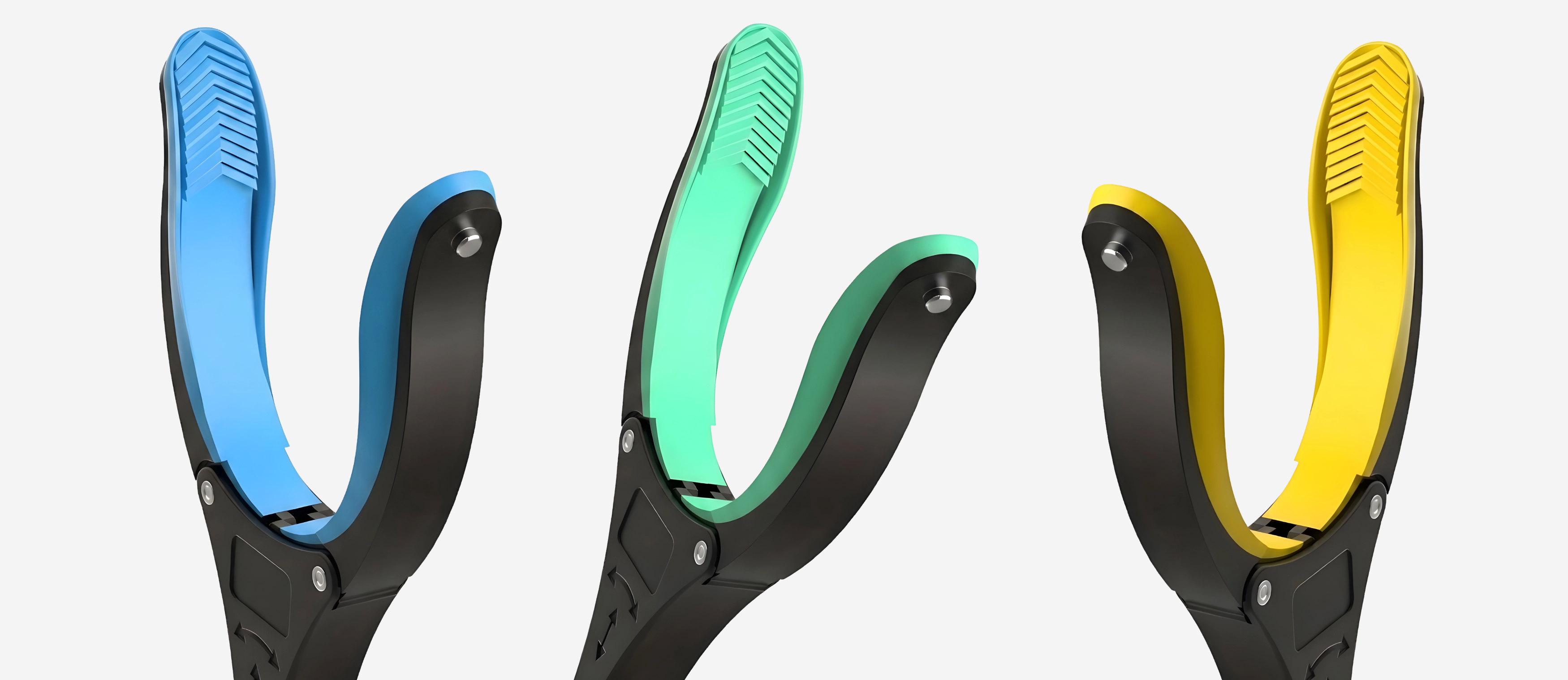
Reacher grabbers for EDS use are appropriate but require technique adjustments. The standard pinch-trigger mechanism on most reachers uses index finger and thumb pressure -- moderate for most users, but potentially loading for EDS finger joints if used repeatedly throughout a day. GrabbersTool customers with EDS report that whole-hand trigger grip (using multiple fingers on the trigger) distributes load more effectively than single-finger operation. The 43 inch length is preferred by many EDS customers because fewer bending and reaching episodes are needed -- each reach covers more range. Lightweight reacher models reduce the force needed to hold and operate the tool, which matters for shoulder and elbow joint loading.
See GrabbersTool 43 inch Reacher Grabber specifications for weight and trigger mechanism details.
Energy Conservation and EDS
Many EDS presentations include post-exertional symptom flares. Joint protection and energy conservation overlap: a task that subluxes a joint requires recovery time beyond the task itself. Electric tools that complete kitchen tasks in one operation rather than multiple manual rotations reduce both joint load and energy expenditure simultaneously. This dual benefit makes electric kitchen openers particularly high-return adaptive tools for EDS.
See also: Lupus and Joint Protection: Adaptive Tools for Low-Energy Days and Fibromyalgia and Kitchen Tools: Managing Fatigue Without Sacrificing Independence.
Browse Easy Grip Kitchen Openers and Reacher Grabber Tools.


