

People searching for a reacher grabber for the first time often arrive because a surgeon, physiotherapist, or occupational therapist has said "you need to get a reacher grabber" and sent them home with a word but no other guidance. The term is used interchangeably with "grabber tool," "reaching aid," and "litter picker" in different contexts — same basic mechanism, different names depending on the setting. Understanding what a reacher grabber is, what it actually does, and why the specifications differ between models answers the question that brings most people to this search.
Direct answer: a reacher grabber is a long-handled tool with a grip trigger at one end and a jaw mechanism at the other end, used to pick up objects from floor level or high shelves without bending or stretching. Squeezing the trigger closes the jaw; releasing the trigger opens it. The tool extends the user functional reach by the length of the shaft — typically 32 to 43 inches. GrabbersTool manufactures three primary reacher models: the 32" Reacher Grabber, the 43" Reacher Grabber, and the Precision Grabber for small objects.
How a Reacher Grabber Works
The mechanism is straightforward:
- Hold the handle in one hand, with fingers positioned to squeeze the trigger
- Extend the tool toward the object — pointing the jaw end at the item to be picked up
- Position the jaw so the object is between the two jaw faces
- Squeeze the trigger — the jaw closes around the object
- Lift the tool while maintaining trigger squeeze — the object rises with the closed jaw
- Transfer the object to the desired location, then release the trigger to drop or set it down
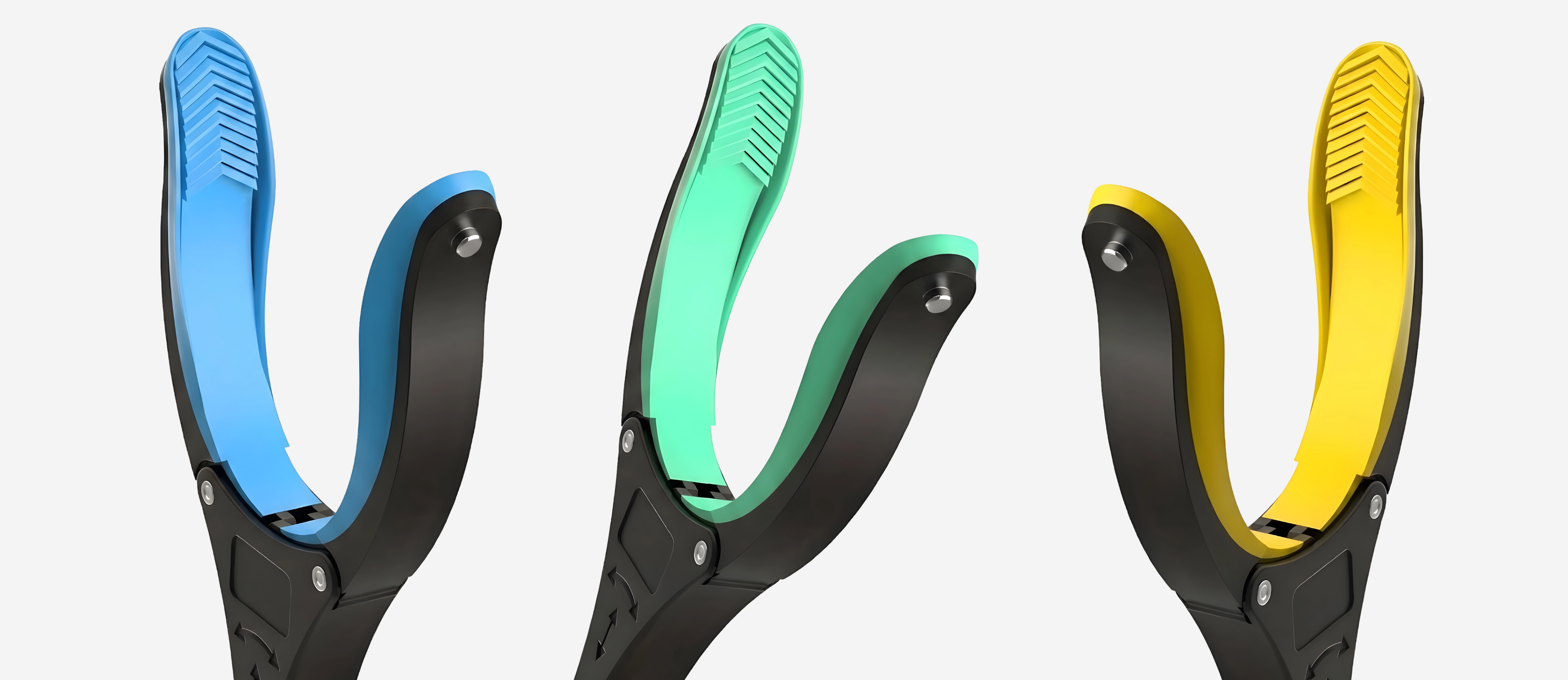
The jaw surface is typically rubber-coated to provide grip on smooth objects. Some models include a magnetic tip on the jaw exterior for retrieving metal objects (keys, coins, pins) that the jaw cannot grip reliably because they are too flat.
Who Uses a Reacher Grabber?
Reacher grabbers are used by anyone who has a functional limitation that makes bending, reaching overhead, or picking up floor-level objects difficult or unsafe. Common user groups:
- Post-surgical patients: hip replacement, knee replacement, spinal surgery — all involve restrictions on bending that make floor retrieval difficult without a tool
- Arthritis and joint pain: bending and rising is painful in hip and spine arthritis; the reacher eliminates the movement
- Back pain and sciatica: forward lumbar flexion aggravates disc conditions; the reacher prevents the flexion
- Wheelchair users: floor-level objects are simply outside reach from a seated wheelchair position without a long tool
- Tall or short individuals: reaching to the back of high shelves or to floor level is more difficult at height extremes — the reacher extends reach in both directions
- Pregnancy: third-trimester abdominal volume limits forward bending; the reacher allows floor retrieval without bending around the abdomen
Reacher Grabber Specifications That Matter
| Specification | What It Means | Why It Matters |
|---|---|---|
| Shaft length | 32" or 43" — total tool length from handle to jaw | Determines how far you can reach without bending or stretching |
| Jaw opening width | Maximum size of object the jaw can grip | Must be wider than the objects you need to pick up |
| Trigger force | Force required to close the jaw | Must be achievable with your available grip strength |
| Jaw surface material | Rubber, foam, or hard plastic | Rubber grips best on smooth objects; foam on very light items |
| Weight | Tool weight in ounces or grams | Heavier tools are more tiring to use at full extension |
| Magnetic tip | Magnet on jaw exterior | Retrieves metal flat objects (coins, keys) that jaw cannot grip |
All specifications for GrabbersTool reacher grabbers — jaw opening width, trigger force, weight, shaft material, and magnetic tip availability — are on the product pages. These are the measurements to compare when choosing between models. View 32" specifications | View 43" specifications | View Precision Grabber specifications
32 Inch vs. 43 Inch: The Most Common Question
The choice between a 32" and 43" reacher is determined by the primary use:
- 32" reacher: appropriate for most indoor home use — floor retrieval from standing, bedside object pickup, standard cabinet reach. Recommended for most post-surgical and arthritis users.
- 43" reacher: appropriate when floor retrieval requires additional reach — particularly for wheelchair users who need to reach down to floor level from a seated position, and for reaching to the back of high shelves without stepping on a stool.
The length guide with specific use-case recommendations is at Reacher Grabber Length Guide: 32 vs 43 Inch Models Explained.
What a Reacher Grabber Cannot Do
Setting expectations correctly prevents frustration: a standard reacher grabber cannot reliably pick up very flat objects (credit cards, single sheets of paper, thin metal objects) without a magnetic tip. It cannot crush or deform objects to fit the jaw — the jaw width must exceed the object diameter. It does not eliminate the need to have sufficient hand strength to squeeze the trigger — users with very severe grip weakness may need a low-resistance trigger model or an alternative retrieval method.
Browse the full reacher grabber range at Reacher Grabber Tools and Long Reach Grabber Tools.


