

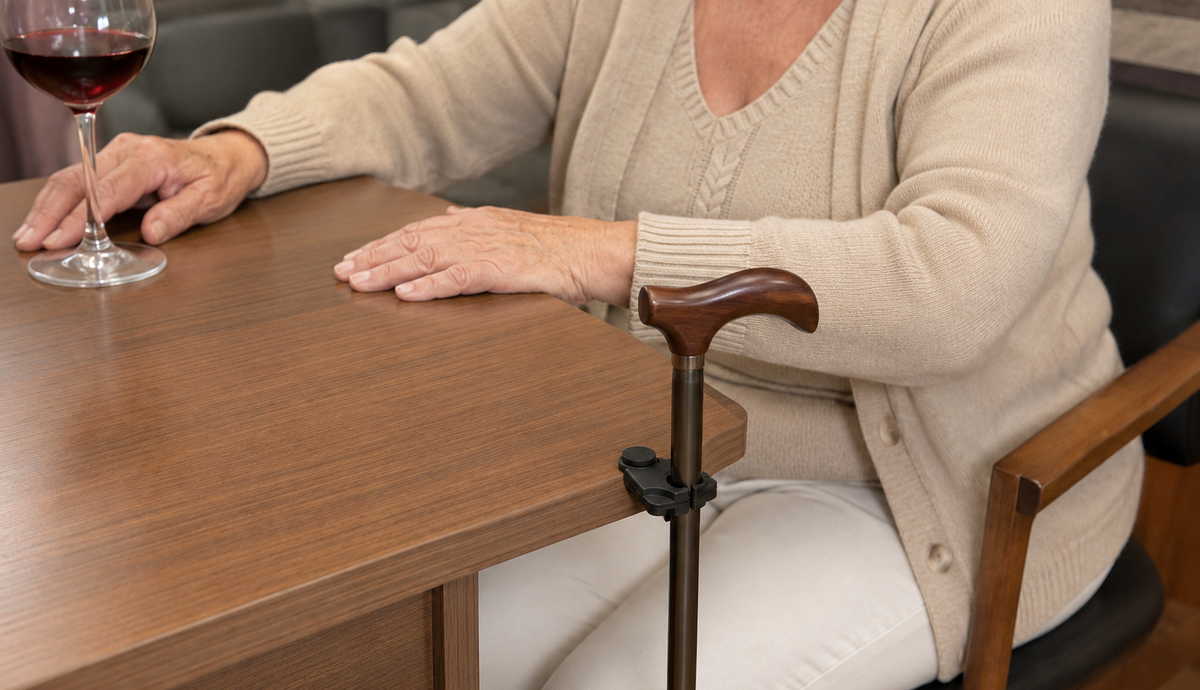
A dropped cane is the most reliably annoying thing about using one, and it is almost never discussed. People assume it is their fault for not leaning it properly. It is not.
Direct answer: A cane falls over because a single-tip cane has no stable resting position. Standing upright it balances on one point, which is inherently unstable. Leaned against a surface it depends on friction between a smooth handle and a smooth edge, and the slightest bump breaks it. The fix is to give the cane something to hold onto: a clip that grips a table edge, a hook that hangs it from a surface, or a wrist strap that stops it reaching the floor at all.
Quick Answer
Canes fall because they have one contact point and no resting position. A table clip holds the cane upright at a table, desk, counter, or chair back. A wrist strap keeps the cane attached to you so it never fully drops. A quad or self-standing base lets the cane stand alone but adds weight and can catch on uneven ground. Choose based on where the cane actually falls: mostly at tables, mostly while walking, or mostly at home.
Key Takeaways
- The falling is a design consequence, not carelessness.
- Retrieving the cane is the actual hazard, because bending and reaching without support is exactly what a cane user should avoid.
- A worn tip makes a cane both more likely to slip and less safe to walk with.
- The social cost is real. Many people report avoiding restaurants partly because of it.
- Different accessories solve different moments, and most people need two.
Why picking it up is the real problem
The fall itself costs nothing. Retrieval is the hazard.
To pick up a cane from the floor you must bend forward, reach sideways, and rotate slightly, all while balancing without the support you were using a moment ago. That combination of movements is precisely what a cane is there to prevent. In a restaurant it is worse, because the cane usually lands under the table, out of reach, in a confined space between chairs.
Which is why the most common solution is asking a stranger. GrabbersTool's support conversations return to this repeatedly: people do not object to needing a cane, they object to the small public moment of asking someone else to bend down for them. The equipment fails, and the person feels it as their own dependence.
The three accessories, and when each is right
| Accessory | Solves | Best when the cane falls | Limitation |
|---|---|---|---|
| Table clip holder | Cane standing while you are seated | At tables, desks, counters | Needs an accessible edge to grip |
| Wrist strap | Cane never reaches the floor | While walking or standing | Does not hold it upright when seated |
| Quad or self-standing base | Cane stands unaided anywhere | All the time, at home | Heavier, and can rock on uneven ground |
Most people are best served by two: a strap for movement and a clip for sitting. They address different moments and do not overlap.
The table clip
A clip grips the edge of a table, desk, kitchen counter, or chair back and cradles the cane shaft so it stands beside you. The GrabbersTool Cane Holder is roughly two inches across and lives in a coat pocket, which matters more than it sounds: an accessory that stays at home helps nobody in an unfamiliar restaurant.
The one thing to check is your tables. A clip needs a firm, accessible edge, so it will not attach to a table with a very deep apron or a rolled rim. The full list of compatible surfaces is on the product page.
The wrist strap
A cane strap solves the other half of the problem. When you let go to open a door, take your wallet out, or reach for a handrail, the cane swings from your wrist instead of clattering to the floor. It cannot hold a cane upright at a table, so it complements a clip rather than replacing it.
The accessory nobody thinks about until it matters
A cane tip is a consumable, and most people treat it as permanent.
The rubber tip is the only thing between an aluminium shaft and a hard floor. As the tread wears smooth, two things happen at once: grip drops on wet pavement and polished indoor floors, and the cane becomes more likely to slide out when you lean it against something.
Check yours now. If the tread pattern is worn flat, if the rubber is cracked or hardened, or if you can see the metal ferrule through the base, replace it. A replacement rubber tip costs a fraction of a cane and restores the traction the cane was designed with. Tips come in different diameters, so measure your shaft before ordering.
If you are choosing or adjusting a cane rather than accessorising one, our cane height calculator works out the correct height, which affects both comfort and stability far more than most people expect.
Small habits that help immediately
- Lean the handle down, not up. Hooking the crook over the table edge is more stable than resting the shaft against it, though it still slides.
- Choose the chair side, not the table side. A cane leaned into the corner between a chair back and its arm has two contact points rather than one.
- Lay it down deliberately when there is genuinely nowhere to stand it. A cane on the floor by choice is easier to retrieve than one that fell somewhere random.
- Keep a reacher grabber where you sit most. It retrieves a dropped cane without bending, which is the whole point.
Frequently asked questions
How do I keep my cane from falling over at a restaurant?
Use a clip-on holder that grips the table edge. It is the only method that reliably keeps a cane upright at a table you do not control, and it is small enough to carry so it is with you when you need it.
Do self-standing canes actually stand up?
On flat, level indoor floors, yes. On uneven pavement or thick carpet the wider base can rock, and the extra weight at the bottom changes how the cane swings. They suit home use better than travel.
How often should I replace a cane tip?
When the tread wears smooth, the rubber hardens or cracks, or the metal shows through. For daily outdoor use that is often every six to twelve months, though it depends entirely on surfaces and mileage.
Will a cane holder work on any table?
It needs a firm, accessible edge. Tables with a very thick apron, a rolled rim, or no overhang will not accept a clip. Most dining tables, desks, and counters are fine.
Is a wrist strap safe if I fall?
A strap keeps the cane within reach, but it should sit loosely enough that your hand can come free. Do not wrap a strap tightly around the wrist, since a cane attached rigidly to your arm can twist it during a fall.
The short version
Your cane is not falling because you are careless. It is a stick with one contact point and nowhere to rest. Give it somewhere to hold, keep the tip fresh, and the most irritating part of using a cane simply stops happening.
Written by GrabbersTool Editorial. GrabbersTool designs practical independence tools for everyday tasks. This article is general educational information and is not medical advice. A physical therapist or occupational therapist can advise on the right mobility aid for your situation.
Sources
- Centers for Disease Control and Prevention: Older Adult Falls, prevention guidance.
- National Institute on Aging: Falls and fractures, and using mobility aids safely.


