

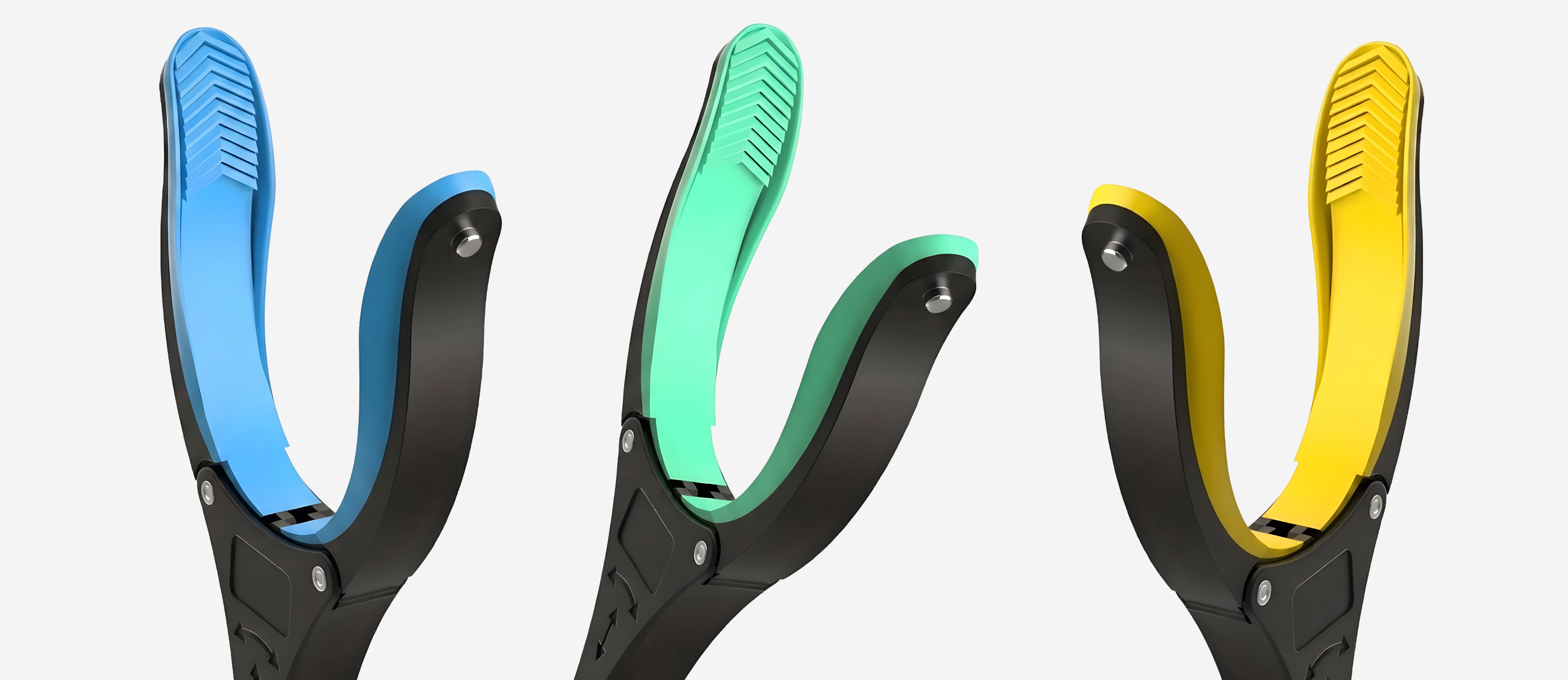
The gap between what a grabber tool can grip in a product photo and what it can grip on your floor is determined by one specification most product listings do not mention: jaw opening width at minimum trigger compression. A jaw that opens to 5cm at full trigger depression can close to 2cm with gentle pressure — and it is that partial-closure grip that determines whether the tool can hold a coin, a pill, a pen, or an earring without crushing or missing it entirely.
Direct answer: for picking up small objects, the relevant specifications are jaw opening width at partial closure, jaw surface texture (fine rubber grip rather than coarse), and jaw tip profile (narrow tip allows approach in confined spaces). The GrabbersTool Precision Grabber Tool 33" is designed specifically for small object retrieval — narrower jaw profile, precision grip surface, and a tip geometry that allows approach to flat small objects that a standard-width jaw cannot contact.
Why Standard Grabber Tools Fail on Small Objects
A standard reacher grabber jaw is designed for objects in the 2–8cm range — cans, bottles, shoes, clothing. The jaw opening, rubber pad surface area, and grip mechanism are optimized for this range. For objects below 2cm, three problems emerge:
- Jaw width: the jaw body is too wide to position precisely around a small object — the jaw contacts surrounding objects or floor surface before centering on the target
- Grip surface: coarse rubber pads designed for large objects slide off smooth, small surfaces rather than gripping
- Approach geometry: the jaw tip is too blunt to get under or beside a flat small object lying flush with the floor
The magnetic tip handles the subset of ferrous small objects (keys, some coins). For non-ferrous small objects — plastic pill capsules, earrings, pens, plastic bottle caps — neither the standard jaw nor the magnetic tip is reliable.
Small Objects That Require Precision Jaw Design
| Object | Challenge | Standard Jaw | Magnetic Tip | Precision Jaw |
|---|---|---|---|---|
| Medication pill (capsule) | Small, smooth, crushable | Often crushes or misses | No — not ferrous | Yes — gentle grip |
| Pen or pencil | Cylindrical, narrow diameter | Unreliable | No | Yes |
| Coin (steel-core) | Flat, no profile above floor | Cannot grip flat surface | Yes — magnetic | Yes — tip slides under edge |
| Coin (copper/nickel, US) | Flat, non-ferrous | Cannot grip | No — not ferrous | Yes — tip approach |
| Earring or jewelry | Very small, delicate | No — too large | Sometimes — if metal | Yes — fine jaw |
| Small screw or nut | Small, metal | Unreliable | Yes — if ferrous | Yes |
| Folded paper or card | Flat, no profile | Cannot grip | No | Yes — tip slides under edge |
The jaw tip width, minimum grip diameter, and rubber surface texture specification for the GrabbersTool Precision Grabber 33" — which determine its small-object retrieval capability — are detailed on the product page. These specifications are the deciding factor for whether this tool handles your specific retrieval scenario. View full specifications →
The Pill-Retrieval Problem
For users who manage daily medications, a dropped pill on the floor represents a specific difficulty. The pill is small, smooth, and often crushable — a standard jaw compresses rather than grips. The magnetic tip does not engage plastic or gel capsule shells. Getting down to floor level to retrieve by hand may not be possible.
GrabbersTool's Precision Grabber is the recommended tool for this scenario. The narrower jaw body with fine-texture rubber pads can close gently around a standard capsule or tablet without crushing, provided the trigger is applied with light pressure. GrabbersTool customers who manage multiple daily medications consistently identify dropped pill retrieval as the use case that motivated the purchase of a precision-jaw tool specifically.
In Confined Spaces: The Approach Problem
Small objects frequently fall into confined spaces — between sofa cushions, under furniture with narrow clearance, into the crack between the counter and the wall. A standard jaw width cannot enter these spaces. A precision jaw with narrow tip profile enters gaps that a standard jaw cannot approach.
The 33" length of the GrabbersTool Precision Grabber reaches under furniture with low clearance from a standing or seated position, making it functional for the gap-retrieval scenarios that a standard grabber tool cannot address.
When to Use Two Tools
GrabbersTool customers who manage daily independence tasks regularly report using both a standard reacher (for general object retrieval, kitchen use, dressing tasks) and a precision grabber (for small objects, confined spaces, delicate items). The two tools address non-overlapping object classes — there is no redundancy in having both.
A standard reacher handles 80% of daily retrieval tasks by frequency. A precision grabber handles the 20% of tasks that the standard jaw cannot manage reliably. Together they provide complete coverage.
See also: Grabber Tool Magnetic Tip: What It Picks Up and When It Matters for the magnetic component of small-object retrieval, and Grabber Tool Length Guide: 32 vs 43 Inch for the length selection decision.
Browse the full Reacher Grabber Tools collection for all jaw configurations and lengths.


