

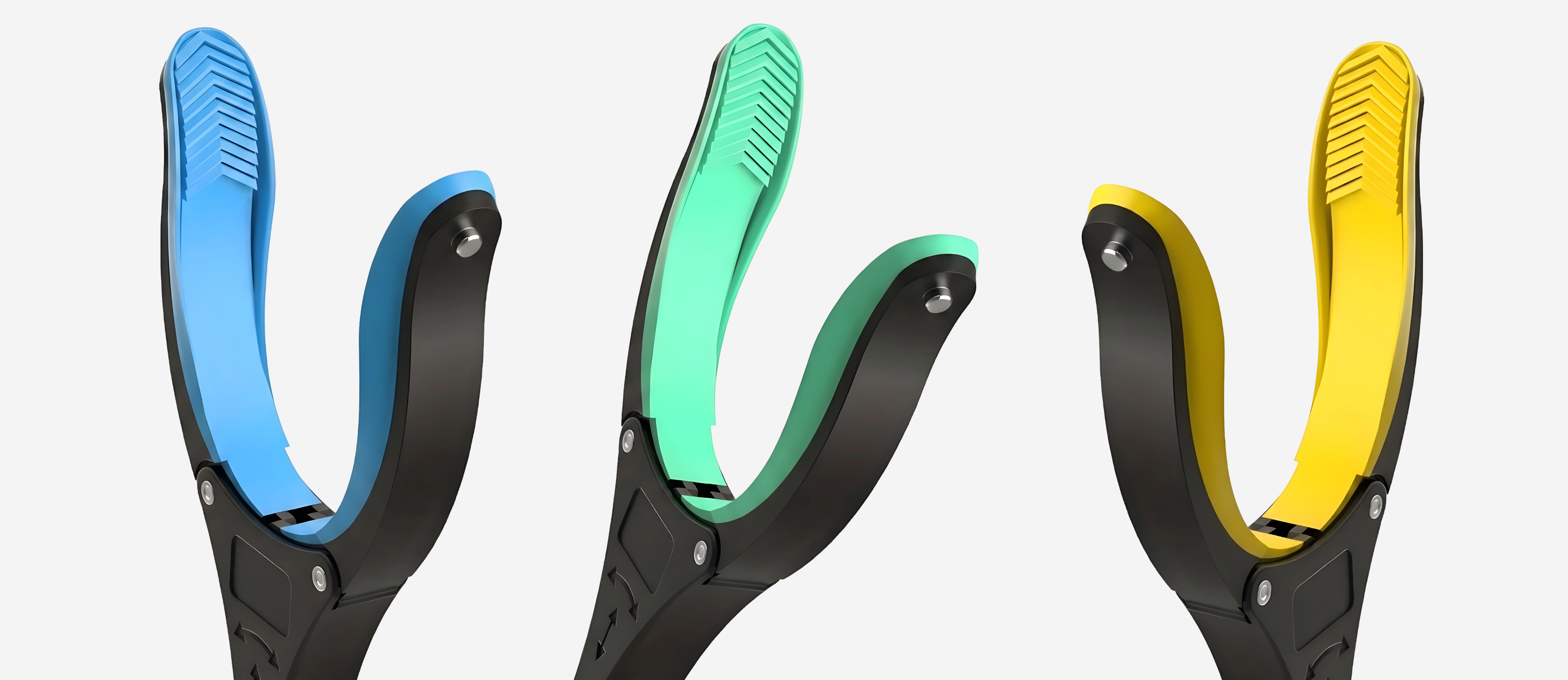
Jar opening is consistently ranked by occupational therapists as one of the most difficult and commonly abandoned kitchen tasks for patients with reduced grip strength, hand arthritis, joint precautions, and neurological conditions. The difficulty is biomechanical: standard jar opening requires sustained isometric grip force on the lid (generating friction torque), combined with forearm supination (twisting motion), applied simultaneously. This two-component demand -- strong grip PLUS rotation torque -- is the reason jar opening fails first when grip or wrist function is impaired. Manual jar-opening assistive devices (rubber grip pads, under-cabinet mounted openers, lever-style openers) reduce the rotation requirement but still require significant grip force. Electric jar openers eliminate both components: a motor applies both the grip clamping force and the rotation torque; the user simply holds the device in position.
Direct answer: For arthritis, stroke recovery, MS, Parkinson disease, one-handed use (mastectomy sling, TIA, hemiplegia), and lymphedema arm precautions, electric jar openers are clinically superior to manual alternatives. The GrabbersTool Electric Jar Opener eliminates both grip force and rotation torque demands -- the two components that all manual methods still require to varying degrees.
Electric vs Manual Jar Opener Comparison for Medical Use
| Feature | Electric Jar Opener (GrabbersTool) | Manual Rubber Grip Pad | Under-Cabinet Manual Opener |
|---|---|---|---|
| Grip force required | None -- the motor clamps the jaw onto the lid automatically; user holds the device, not the lid | High -- the rubber pad increases friction but the user must still generate all the rotation torque with hand and wrist; no reduction in grip force required | Moderate -- the fixed jaw holds the lid; user must still push the bottle/jar to rotate it; less than standard opening but still requires significant force |
| Forearm rotation (supination) required | None -- the motor applies the rotation; user holds steady | Full supination required -- this is the primary wrist motion impaired in RA, wrist fracture recovery, and wrist fusion; rubber pad provides no benefit for the supination component | Partial -- lid is held by the mounted device; body rotation substitutes for forearm rotation; reduces but does not eliminate the rotation demand |
| One-handed use | Yes -- designed for single-handed operation; the device can be operated with the non-dominant hand; critical for mastectomy sling, stroke hemiplegia, rotator cuff repair sling, BPI | No -- requires one hand to hold the rubber pad over the lid and the other hand to rotate; inherently bilateral | Partially -- requires positioning the jar under the fixed jaw (two hands helpful for stability); may be managed one-handed by some users but not designed for it |
| Best for these medical conditions | RA, OA (CMC/wrist), stroke hemiplegia, MS, Parkinson disease, one-arm sling (rotator cuff, mastectomy), lymphedema arm precautions, post-wrist surgery, CRPS, neuropathy, post-mastectomy lifetime precautions | Mild grip weakness without rotation impairment; most users with significant medical grip limitation find rubber pads insufficient | Bilateral users without grip limitation but with rotation/supination impairment (less common clinical scenario); requires wall or cabinet installation |
Clinical Recommendation
Occupational therapists consistently recommend electric jar openers over manual alternatives for patients with grip strength below 20 kg on dynamometry, wrist arthritis, post-mastectomy lymphedema precautions, or any one-handed limitation. The GrabbersTool Electric Jar Opener and adaptive kitchen collection are designed for clinical-grade daily use.


