

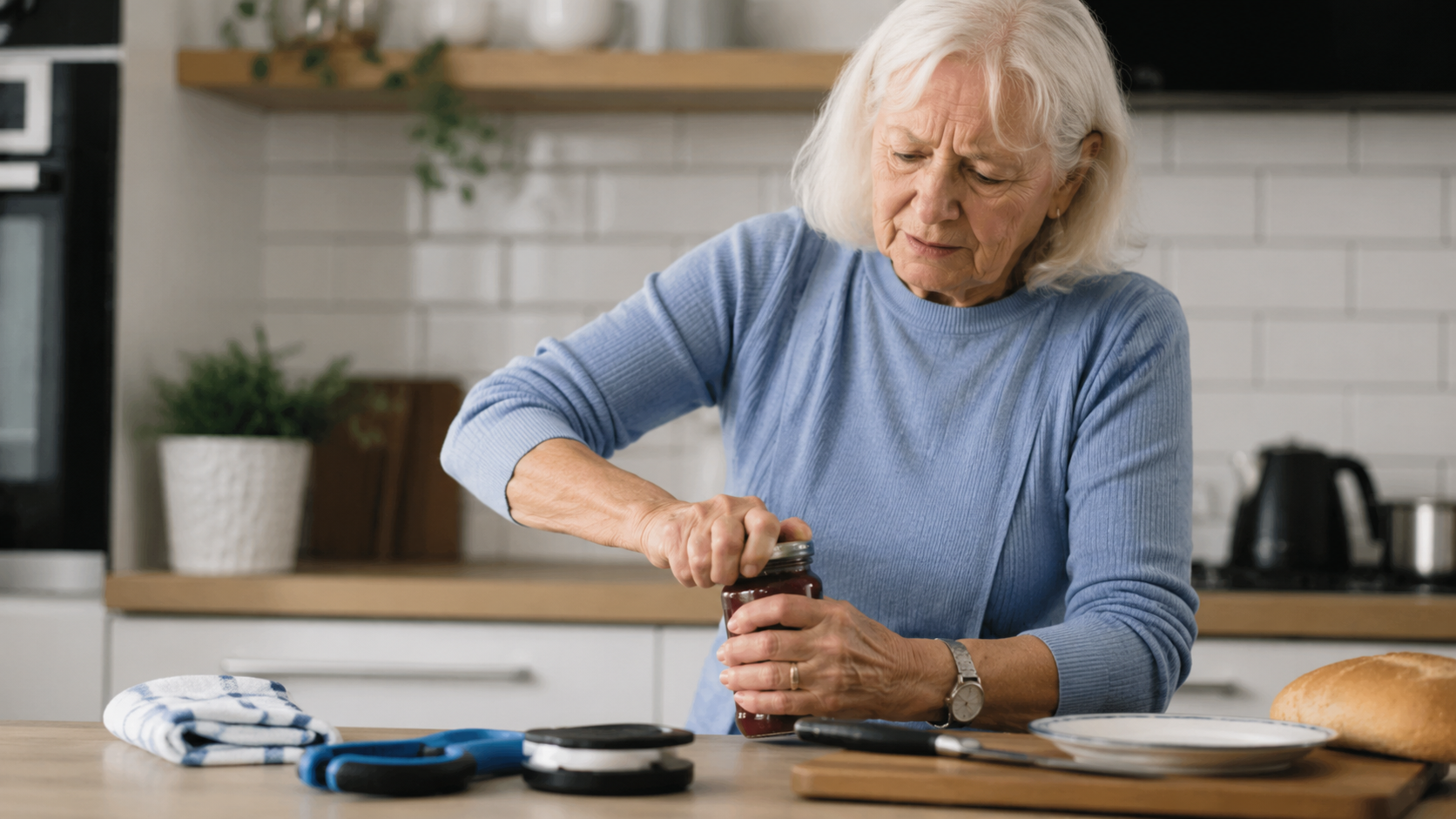
If you have arthritis in your hands, opening a jar can feel impossible. The combination of a tight seal, wet surface, and the twisting motion required puts maximum stress on the joints that arthritis has weakened. Here are five methods — ranked from no tools to purpose-built solutions — that genuinely work.
Why Arthritis Makes Jars So Difficult
Rheumatoid arthritis (RA) and osteoarthritis both affect the small joints in the hands and wrists. Opening a jar requires:
- Pinch grip strength (holding the lid)
- Rotational force (twisting the wrist)
- Stabilizing the jar with the other hand
For people with arthritis, each of these motions can cause pain, and the combination often makes the task completely unmanageable. The good news: the right tool can make any jar openable with minimal effort.

Method 1: Rubber Grip Pad (Best for Mild Arthritis)
A non-slip rubber grip pad dramatically increases friction between your palm and the lid, so you need less force. You place the pad over the lid and twist normally — but with significantly less effort because you're not fighting slippage.
Best for: Lightly sealed jars, people with mild grip weakness
Not ideal for: Vacuum-sealed jars, severe arthritis
Method 2: Break the Vacuum Seal First
Most jar lids are held by a vacuum seal, not just friction. Breaking that seal is the key step. Effective methods:
- Slide a butter knife or spoon handle under the lid edge and pry slightly until you hear a pop
- Use the tip of a can opener to pierce the seal
- Run warm water over the lid for 30 seconds (the metal expands slightly, breaking the seal)
Once the vacuum is broken, almost any jar opens with minimal force — even without grip strength.

Method 3: Jar Opener Grip Pad (Better Leverage)
An ergonomic jar opener grip pad uses a wider, thicker surface and often includes multiple sizes in one flexible piece, adapting to different lid diameters. Unlike a flat rubber pad, a contoured grip pad wraps around the lid and multiplies the force you can apply.
Our Jar Opener Grip Pad works on lids from small jam jars to large pasta sauce containers.

Method 4: Under-Cabinet Jar Opener
Mounted under a cabinet, this type of opener holds the lid while you turn the jar body — which is much easier for people with arthritis because the jar is heavier and easier to grip. You don't need finger strength; you use your whole hand and arm.

Method 5: Electric Jar Opener (Best for Severe Arthritis)
An electric jar opener requires almost no grip strength. You place it on top of the jar, press a button, and the motor does the work. It handles virtually any lid size automatically.
| Method | Effort Required | Best For | Price |
|---|---|---|---|
| Rubber grip pad | Low | Mild arthritis, slightly stuck lids | $10–15 |
| Break the seal | Very low | Vacuum-sealed jars | Free |
| Grip pad opener | Low | Moderate arthritis, all jar sizes | $12–18 |
| Under-cabinet mount | Very low | Daily use, people who cook frequently | $15–25 |
| Electric jar opener | Minimal | Severe arthritis, one-handed use | $25–40 |
Tips to Prevent Jar-Opening Pain
- Never use your fingertips — use your whole palm
- Warm your hands before attempting (warm muscles and joints are more flexible)
- Break the seal first, always — this reduces required force by 70%+
- Use two hands when possible (one to stabilize, one to turn)
- Keep jar surfaces dry — use a towel on both the jar and lid
Over 27,000 customers have used our Kitchen Adaptive Tools to take back independence in the kitchen. If arthritis is making daily cooking tasks difficult, our electric jar opener and grip pad openers are specifically designed to minimize hand strain.


