

Macular degeneration does not cause complete blindness in most cases -- it causes the loss of central vision while peripheral vision is preserved. This specific pattern creates a counterintuitive kitchen safety profile: a person with advanced AMD may be able to navigate a room (peripheral vision intact) but cannot clearly see the jar in their hand or the knife on the cutting board (central vision lost). The hazards are not from general spatial disorientation but from the inability to precisely see what is directly in front of them -- the pot handle, the can opener blade, the expiration date on the container. Adaptive kitchen tools for AMD must account for this specific vision loss pattern.
Direct answer: for macular degeneration, the highest-value adaptive kitchen tools are those that reduce the need for precise visual targeting during operation. The GrabbersTool Electric Jar Opener places over the jar lid and operates by button press -- no precise alignment required. The Electric Can Opener uses edge-placement mechanics rather than requiring visual alignment of a manual cutting wheel. The 5-in-1 Multi-Opener uses tactile placement rather than visual positioning. These tools reduce the precision demand that central vision loss creates.
AMD Vision Profile and Kitchen Hazard Map
Understanding what AMD specifically impairs helps identify which kitchen tasks are highest risk:
- Reading labels and expiration dates: central vision required -- use magnification aids or label organization systems
- Precise knife work: cutting requires central vision for blade placement -- use pre-cut vegetables, food processors, or caregiver assistance for cutting tasks
- Stove burner alignment: placing pots on burners requires central vision -- induction cooktops with pan detection eliminate this visual demand
- Can opener blade placement: aligning a manual can opener requires central vision -- electric can openers with edge-grip mechanics reduce this requirement
- Jar opening: less visual demand than cutting, but liquid spill if jar slips -- electric jar opener with secure clamping eliminates this risk
- Retrieving dropped items: floor-level items in peripheral-only vision -- reacher grabber reduces need to see the item precisely
Electric Opener Advantage for Low Vision
| Opener Type | Visual Demand | AMD Suitability |
|---|---|---|
| Manual jar lid gripper (rubber) | Low placement demand -- wraps around lid | Moderate -- still requires manual rotation |
| Electric Jar Opener | Place over lid, press button -- minimal visual targeting | High -- automated operation, one control |
| Manual can opener (wheel type) | High -- blade must align precisely on can edge | Low -- central vision required for blade placement |
| Electric Can Opener | Place on can edge, press lever -- tactile placement | High -- tactile edge-finding reduces visual demand |
| 5-in-1 Multi-Opener | Tactile placement on cap or lid | Moderate-High -- lever operation by feel |
Electric opener dimensions and operation details -- including button placement and visual indicator design -- are on the product pages. View Electric Can Opener specifications
The Reacher Grabber and Low Vision Floor Retrieval
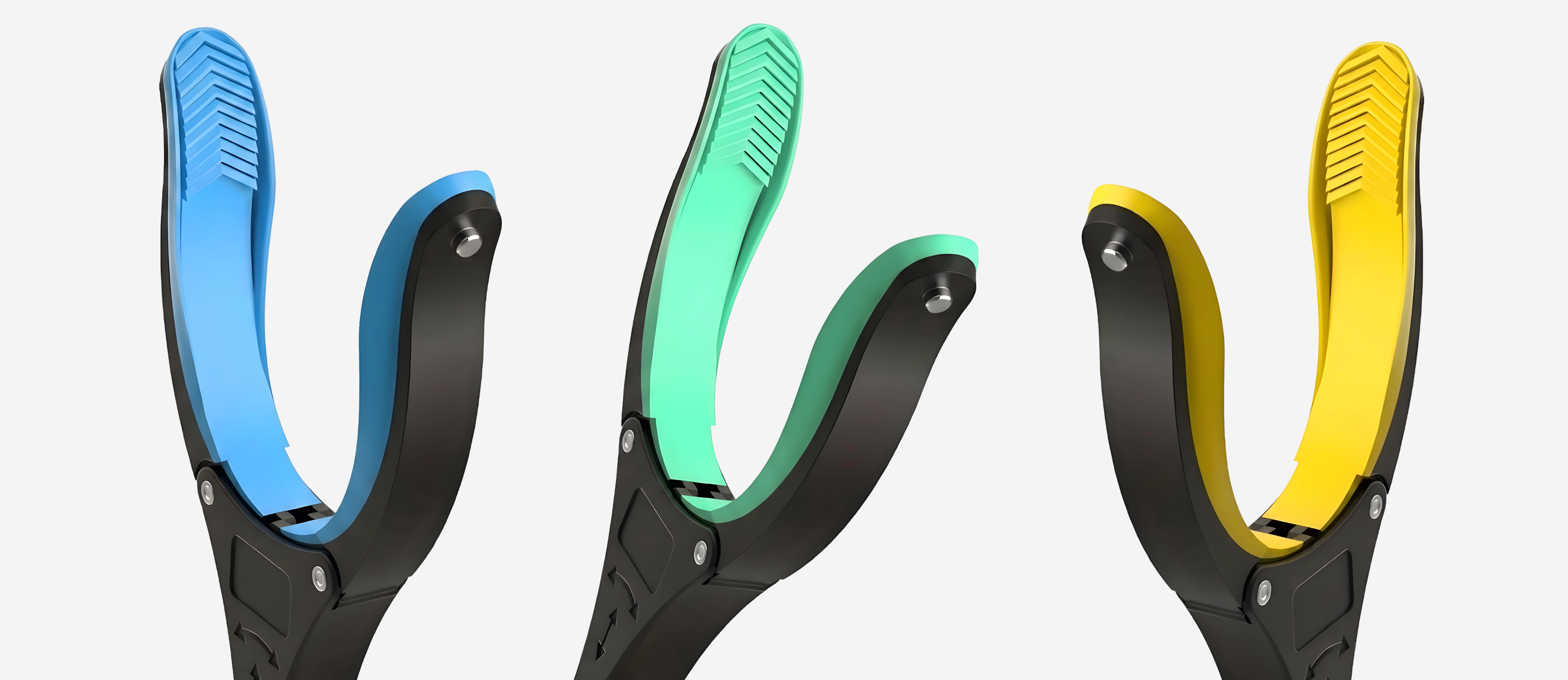
Retrieving dropped items from the kitchen floor is particularly hazardous with AMD because the item may be in the peripheral vision zone but not clearly visible when looked at directly. The GrabbersTool Reacher Grabber allows retrieval by tactile approach -- lowering the grabber to the area where the item was seen peripherally and retrieving without requiring precise central vision targeting. The wide jaw models are more forgiving of visual imprecision in aiming the grabber head.
Kitchen Organization for AMD
Beyond adaptive tools, kitchen organization strategies substantially reduce AMD kitchen hazards:
- Consistent item placement: everything in its designated location, always -- reduces the central vision demand for locating items
- High-contrast surfaces: dark items on light counters (and vice versa) improve peripheral vision detection
- Tactile labeling: rubber bands or bump dots on frequently used items differentiate them by touch
- Task lighting: strong directional lighting on the work surface (not overhead only) enhances remaining vision function
When to Involve a Low Vision Specialist
A certified low vision specialist or occupational therapist with low vision expertise can conduct a kitchen safety assessment specific to the AMD pattern. They evaluate the specific degree of central vision loss, recommend lighting modifications, and can prescribe optical aids that complement the adaptive tool setup described here. GrabbersTool tools address the physical manipulation component; the vision specialist addresses the optical and environmental components. Both are part of a complete low vision kitchen safety approach.
See also: Kitchen Safety for Seniors: Fall and Injury Prevention in the Most Dangerous Home Room and Aging in Place: The Adaptive Tool Strategy That Actually Works.
Browse Easy Grip Kitchen Openers and Reacher Grabber Tools.


