

Almost every guide to reacher grabbers is written for someone standing up. From a wheelchair the geometry changes completely, and so does the risk.
Direct answer: When reaching from a wheelchair, the limiting factor is not how far the tool extends. It is the point at which leaning shifts your centre of gravity outside the chair's wheelbase. The safe technique is to bring the object to you rather than reaching out to it: brake the chair, keep your shoulders inside the frame, extend the tool rather than your body, and drag the object into range before lifting it.
Quick Answer
Lock the brakes before every retrieval. Reach forward between your knees rather than out to the side, because forward reach is more stable than lateral reach. Use a longer tool so your torso does not have to travel: the GrabbersTool 43 inch reacher, which folds into three sections down to 17 inches, exists for exactly this. Drag distant objects into easy range first, then lift them close to the chair.
Key Takeaways
- Tipping, not dropping, is the real risk when reaching from a seated position.
- Forward reach between the knees is more stable than reaching sideways.
- Reaching across your body to the opposite side is the least stable movement of all.
- Extra tool length substitutes directly for torso lean, which is why 43 inches matters here.
- Drag first, lift second. Lifting at full extension is where grip and balance both fail.
Why seated reaching is a different problem
Standing, you can step closer to an object, bend at the hips, and use your legs to counterbalance. Seated, none of that is available. The only way to extend your reach is to lean, and leaning moves your centre of gravity toward the edge of the chair's wheelbase.
A wheelchair is stable while your mass stays inside the footprint of the wheels. Lean far enough forward or sideways and that stops being true. This is why the useful measure is not how far you can reach, but how far you can reach without moving your shoulders outside the frame.
A longer reacher is not a convenience here. Every extra inch of tool is an inch your torso does not have to travel.
The technique, step by step
- Brake first, every time. An unbraked chair rolls backwards as you push forward with the tool, which both moves you away from the object and destabilises you.
- Square up to the object. Turn the chair so the object is in front of you rather than beside you. Repositioning the chair is always safer than extending your reach.
- Reach between your knees, not past your hip. Forward reach keeps your mass between the wheels. Lateral reach moves it toward one wheel.
- Keep your shoulders inside the frame. If your shoulder passes beyond the front or side of the chair, you are past the safe limit. Reposition instead.
- Drag, then lift. Pull the object across the floor toward the chair with the jaw, then lift it when it is close. Lifting at full extension is where both grip and balance are weakest.
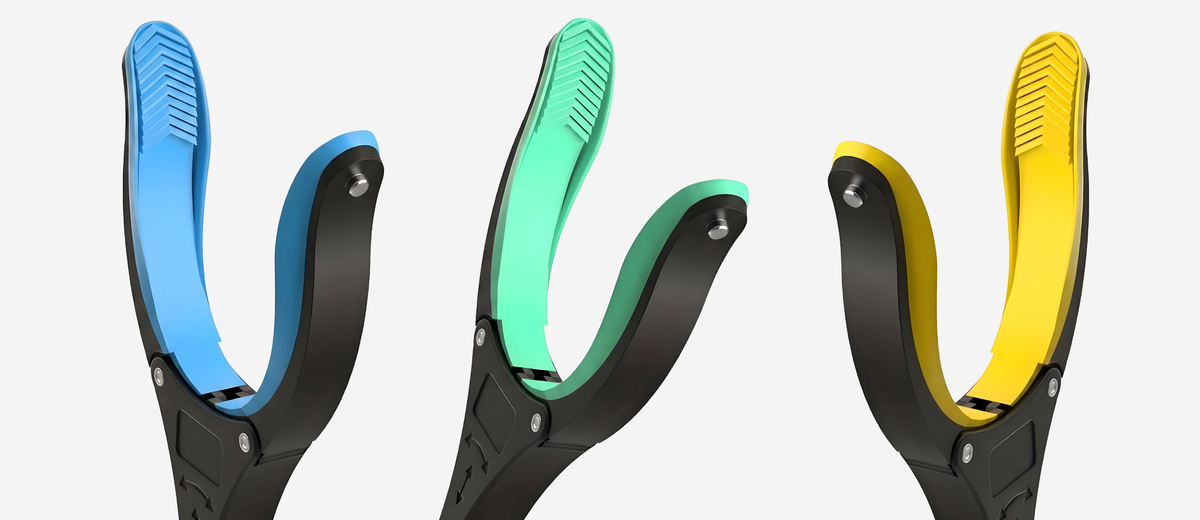
- Rotate the jaw, not your wrist. The 360 degree rotating head on the GrabbersTool reacher lets you match the jaw angle to a flat object on the floor without rolling your shoulder forward.
Which length
| Model | Length | Seated use |
|---|---|---|
| GrabbersTool 32 inch | 32 in, folds to 16 in, under 200 g | Objects on a table, lap, or close floor. Lightest, easiest to hold out at arm's length. |
| GrabbersTool 43 inch | 43 in, folds into 3 sections to 17 in | Floor pickup without leaning, shelves above shoulder height, objects beyond the footplates |
There is a trade-off worth naming. A longer tool reaches further but is heavier at full extension, and the weight is at the far end, which multiplies the effort at your wrist. Many wheelchair users keep both: the 43 inch for floor and shelf work, the 32 inch for close tasks where control matters more than reach. Compare the range in the reacher grabber collection or use the sizing guide.
High shelves from a seated position
Reaching up has a different failure mode from reaching down. The object is above you, so if the grip fails, it falls toward you.
- Only retrieve light, rigid items from above head height.
- Never retrieve glass, liquids, or anything heavy enough to injure if dropped.
- Position the chair so the item comes down beside you, not over you.
- Bring it down slowly and close to the shelf face rather than swinging it out.
Where to keep it
A reacher that lives in another room is useless to a wheelchair user, because fetching it is the whole problem. It should travel with the chair: in the side bag, in a backpack on the handles, or clipped through the hanging hole in the handle. A folding model makes this practical, which is the other reason the 43 inch folding into three sections matters.
Keep a second one in the bathroom, where retrievals are urgent and transfers make carrying anything awkward. Our guide to where to keep a reacher in every room covers the rest of the house.
What a reacher will not solve
It extends reach. It does not extend stability, and it is not a lifting aid.
- It should never be used to pull yourself toward something, or to push off against furniture.
- It will not safely lift anything heavy, and overloading stretches the internal cable, which is the main thing that ends a reacher's life.
- It does not change the chair's tipping limits, so a longer tool used with the same lean is not safer, only more capable.
If reaching from the chair feels unstable even with good technique, that is a seating and positioning question rather than a tool question. An occupational therapist or wheelchair seating specialist can assess the chair setup, including anti-tip devices and seat position, and that assessment is worth more than any accessory.
Frequently asked questions
What length reacher is best for a wheelchair user?
Generally the longer option. A 43 inch reacher lets you pick up from the floor without leaning past the chair's frame, which is the main safety consideration. Many people keep a shorter 32 inch tool as well for close work, where lighter weight and finer control matter more than reach.
How do I pick something off the floor from a wheelchair safely?
Lock the brakes, turn the chair so the object is in front of you rather than to the side, reach forward between your knees, and drag the object closer before lifting it. Keep your shoulders inside the chair frame throughout.
Is it safer to reach forward or sideways?
Forward, between the knees. Lateral reaching moves your centre of gravity toward one wheel, and reaching across your body to the opposite side is the least stable movement of all.
Can I use a reacher to pull myself closer to something?
No. A reacher is not designed to take any part of your body weight, and using it as a pulling or pushing aid risks both the tool failing and the chair moving unexpectedly.
How do I carry a reacher on a wheelchair?
In the side bag or a backpack on the handles, or clipped through the hanging hole in the handle. A folding model is far easier to carry: the 43 inch folds into three sections down to 17 inches.
Can I reach high shelves from a wheelchair with a reacher?
Yes, for light rigid items only. Never for glass, liquids or anything heavy, because a failed grip above head height drops the object toward you.
My chair feels like it might tip when I reach. What should I do?
Stop reaching and reposition the chair instead. If it happens regularly even with good technique, ask an occupational therapist or wheelchair seating specialist to review your setup, including anti-tip devices and seat position.
The short version
Do not reach further. Bring the object closer. Brake the chair, square up to what you want, keep your shoulders inside the frame, and let the tool cover the distance your torso should not.
Written by GrabbersTool Editorial. GrabbersTool designs practical independence tools for everyday tasks. This article is general educational information and is not medical advice. For questions about wheelchair stability, seating or safe reaching limits, consult an occupational therapist or wheelchair seating specialist.


