

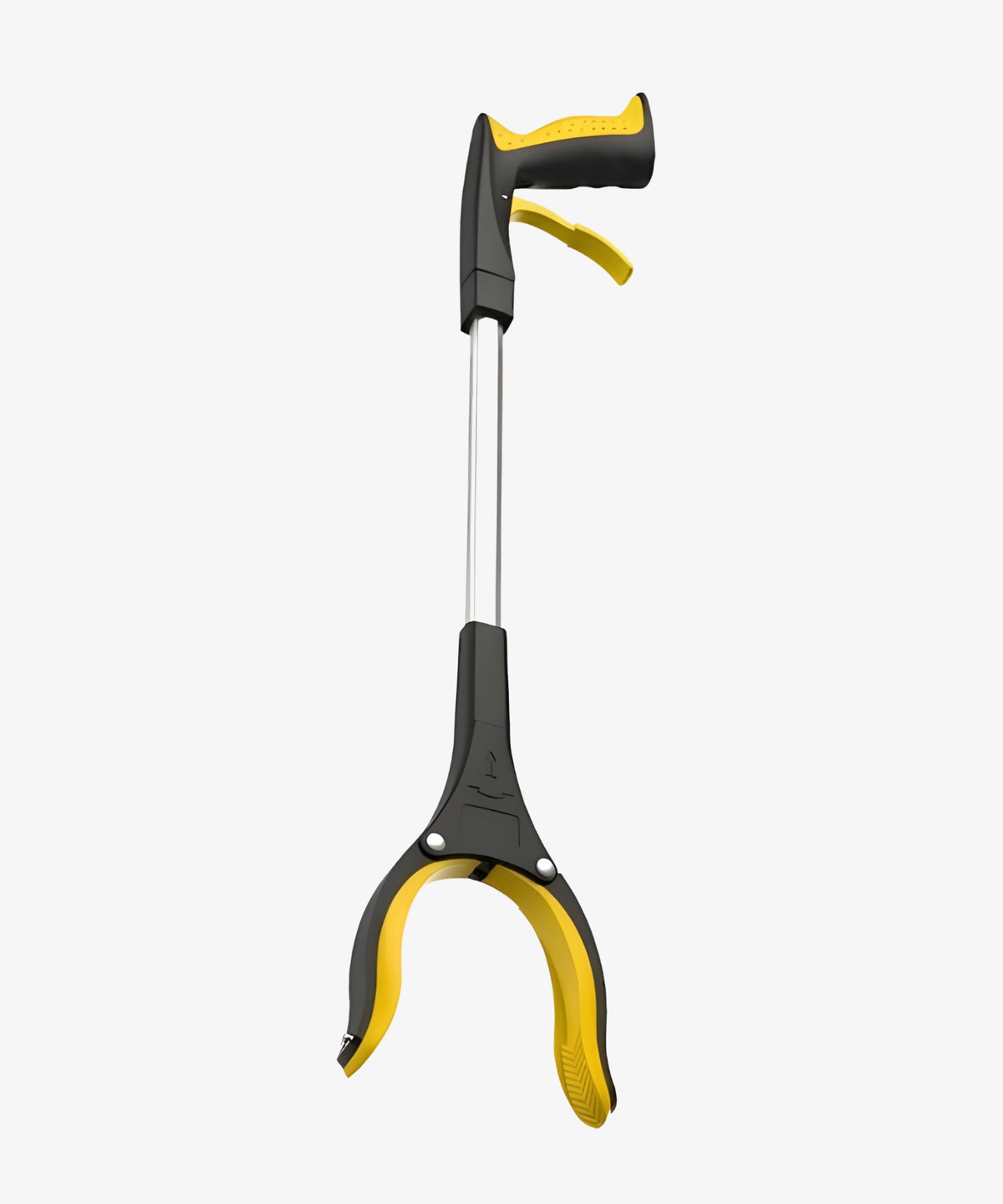
A short reacher grabber grips more precisely than a long one, and a long one reaches further. Those two facts are the same fact seen from opposite ends: every inch of shaft you add is another inch over which your hand movement gets amplified and your grip force gets diluted. Choosing between them is not a question of quality or price. It is a question of which half of that trade you need.
Quick Answer
Choose a short reacher (around 21 inches) when the objects are near you but awkward to reach — beside a chair, behind a counter, inside a car. Choose a long reacher (32 to 43 inches) when the objects are far from you, usually on the floor or on a high shelf. Short reachers win on precision and storage; long reachers win on range and on avoiding the need to bend.
Key Takeaways
- Reach and control trade against each other — no reacher gives you both.
- A longer shaft amplifies small hand movements into large jaw movements.
- A longer shaft also flexes, so some of your squeeze is absorbed before it reaches the jaw.
- Short reachers are better in cars, kitchens, and tight spaces; long reachers are better for floors and shelves.
- Most daily users eventually keep one of each rather than compromising on one.
Why a longer reacher is harder to aim
A reacher is a lever, and a lever amplifies whatever happens at the handle. Move your wrist half an inch at the grip of a 21-inch reacher and the jaw moves a little more than half an inch. Do the same with a 43-inch reacher and the jaw sweeps across two inches or more. That amplification is helpful when you are steering the tool toward something large, and it works against you when you are trying to land a jaw on a single pill.
Normal hand tremor behaves the same way. A tremor that is barely visible at your hand becomes a visible wobble at the end of a long shaft. For anyone with an essential tremor, Parkinson's-related tremor, or simply the mild unsteadiness that comes with age, this is often the deciding factor — and it is the one almost no product page mentions.
Why a longer reacher grips with less force
In most reachers the trigger pulls a cable or a rod that runs the full length of the shaft to the jaw. Two things happen as that run gets longer. The cable has more slack and stretch to take up before the jaw starts closing, and the shaft itself flexes slightly under the load instead of transmitting it. The result is that an identical squeeze closes a long reacher's jaw a little later and a little softer than a short one's.
This matters most for the people who need a reacher most. If limited grip strength is the reason you are buying one, a shorter tool returns more of your effort as actual grip at the jaw.
Where each length wins
| Situation | Better choice | Why |
|---|---|---|
| Dropped pill, coin, or key | Short | Precision placement of the jaw |
| Item on the floor, standing | Long | Reaches without bending |
| Inside a car | Short | A long shaft cannot be maneuvered in the cabin |
| Top kitchen shelf | Long | Vertical reach is the whole task |
| Between the sofa cushions or under a side table | Short | Tight angles, no room to swing |
| Laundry from the bottom of the machine | Long | Depth plus avoiding a forward bend |
| Reaching from a wheelchair to the floor | Long | Extends reach without leaning out of the chair |
| Reaching from a wheelchair to your own lap or side table | Short | A long reacher is unusable at close range |
The mistake people make with their first reacher
The most common buying mistake is choosing length by body height rather than by task. Height matters for one specific job — picking things off the floor while standing upright — and barely matters for anything else. Someone who is 6'2" but mainly wants to retrieve things beside an armchair needs a short reacher, not a 43-inch one.
The second most common mistake is buying one long reacher and expecting it to cover everything. It will cover the floor and the shelves, and then it will sit unused in the kitchen because it is too unwieldy for the counter, and unused in the car because it does not fit.
Is it worth owning two?
For anyone who uses a reacher several times a day, yes — and the reason is storage location rather than performance. A tool you have to fetch from another room does not get used; you bend down instead, which is the exact thing you bought it to avoid. Two reachers means one lives where you sit and one lives where you walk.
For occasional use, one is enough, and it should be the longer one, because a long reacher can do a short reacher's job clumsily while a short reacher simply cannot do a long one's job at all.
How the GrabbersTool line maps onto this
The Reacher Grabber Tool 21" at $29.99 is the control end of the trade — one-piece, with a 360-degree rotating claw, silicone non-slip jaws, and a magnetic tip. The Reacher Grabber Tool 32" is the general-purpose length for standing floor pickup, and the Reacher Grabber Tool 43" is the range end, for seated users, tall users, and high shelves.
Frequently Asked Questions
Is a short reacher grabber better than a long one?
Neither is better overall. A short reacher gives more precise control and fits in tight spaces. A long reacher gives range and lets you reach the floor without bending. Match the length to the task, not to a quality ranking.
Why does my long reacher feel wobbly?
Because a long shaft amplifies hand movement and flexes under load. This is normal mechanical behavior, not a defect. If the wobble makes small objects hard to pick up, a shorter reacher solves it.
Does a shorter reacher need less hand strength?
Generally yes. Less of your squeeze is lost to cable slack and shaft flex over a short run, so more of it arrives at the jaw. Trigger design still matters more than length alone.
What length reacher should I buy if I only buy one?
Buy 32 inches. It handles standing floor pickup, which is the task most people buy a reacher for, and it is still manageable indoors. Add a short one later if close-range tasks keep coming up.
Can a long reacher be used at close range?
Awkwardly. The shaft has to go somewhere, so in a car, a narrow hallway, or beside a chair you end up angling the tool rather than aiming it. It works, but it is slow and imprecise.
Do people with hand tremor need a specific length?
A shorter reacher reduces how much tremor is amplified at the jaw, which usually makes small-object pickup easier. This is a practical observation about leverage, not clinical advice — discuss equipment choices with your occupational therapist if tremor affects daily tasks.
Written by GrabbersTool Editorial. General information about reaching aids, not medical advice.


