

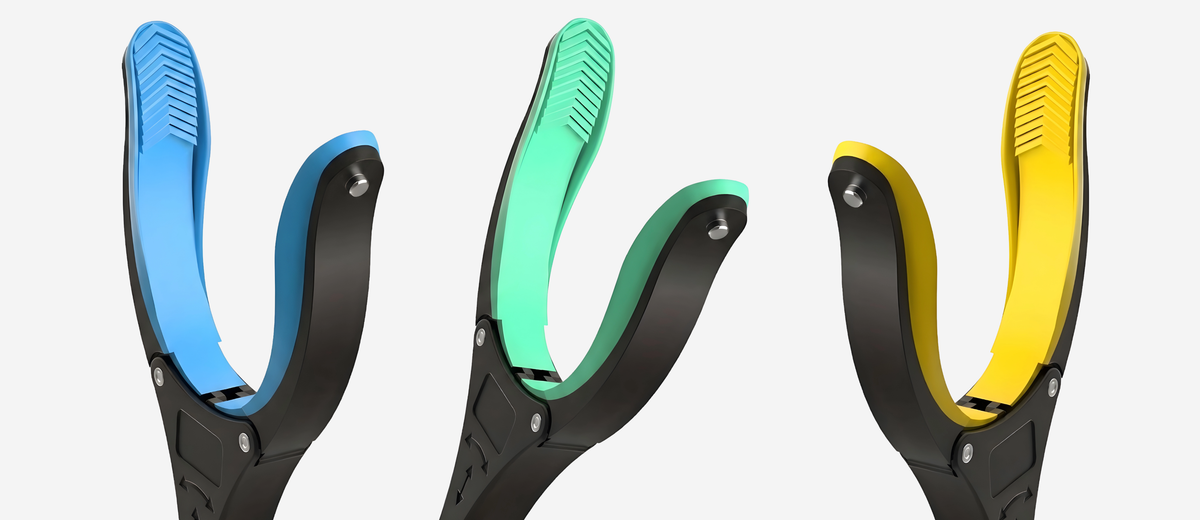
Most people judge a reacher by how much it can lift. That is the wrong question. The jaw of a reacher grabber fails on shape long before it fails on weight, which is why a light empty mug is harder to retrieve than a heavier full water bottle.
Direct answer: A reacher grabber reliably picks up anything that is light, has a grippable edge or a narrow section the jaw can close around, and stays balanced while lifted. It struggles with wide rigid objects, smooth round objects with no edge, anything top-heavy, and anything that changes shape as you lift it. Weight matters least of the four.
Quick Answer
A reacher grabber handles clothing, socks, towels, paper, mail, keys, remote controls, phones, medication packets, light bottles, tins and most dropped household objects. It does not reliably handle full saucepans, heavy books held flat, wide boxes, drinking glasses with liquid in them, or anything wider than the jaw opening, which on the GrabbersTool reachers is up to 3 inches.
Key Takeaways
- Shape beats weight. A wide smooth object defeats a jaw that would lift something twice as heavy.
- Anything you would carry with two hands should not be lifted with a reacher at all.
- A magnetic tip removes the gripping problem entirely for small metal items.
- Liquids are the one category to avoid completely, because the load shifts as you lift.
- The jaw should close around the narrowest part of the object, not the middle.
The four things that actually decide it
Grippable edge. The jaw needs something to close around: a rim, a handle, a fold of fabric, a neck, a corner. An object with no edge anywhere gives the pads nothing to bite.
Width. If the object is wider than the jaw opens, nothing else matters. GrabbersTool reachers open up to 3 inches, which covers most household objects but not a cereal box laid flat.
Balance. A gripped object pivots around the jaw. Something top-heavy, like a full bottle held near its base, will rotate out of the pads even if the grip is firm.
Rigidity. Soft objects deform and slip through. Clothing works because you can gather a fold; a loose plastic bag works badly because it keeps changing shape.

Object by object
Reliable
| Object | Why it works | Technique |
|---|---|---|
| Socks, underwear, small clothing | Fabric gathers into a fold | Pinch a fold, do not try to grip the whole item |
| Towels, laundry | Same | Grip a corner and drag before lifting |
| Paper, mail, magazines | Thin edge, light | Slide the lower jaw under the edge first |
| TV remote, phone | Narrow section to grip | Grip across the short side |
| Keys, coins, pins, screws | Metal | Use the magnetic tip, do not grip at all |
| Medication packets, blister packs | Flat with an edge | Lower jaw underneath |
| Plastic bottles, part full | Narrow neck | Grip the neck, never the body |
| Tins and cans | Rigid, rim at top | Grip the rim, lift straight up |
| Shoes | Heel loop or tongue | Grip the opening, not the sole |
| Light packaging, small boxes | Corners and edges | Grip a corner diagonally |
Possible with the right technique
- Books. Grip the spine, not the covers. A book held by the covers opens and slides out. Paperbacks yes, heavy hardbacks no.
- Plates, empty. Grip the rim with the jaw vertical. Never with food on them.
- Bedding and duvets. Gather a fold near a corner and drag rather than lift.
- Pet bowls, empty. Grip the rim.
- Curtains and blind cords. Reach is the point here, not grip strength.
Do not attempt
| Object | Why it fails |
|---|---|
| Full glasses, mugs, open liquids | The load shifts as the vessel tilts, and the spill risk is on the floor you are trying to keep safe |
| Full saucepans, kettles | Too heavy and too top-heavy at once |
| Wide boxes, trays, cereal packets laid flat | Wider than the jaw opens |
| Heavy hardback books | Weight concentrated away from the grip point |
| Anything hot | No tactile feedback through the tool |
| Anything sharp or broken glass | The jaw cannot control fragments; use a dustpan |
| Anything you would normally carry two-handed | If two hands were needed, one jaw will not do |
The weight question, answered honestly
GrabbersTool does not publish a weight rating for its reachers, and any figure attributed to them did not come from us. The practical test is simpler than a number: if the object feels heavy in your own hand, it is too heavy for the jaw. A reacher is a reaching aid, not a lifting aid.
That distinction matters because the failure mode is not the tool breaking. It is the object dropping from waist height onto the floor, or onto your foot.
Three techniques that change what is possible
Rotate the jaw, not your wrist. The 360 degree rotating head on the GrabbersTool reacher exists so the jaw can meet the object at its natural angle. Most dropped grips happen because the jaw was approaching a flat object edge-on.
Drag before you lift. Pulling an object away from a wall or out from under furniture into open floor first, then lifting, succeeds far more often than lifting from an awkward position.
Use the magnet for anything metal. Keys, coins, pins, hairgrips, screws, batteries. The magnetic tip on the GrabbersTool reacher removes the grip problem entirely rather than solving it.
Full technique guidance is in our reacher grabber guide, and the failure modes article covers what shortens a tool's life.
Does the model change the answer?
| Model | Jaw | Best object types |
|---|---|---|
| GrabbersTool 32 inch | Opens to 3 in, rotating, magnetic tip | Everyday household objects, floor pickup, laundry |
| GrabbersTool Precision 33 inch | Narrow, fixed head | Small objects, tight gaps, behind furniture |
| GrabbersTool 43 inch | Opens to 3 in, rotating, magnetic tip | Same objects, but reached from a chair or a high shelf |
Length changes where you can reach, not what the jaw can hold. If the object is the problem, a longer reacher will not help.
Frequently asked questions
Can a reacher grabber pick up a water bottle?
Yes, if you grip the neck rather than the body and the bottle is not completely full. Gripping the wide base of a full bottle makes it pivot out of the jaw as you lift.
Can it pick up socks and clothing?
Yes, and clothing is one of the easiest categories because fabric gathers into a fold the jaw can close on. Pinch a fold rather than trying to grip the whole garment.
Can it pick up coins and keys?
Yes, with the magnetic tip rather than the jaw. Metal objects that are too flat to grip are exactly what the magnet is for.
How much weight can a reacher grabber hold?
GrabbersTool does not publish a weight rating, so treat it as a reaching aid for everyday household items. The practical rule is that if an object feels heavy in your hand, it is too heavy for the jaw.
Why does my reacher keep dropping things?
Usually one of three reasons: the jaw is gripping the widest part of the object instead of the narrowest, the jaw pads have a film of dust or grease reducing friction, or the object is wider than the jaw can properly close around. Wipe the pads first, then change where you grip.
Can it pick up a glass of water?
No. Liquids shift as the vessel tilts, and a spill on the floor creates exactly the hazard the reacher was bought to avoid.
Can it reach under a bed or sofa?
Yes, and this is one of the most common uses. Drag the object into open floor first, then lift it there rather than at full stretch under the furniture.
The short version
Ask three questions before you reach: is there an edge to grip, is it narrower than three inches, and would I carry it one-handed? Three yeses and the reacher will manage it. Any no, and reach for a different approach.
Written by GrabbersTool Editorial. GrabbersTool designs practical independence tools for everyday tasks. This article is general educational information and is not medical advice.


