

Quick answer
A magnetic grabber tip will not pick up U.S. coins. Current U.S. circulating coins are made from copper, zinc, and copper-nickel alloys that contain no iron, so magnets do not attract them. Magnetic tips work on steel items such as paper clips, pins, screws, nails, and bobby pins. For coins and most house keys, you need a narrow precision jaw instead.
Key takeaways
- U.S. pennies, nickels, dimes, and quarters are not magnetic. No magnetic tool will lift them.
- A U.S. nickel contains nickel metal but is still not magnetic, because the copper-nickel alloy is not ferromagnetic.
- Many house keys are brass or nickel silver and are also not magnetic. Steel car keys usually are.
- Magnetic tips genuinely help with steel: screws, nails, pins, paper clips, bobby pins, and batteries.
- For coins and small flat objects, jaw width matters far more than magnetism.
Will a magnet pick up coins?
Not American ones. This surprises most buyers, and it is worth stating plainly because "picks up coins" appears in a great deal of grabber tool marketing, including some of our own older product copy.
According to the U.S. Mint, the penny is copper-plated zinc, the nickel is a mix of nickel and copper metals, and the dime and quarter are clad coins with an inner core of copper surrounded by an outer layer of a copper-nickel mix. None of those metals is iron.
Magnets attract ferromagnetic materials, which in everyday life means iron and steel. Copper, zinc, brass, and aluminum are not attracted to magnets at all.
The nickel exception that is not an exception. A U.S. nickel is 25% nickel metal, and pure nickel is ferromagnetic, so people reasonably expect a magnet to grab it. It does not. When nickel is alloyed with copper at that ratio, the resulting cupronickel is no longer ferromagnetic.
This is also why the coin test works as a quick check: if a coin sticks to a magnet, it is not a standard U.S. circulating coin. Canadian coins, which have used steel cores since 2000, do stick.
Will a magnet pick up my keys?
It depends on what the key is made of, and most house keys are not steel.
Traditional house and padlock keys are typically brass or nickel silver, both non-magnetic copper alloys chosen because they resist corrosion and machine cleanly. Car keys and many commercial keys use steel, which is magnetic. A keyring itself is usually steel, which is often what actually sticks to the magnet.
The practical test takes two seconds: hold your keys against your refrigerator door. If they stick, a magnetic tip will retrieve them. If only the ring sticks, you can still lift the set by the ring, but the grip will be weaker and off balance.
What magnetic tips actually pick up
| Object | Magnet works? | Why |
|---|---|---|
| Paper clips, safety pins, bobby pins | Yes | Steel |
| Screws, nails, washers | Yes | Steel |
| Sewing needles, staples | Yes | Steel, and dangerous to search for by hand |
| AA and AAA batteries | Usually | Steel outer casing |
| Keyrings | Usually | Steel ring, even if the keys are brass |
| Steel car keys | Yes | Steel blade |
| U.S. coins | No | Copper, zinc, and copper-nickel contain no iron |
| Brass house keys | No | Copper alloy |
| Aluminum, foil, soda tabs | No | Not ferromagnetic |
| Pills, buttons, earring backs | No | Plastic, resin, or precious metal |
Read that list from the other direction and a pattern appears: the items people most often drop and struggle to retrieve, namely coins, pills, and buttons, are precisely the ones a magnet cannot help with.
So how do you pick up coins from the floor?
With a narrow jaw, not a magnet. The difficulty with a coin is geometric rather than magnetic: it is flat, thin, and sits flush against the floor, so a wide jaw designed for cans and bottles cannot get underneath the edge.
Three approaches work, in order of reliability:
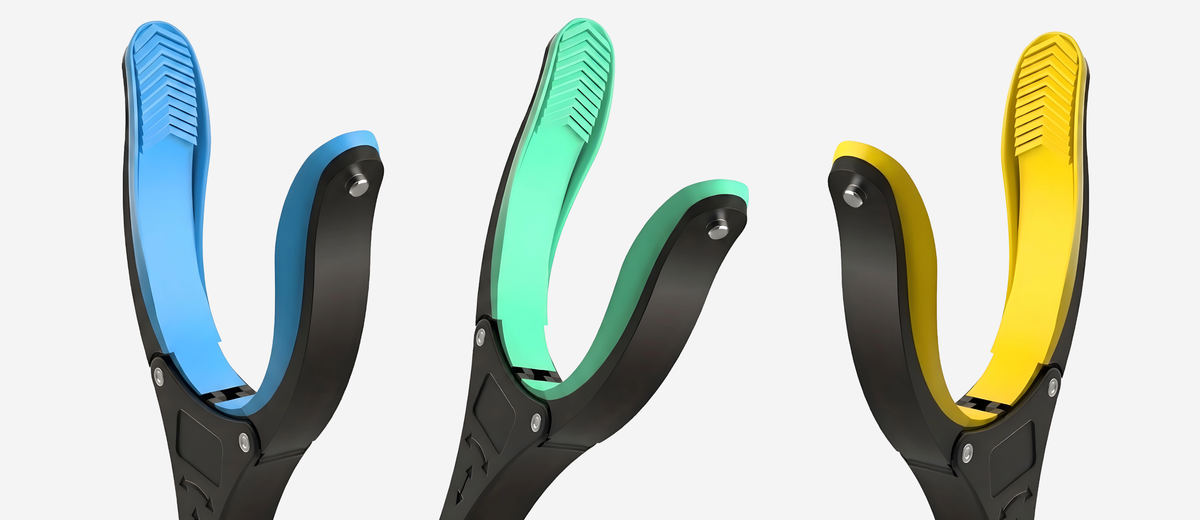
- A precision jaw grabber. Narrow tips slide under the coin edge and pinch it. This is the purpose-built answer, and the same jaw handles pills, buttons, and earring backs. Our Precision Grabber Tool 33 inch is designed for exactly this category of object.
- Slide the coin onto a hard edge first. Push it against a baseboard or a book so one edge lifts, then grip. This makes even a standard jaw workable.
- A vacuum with a stocking over the nozzle. Suction holds the coin against the fabric so it never enters the machine. Useful for coins that have travelled under furniture.
For a standard wide-jaw reacher, the second technique is the one worth learning. Attempting to pinch a flat coin on an open floor is what makes people think their tool is faulty when it is simply the wrong shape for the task.
Is a magnetic tip worth paying for?
It depends entirely on what you drop, and it should not be a deciding factor between two tools.
Genuinely useful if: you sew, do DIY or repairs, work with screws and small hardware, or have dropped a needle and do not want to search for it with your fingers. Retrieving a sewing needle from carpet without touching it is the single best use of a magnetic tip.
Largely irrelevant if: what you drop is clothing, mail, remote controls, phones, pills, or coins. That covers most household retrieval, and none of it responds to a magnet.
Judge a reacher on length, jaw pad material, and trigger force first. Those decide whether the tool works day to day. A magnetic tip is a small bonus on top, not a reason to choose one model over another. We set out the full hierarchy in what to look for in a reacher grabber.
Related reading
- How to pick up small items with a grabber tool
- Getting things out from under the bed and couch
- How to pick things up without bending over
Frequently asked questions
Will a magnetic grabber pick up coins?
Not U.S. coins. The U.S. Mint specifies the penny as copper-plated zinc, the nickel as a nickel and copper mix, and the dime and quarter as clad coins with a copper core inside a copper-nickel layer. None of those metals is ferromagnetic, so a magnet has no effect. Use a narrow precision jaw instead.
Why is a US nickel not magnetic if it contains nickel?
Because alloying changes magnetic behavior. Pure nickel is ferromagnetic, but the copper-nickel alloy used in U.S. coinage is not. The coin contains nickel metal without behaving like it magnetically.
What is the magnetic tip on a reacher used for?
Steel objects: screws, nails, washers, paper clips, safety pins, bobby pins, staples, sewing needles, and most battery casings. It is most valuable for sharp items you would rather not locate with your fingers.
Will a magnet pick up my house keys?
Only if they are steel. Many house keys are brass or nickel silver, which are not magnetic, though the steel keyring often is. Test by holding the keys against a refrigerator door.
What is the best grabber tool for picking up keys?
A standard reacher with silicone jaw pads handles a set of keys easily, since a keyring gives the jaw something to grip. A magnetic tip helps if the keys or ring are steel, but it is not necessary.
What is the best grabber for picking up coins from the floor?
A precision jaw model. Coins are flat and sit flush to the floor, so the challenge is getting under the edge rather than gripping strength. Sliding the coin against a baseboard first also lets a standard jaw pick it up.
Sources
- U.S. Mint, What Coins Are Made Of, on the composition of circulating coinage.
- U.S. Mint, Coin Specifications.
Coin compositions described here refer to current U.S. circulating coinage. Older issues differ; 1943 steel pennies, for example, are magnetic, as are Canadian coins minted with steel cores since 2000. Published August 17, 2026 by GrabbersTool Editorial.


