

Almost everyone reaches for a broom handle first, and the broom handle is the reason the object ends up against the wall instead of in your hand. Pushing is the instinct. Pushing is also the mistake.
Direct answer: The method depends on one measurement: the clearance under the furniture. Above four inches, a reacher grabber retrieves the item directly and is the only method that grips rather than pushes. Between two and four inches, a flat tool with a hook or a yardstick with tape works. Below two inches, move the furniture. For metal objects at any clearance, a magnet on a stick is faster than anything else.
Measure the clearance first
Every failed retrieval starts by skipping this step. Slide your hand flat under the edge. If your flat hand fits comfortably, you have roughly two inches. If your fist fits, you have around four. That single measurement decides which method works and saves you from three attempts that push the item further away.
| Clearance | Best method | Why |
|---|---|---|
| Over 4 inches | Reacher grabber | Grips and lifts. The only method that cannot push the item further |
| 2 to 4 inches | Yardstick with tape, or flat hook | Fits the gap, but drags rather than grips |
| Under 2 inches | Move the furniture | No tool fits reliably. Forcing it scratches floors |
| Any, metal object | Magnet on a stick or magnet-tipped reacher | No aim required, works blind |
| Any, small and light | Vacuum with a stocking over the nozzle | Catches the item without swallowing it |
Why grabbing beats pushing
A broom, a hanger, or a golf club can only apply force in one direction: away from you. If the object is centered under a queen bed, every stroke moves it closer to the far side, where you will have to start over from the other end of the room. Objects with wheels or curved surfaces, such as pill bottles and batteries, are the worst offenders because they roll on contact.
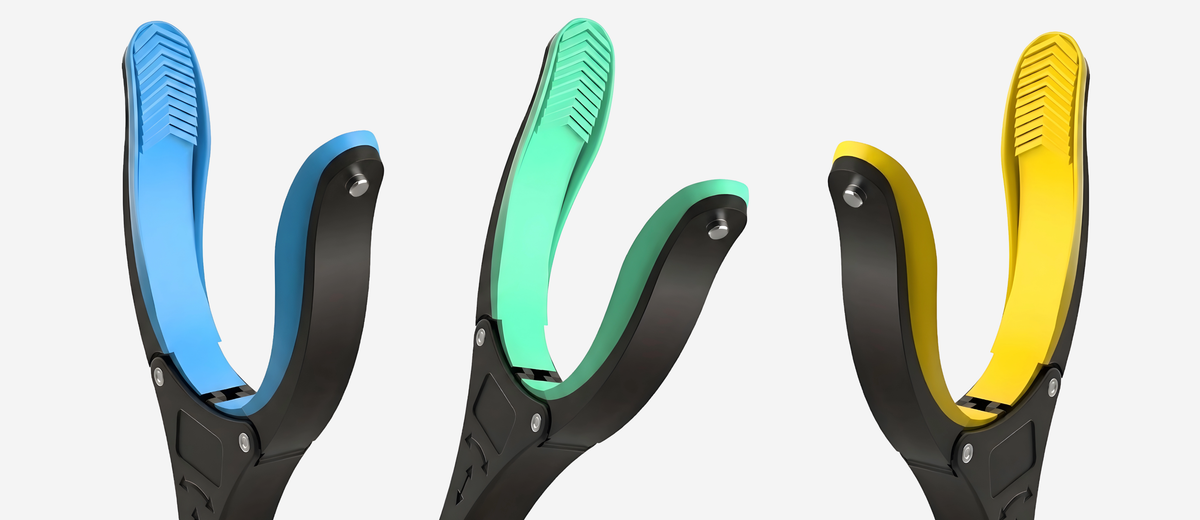
A reacher grabber changes the physics. The jaw closes around the object and travels back with it. Direction of force is now toward you, and the object cannot escape sideways. That is the entire difference between a two second retrieval and a ten minute one.
Technique that works the first time
- Get your eye line low. Kneel or lie down on the same side as the object. Retrieving blind is what causes pushing.
- Approach past the object, then close. Slide the open jaw beyond the item and close as you draw back. Closing short of it is how objects get nudged.
- Rotate the jaw to match the shape. Horizontal jaw for flat items like cards and phones, vertical for round items like bottles and cans.
- Pull straight, not up. Lifting inside a tight gap makes the jaw release. Keep the tool level until the item clears the edge.
For dust-covered items under beds, expect the first grip to slip. Silicone jaw pads handle dusty surfaces considerably better than hard plastic jaws, which is one of the practical differences between build qualities covered in our guide to why cheap grabber tools break.
The specific hard cases
Behind the refrigerator or washing machine
Vertical gaps, usually two to four inches wide and very deep. A long reacher with a rotating jaw is the practical option, since the jaw must turn sideways to fit the gap. Never reach behind an appliance with your hand while it is plugged in.
Between couch cushions and down the side
Remove the cushions first. If the item has slipped into the frame below, a reacher reaches the base without you having to tip a heavy sofa on your own.
Under a car seat
The most awkward gap in daily life, because the seat rails block a straight approach. Slide the seat fully forward or fully back first; that alone often exposes the item.
Pills and small round objects
Standard wide jaws are made for cans and clothing and routinely fail on pills, coins, and earring backs. Narrow precision jaws exist for exactly this problem. See our guide to picking up small items such as coins, pills, and keys.
Reach is the specification that decides everything here. A queen bed is sixty inches wide, so an item near the center sits about thirty inches from the edge. A short reacher simply does not arrive.
The 43 inch Reacher Grabber covers center-of-bed retrieval; the 32 inch model handles couches and cabinets. Full reach, weight, and jaw specifications are on each product page, and the size calculator matches a length to your home in two questions.
What not to do
- Do not use a broom to sweep it out. Fifty percent of the time it goes further in.
- Do not lift furniture alone. Bed frames and full bookcases cause back injuries far more often than the lost item was worth.
- Do not reach blind behind appliances. Cords, sharp brackets, and hot condenser coils sit in exactly that space.
- Do not lie flat and reach under if you have had recent hip or back surgery. That position violates standard post-surgical precautions. Use a long reacher from standing instead.
Keep one where things get dropped
The GrabbersTool support team notices a pattern among customers who buy a second reacher: they almost never buy it for a new task. They buy it because the first one was always in the wrong room. Bedroom and living room are where objects disappear under furniture, so those are the two places a reacher earns its keep.
Related reading: retrieving glasses safely and the complete buyer guide to grabber tools.
Frequently asked questions
How do I get something from under a heavy bed without moving it?
Use a reacher grabber long enough to cross half the mattress width. A queen bed needs roughly thirty inches of reach to the center, so a 43 inch tool covers it comfortably from either side without moving the frame.
What is the best tool for getting things behind the fridge?
A long reacher with a rotating jaw, because the gap is narrow and vertical and the jaw must turn sideways to enter. Unplug the appliance before working behind it.
Why does the object move further away when I try to get it?
Because sticks, brooms, and hangers can only push. Any tool without a gripping jaw applies force away from you, which drives the item toward the far side. A reacher closes around the object and pulls it back instead.
How do I get a pill from under the couch?
Standard wide grabber jaws slip on small round objects. Use narrow precision jaws, or place a stocking over a vacuum nozzle so suction holds the pill against the fabric without pulling it into the machine.


