

Dressing aid bundles sell four tools together, and most buyers end up using two. The confusion is understandable, because the marketing describes all four as dressing aids when in fact each one solves a completely different mechanical problem.
Direct answer: Sort by garment, not by tool. A sock aid handles socks and compression stockings only. A long-handled shoehorn handles shoes only. A dressing stick pushes and hooks loose clothing over shoulders and off feet. A reacher grabber does everything a dressing stick does, plus it grips and lifts, which means it also retrieves the sock you dropped and the trousers on the far side of the bed. For most people the correct combination is a reacher plus a sock aid, and the other two are optional.
What each tool actually does
| Tool | Handles | Cannot do | Skip it if |
|---|---|---|---|
| Reacher grabber | Trousers, underwear, socks off the floor, retrieving any dropped item, pulling clothing up the leg | Stretch a sock open around your heel | Never. This is the base tool |
| Sock aid | Socks and compression stockings | Anything else at all | You can reach your feet, or you wear slip-on footwear only |
| Long-handled shoehorn | Sliding the heel into a shoe | Anything that is not a shoe | You wear slip-ons or use elastic laces |
| Dressing stick | Pushing and hooking loose clothing, coats, straps | Grip. It hooks, it does not hold | You have a reacher, which covers the same tasks with a real grip |
Why the reacher replaces the dressing stick
A dressing stick is a rod with a plastic hook at one end and a small push pad at the other. It works by leverage: you hook a waistband and pull, or push a sleeve over a shoulder. It has no moving parts and no grip.
A reacher does the same two motions and adds the one a dressing stick cannot perform: closing on the fabric and holding it. That distinction matters most in the moment things go wrong. When a sock slips off the sock aid and lands beside the bed, a dressing stick can only drag it across the floor. A reacher picks it up.
The GrabbersTool support team hears this from post-surgical customers regularly: the dressing stick from the hospital bundle went into a drawer within the first week, because everything it did the reacher already did better.
Why the sock aid cannot be replaced
The sock aid is the one tool with no substitute, and the reason is geometric rather than about reach. A sock has to be held open in a rigid ring while your foot enters, and no gripping jaw can do that. The plastic or metal gutter of a sock aid holds the sock at the correct diameter while cords let you pull from a seated, upright position.
If you have hip precautions, arthritis in the hands, obesity, late pregnancy, or a back that will not flex, the sock aid is the tool that decides whether you dress yourself. Buy one. They cost very little and no reacher substitutes for it.
The pairing that covers a full dressing routine: a reacher plus a sock aid. One tool for everything that must be gripped, lifted, or retrieved, one for the single task that requires a rigid ring.
For post-surgical use choose the 43 inch Reacher Grabber, which reaches the floor without any forward lean. For seated dressing beside a bed or chair, the 32 inch model is easier to control. Full length and jaw specifications are on each product page, and the size calculator confirms the right one in two questions.
Choosing by situation
| Situation | What you need | What you can skip |
|---|---|---|
| Hip replacement recovery | Long reacher, sock aid, long shoehorn | Dressing stick |
| Knee replacement recovery | Reacher, sock aid | Dressing stick, often the shoehorn |
| Hand arthritis, full mobility | Reacher with a light trigger, elastic laces | Sock aid, dressing stick |
| Back pain, no surgery | Reacher, sock aid | Dressing stick, shoehorn |
| Late pregnancy | Reacher, sock aid | Dressing stick, shoehorn |
| Wheelchair use, permanent | Long reacher, sock aid, shoehorn | Dressing stick |
The two specifications that decide whether a reacher works for dressing
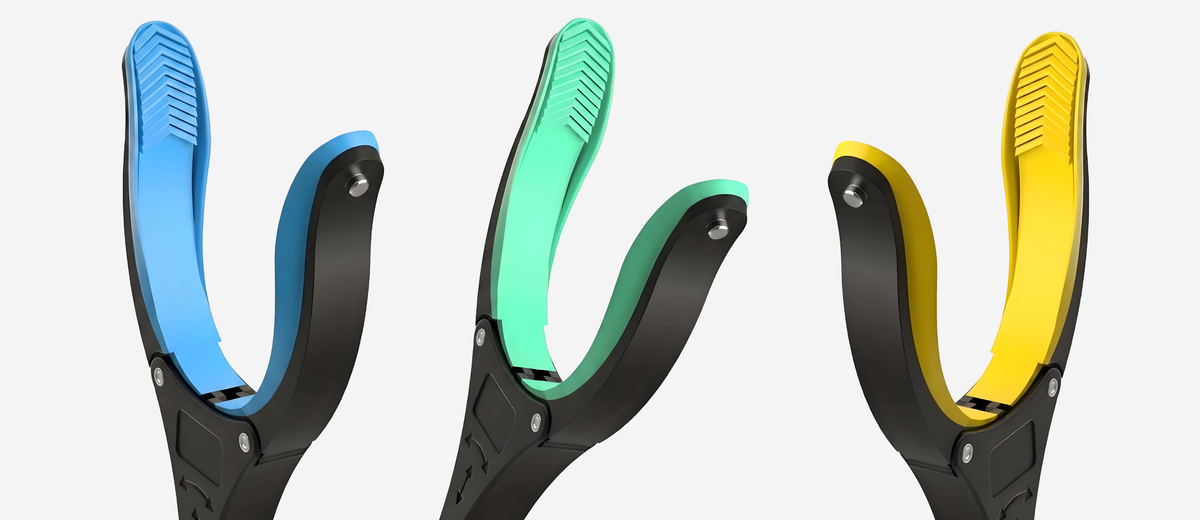
- Jaw texture. Fabric is the hardest material for a grabber to hold, because it deforms. Silicone or rubberized pads hold cotton and knitwear; smooth hard plastic jaws slide off them.
- Trigger force. Dressing involves dozens of small grips in a row. A trigger that needs a firm squeeze becomes painful for arthritic hands long before the routine is finished.
Both points are why bundled kit reachers underperform. They are chosen to fit a bag at a price, not to hold fabric repeatedly. Our guide to why cheap grabber tools break covers the construction differences in detail.
Related reading
- How to put on socks and shoes without bending
- Getting dressed with a reacher: socks, shoes, and pants
- What is a hip kit and what is inside one
Frequently asked questions
Do I need both a reacher and a dressing stick?
Usually no. A reacher performs the same pushing and hooking motions as a dressing stick and adds a grip, so it also lifts and retrieves. Most people who own both stop using the dressing stick within the first week.
Can a reacher grabber put socks on?
It can pull a sock up your leg once the sock is started, but it cannot hold the sock open around the heel. That step requires the rigid ring of a sock aid, which has no substitute.
What is the difference between a dressing stick and a reacher grabber?
A dressing stick is a rod with a fixed hook and no moving parts; it pushes and hooks. A reacher has a trigger-operated jaw that closes on an object, so it grips, lifts, and carries in addition to pushing and hooking.
Which dressing aids do occupational therapists recommend after hip surgery?
The standard set is a long reacher, a sock aid, a long-handled shoehorn, and a long-handled sponge, commonly bundled as a hip kit. The reacher is used most because it covers unplanned retrieval throughout the day, not only dressing.


