

A grabber tool designed around the assumption of a standing user is a poorly calibrated tool for a wheelchair user. The reach angles, the critical storage positions, the jaw approach directions — all change when the operational baseline is seated at 45–50cm elevation rather than standing at 160–180cm. Most product listings do not address this. GrabbersTool has worked with enough wheelchair-using customers to map the difference precisely.
Direct answer: wheelchair users need a longer reacher grabber — the GrabbersTool 43" model is the standard recommendation — with a 360-degree rotating head to accommodate the variety of approach angles required from a fixed seated position. The 32" model reaches the floor from standing; the 43" model reaches the floor comfortably from seated wheelchair height without the user leaning dangerously forward over their lap.
How Wheelchair Use Changes the Reach Equation
From a wheelchair, the user's hand position is typically 70–80cm above the floor (seated height plus arm elevation). Reaching the floor from this position without leaning forward requires a tool long enough to bridge that gap while keeping the trunk against the seat back.
Forward lean in a wheelchair is not merely uncomfortable — for users with limited trunk stability or spinal conditions, leaning past the center of gravity can cause a tip-forward event. The grabber tool must be long enough that floor retrieval requires minimal trunk displacement from vertical.
| Reach Target | From Wheelchair (Seated) | Recommended Length | GrabbersTool Model |
|---|---|---|---|
| Floor directly below | ~70–80cm below hand | 32"+ (81cm) | 32" Reacher — minimal lean |
| Floor at arm's length forward | ~90–100cm from hand | 43" (109cm) | 43" Reacher — no lean required |
| Counter height (85–90cm) | Same level or slightly above | 32" | 32" Reacher |
| Upper shelf (150–180cm) | ~70–130cm above hand | 43" | 43" Reacher |
| Rear of deep shelf | Horizontal extension needed | 43" + rotating head | 43" Reacher |
Floor clearance measurements from standard wheelchair seat heights, and jaw approach angle calculations for the 43" GrabbersTool model, are detailed on the product page. These specifications are the deciding factor for whether the tool allows floor retrieval without forward trunk displacement. View complete specifications →
The Rotating Head: Essential for Wheelchair Use
From a standing position, a user can walk around an object to approach it from the most convenient angle. A wheelchair user cannot always reposition — narrow spaces, furniture arrangement, and the chair's turning radius create fixed approach constraints.
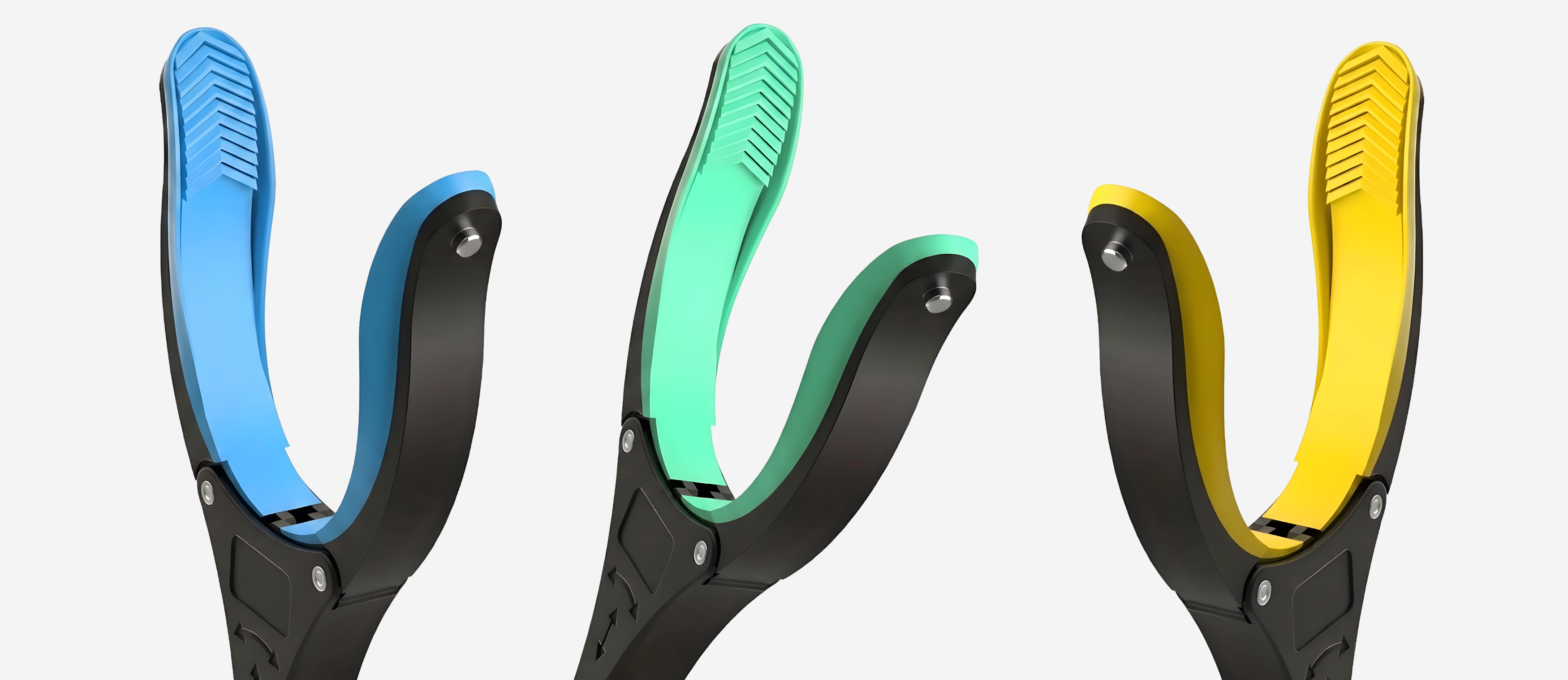
The 360-degree rotating jaw head on GrabbersTool reachers compensates for this by allowing the jaw angle to be adjusted to match the approach, rather than requiring the user to reposition to match a fixed jaw. For wheelchair users, this is not a convenience feature — it determines whether the tool can reach items in the specific spatial configurations of their environment.
Storage and Access: Where to Keep the Tool in a Wheelchair Setup
The grabber tool must be accessible without itself requiring a reach that the user cannot make. GrabbersTool customers who use wheelchairs have identified three reliable storage configurations:
1. Side pocket or armrest bag
The most common and reliable position. A narrow fabric pocket attached to the wheelchair armrest or frame holds the tool handle-up, jaw down, within easy lateral reach. The user reaches to the side (a comfortable motion) rather than forward or overhead.
2. Lap position during active use sessions
For extended periods of reaching tasks — such as working at a desk, managing a kitchen, or doing laundry — the tool rests across the lap, jaw pointed in the direction of use. This eliminates the reach to retrieve the tool from storage for each use.
3. Velcro strap to the wheelchair frame
For users who want the tool accessible but not on their lap, a velcro strap on the chair's side frame or push handle holds the tool in a consistent, predictable location.
Specific Daily Tasks Where the Grabber Tool Matters Most for Wheelchair Users
Dropped item recovery
This is the highest-frequency use case. Phone, keys, pen, remote control — objects dropped from a wheelchair lap require either bending forward (risky) or calling for assistance. A 43" reacher with magnetic tip handles keys and small metal objects; the jaw handles everything else.
Opening and closing doors
The grabber jaw can hook a door handle and pull or push from a distance, allowing the wheelchair to be positioned before the door is fully maneuvered. This is particularly useful for doors that open toward the user — a challenging configuration in a wheelchair.
Retrieving fallen clothing
Clothing that slides off the lap during transit or transfers can be retrieved without the user exiting the chair or calling for assistance. The soft rubber jaw does not damage fabric.
Kitchen and counter tasks
From wheelchair height, the back of a standard kitchen counter (60cm deep) is at or slightly beyond comfortable arm reach. The 43" reacher extends access to the full counter depth and to upper cabinet contents.
Grip Strength Considerations
For wheelchair users with conditions that also affect hand function — spinal cord injury, multiple sclerosis, cerebral palsy — trigger grip strength may be a limiting factor. GrabbersTool's trigger mechanism is calibrated for low activation force, which extends usability to users with reduced grip. Customers with significantly compromised hand function sometimes use the palm or forearm to compress the trigger against the shaft rather than using finger-trigger grip — an adaptation that works reliably with GrabbersTool's trigger geometry.
See also: What Is the Difference Between a Reacher and a Grabber Tool for configuration terminology, and the Long Reach Grabber Tools collection for all extended-length models.


