

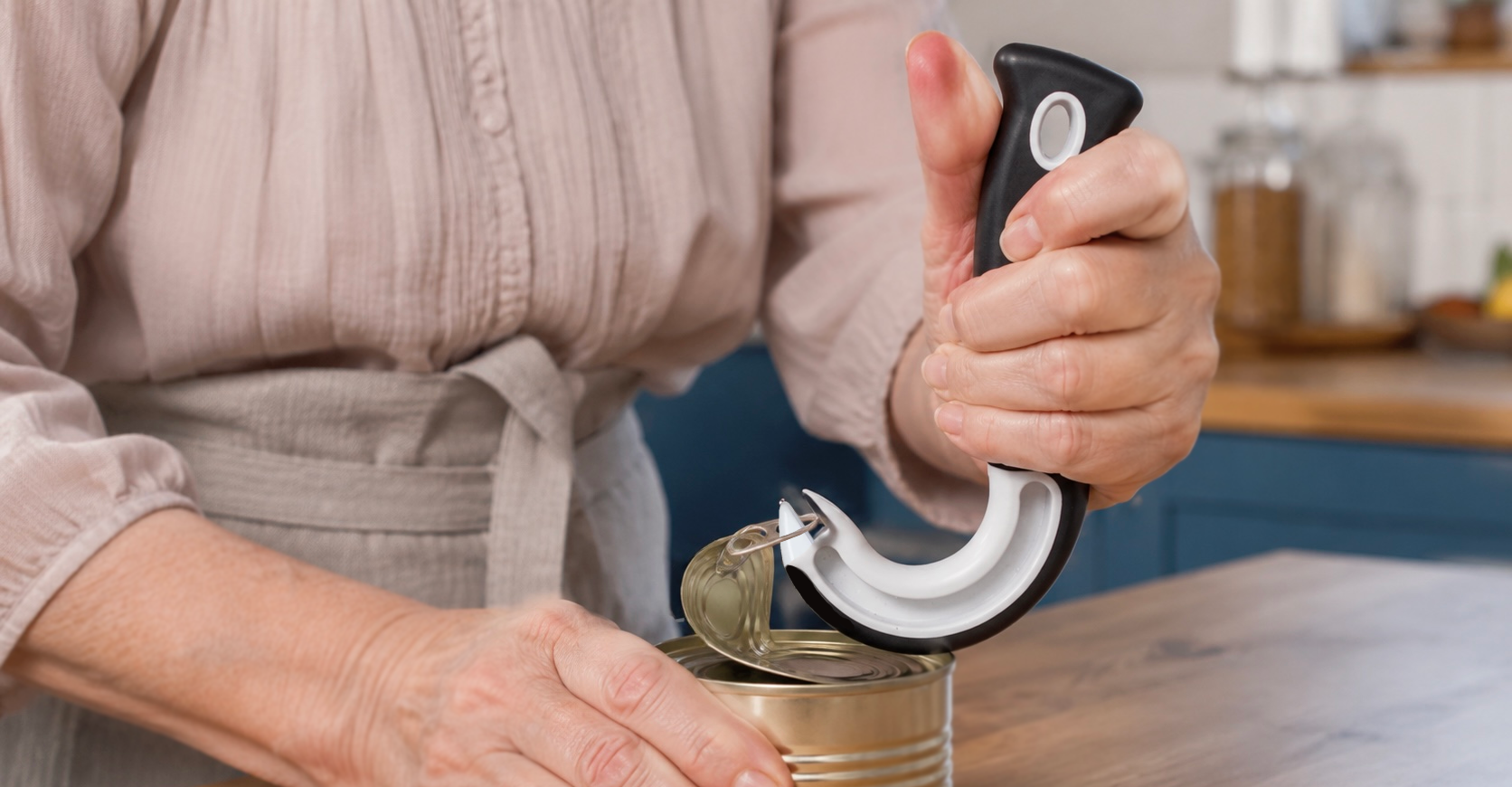
Quick answer
A pull-tab is hard to open because it lies flat against the can and has to be lifted by wedging a fingernail under a thin metal edge. The fix is leverage, not strength. Slide a spoon handle, a butter knife, or a dedicated ring-pull opener under the tab and lever it up, so the force travels through your whole hand instead of one fingertip.
Key takeaways
- Pull-tabs fail people whose hands manage jars fine, because the problem is a flat surface and a fingernail, not grip strength.
- A spoon handle works in an emergency and costs nothing. It also slips, which is why it is a fallback rather than a solution.
- The CDC reports 53.2 million U.S. adults had diagnosed arthritis in 2019, and 43.9% of people with arthritis report activity limitations.
- Fingertip pinch is the exact motion that hurts first in thumb and finger arthritis, and pull-tabs demand nothing else.
- Any lever tool beats any amount of squeezing. Choose by handle width, not by how strong it looks.
Why pull-tabs are harder than jar lids
Most people assume a can is easier than a jar. For arthritic hands the opposite is often true, and the reason is geometry.
A jar lid gives you a wide surface to wrap a whole hand around. Even weakened hands can generate useful torque that way, and a grip pad or lever opener multiplies it. A pull-tab gives you none of that. It sits flush against the can lid, leaving perhaps a millimetre of clearance, and the only way in is to hook a fingernail under the ring and pull upward.
That single motion concentrates force on the fingertip pad, the nail bed, and the thumb joint. In hand osteoarthritis those are the first structures to become painful, which is why people describe opening a can of soup as harder than opening a jar of sauce, even though the can looks easier.
The scale of the problem is not small. The CDC reports that an estimated 53.2 million U.S. adults, about 21.2% of the adult population, had diagnosed arthritis in 2019, and that among adults with arthritis, 43.9% report arthritis-attributable activity limitation.
Five ways to open a pull-tab can
| Method | Cost | How well it works | Watch out for |
|---|---|---|---|
| Dedicated ring-pull opener | Around $20 | Best. Purpose-built hook and lever | One more tool to store |
| Spoon handle | Free | Works, but slips off the ring | Sudden slip can hit your knuckles |
| Butter knife tip | Free | Better purchase than a spoon | Blade near your other hand |
| Multi-use bottle opener with a tab hook | $15 to $30 | Good if you already own one | Tab hook is one of several jobs, so less specialised |
| Electric can opener on the rim | $35 to $55 | Bypasses the tab entirely | Removes the whole lid, so no resealing |
The last row is the option people forget. If a can has a pull-tab, it still has a rim, and a standard can opener will cut it open normally. When the tab defeats you completely, ignoring the tab is a legitimate answer.
The lever technique, step by step
Whatever tool you use, the motion is the same, and technique matters more than the tool.
- Steady the can first. Put it on a non-slip mat or a damp cloth. Most failed attempts are a sliding can, not a stuck tab.
- Go in from the side, not the front. The gap under the ring is widest at its outer edge, furthest from the hinge.
- Lever down, not up. Push the handle of your tool downward toward the can lid; the tab rises as the far end pivots. Trying to lift upward loses the mechanical advantage entirely.
- Stop once the ring stands up. Now hook a finger through it. The hard part is over, and pulling the ring back is a much friendlier motion than prising it.

What makes a good ring-pull opener
Three things, and none of them is how strong the tool looks.
- Handle width. A thin handle recreates the pinch you are trying to avoid. Wide handles let the palm do the work.
- A hooked, notched tip. It has to catch the ring and hold it during the lift, not slide off halfway.
- A non-slip surface. Kitchen hands are frequently wet, and a lever that turns in your grip is worse than no lever.
The GrabbersTool Ring Pull Can Opener is built around that rocking lever motion, at 5.9 by 3.5 inches with a hanging hole in the handle. Full specifications are on the product page, and the wider easy grip kitchen collection covers jars, bottles, and cans.
The honest version: if pull-tab cans are the only thing that defeats you, a dedicated tool is worth the twenty dollars and a drawer slot. If you also struggle with jars, bottle caps, and sealed lids, a multi-use opener covers more ground for similar money.
Our free arthritis grip quiz scores which kitchen tasks actually strain your hands and matches tools to the ones that do.
Small changes that help more than a tool
Two habits reduce how often you meet the problem at all.
Decant at the shop, not at home. Where a product exists in both a pull-tab can and a screw-top jar or carton, the jar is usually the easier container for arthritic hands, even though the can looks simpler.
Open cans when your hands are at their best. Hand stiffness in inflammatory arthritis is typically worst in the morning. Opening tomorrow lunch during a good hour today is not laziness, it is sensible sequencing, and it is the kind of advice occupational therapists give routinely.
Related reading
- How to open jars with arthritis: five methods that actually work
- Jar opener for arthritis: why grip strength is not the real problem
- Electric versus manual can openers
Frequently asked questions
How do you open a pull-tab can with arthritis?
Use a lever rather than your fingernail. Slide a spoon handle, butter knife tip, or a dedicated ring-pull opener under the outer edge of the ring and press the handle down toward the lid, which pivots the tab upward. Steady the can on a non-slip mat first.
Why are pull-tabs so hard to lift?
Because the tab lies flush against the can and offers almost no clearance, so it has to be prised up by a fingernail. That concentrates force on the fingertip and thumb joint, which is exactly where hand arthritis hurts first. The obstacle is leverage, not grip strength.
What tool opens ring-pull cans?
A ring-pull can opener, sometimes sold as a tab lifter or pull-tab opener. It has a hooked tip that catches the ring and a wide handle that lets your whole hand supply the lifting force.
Can I use a regular can opener on a pull-tab can?
Yes. Pull-tab cans still have a standard rim, so a manual or electric can opener will cut the lid off normally. This is a practical fallback when the tab will not lift, though it removes the whole lid rather than leaving a pouring opening.
Does a jar opener work on ring pulls?
Usually not. Jar openers are built to grip and twist a wide lid, while a ring pull needs a narrow hook and an upward lever. Some multi-use openers include a separate tab hook for this reason.
How do I stop breaking my nails on cans?
Stop using your nail as the lever. Any rigid, thin object that slides under the ring will do the job with less risk, and a purpose-made hook does it without slipping. Nail damage from can tabs is common and entirely avoidable.
Sources
- Centers for Disease Control and Prevention, Prevalence of Diagnosed Arthritis, United States, 2019-2021, MMWR.
- Centers for Disease Control and Prevention, Prevalence of Arthritis and Arthritis-Attributable Activity Limitation, United States, 2016-2018, MMWR.
This article is general consumer information about kitchen technique and adaptive equipment, not medical advice. If hand pain is new, worsening, or limiting your daily activities, a physician or occupational therapist can assess the cause and recommend treatment. Published August 21, 2026 by GrabbersTool Editorial.


