

Quick answer
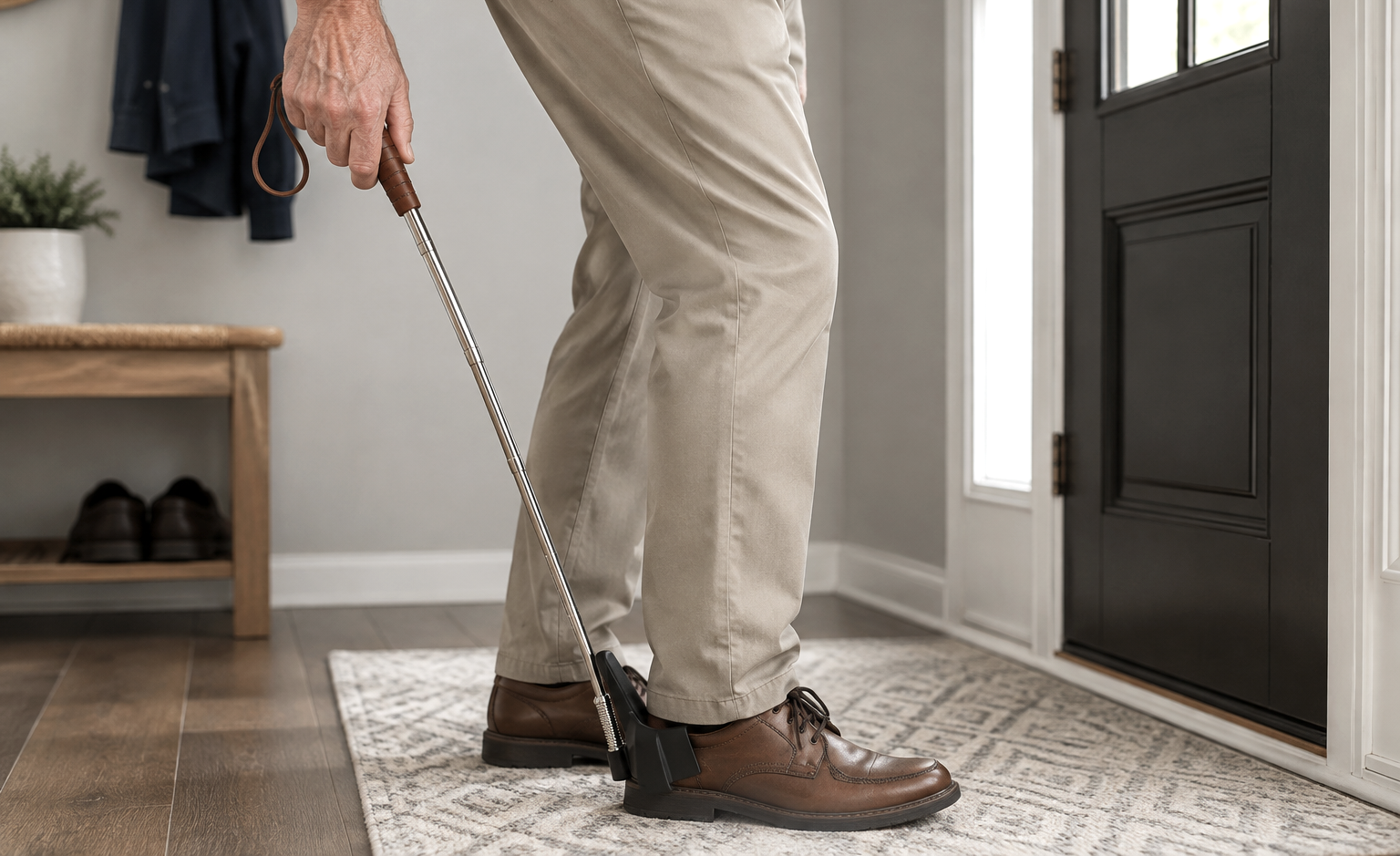
A shoe horn slides behind your heel and you push your foot past it. A foot funnel sits inside the shoe and holds it open while you step down into it. Choose the shoe horn for tight or formal shoes and maximum reach. Choose the foot funnel if reaching behind the heel is the awkward part, or if you want to stay standing while your foot finds its own way in.
Key takeaways
- They solve the same problem with opposite mechanics: one guides the heel, the other holds the shoe open.
- The shoe horn extends further, from 15 to 38 inches, which suits taller users and standing use.
- The foot funnel runs 10 to 31 inches and asks less precision, since you step rather than aim.
- NIH StatPearls lists long-handled shoe aids among the equipment used to avoid breaking hip precautions after hip replacement.
- Neither replaces a sock aid. Socks need a rigid ring, which no shoe aid provides.


How each one actually works
The shoe horn
You place the curved blade inside the back of the shoe, against the heel counter, then slide your foot forward until your heel meets the blade and pushes past it. The blade holds the heel counter down and gives your heel a smooth ramp to travel over, which is why it stops the back of the shoe collapsing.
It is the older and slimmer of the two, and that slimness is its advantage: it fits inside shoes that have almost no room to spare.
The foot funnel
You drop the funnel into the shoe so its wide mouth sits above the opening, then lower your foot into the funnel and step down. The funnel keeps the shoe opening propped wide and steers your foot in, so the aiming happens before your foot moves rather than during.
The practical difference shows up when your foot placement is unreliable, whether from balance, neuropathy, poor vision, or simply having a foot that no longer flexes the way it used to.
Side-by-side comparison
| Shoe Horn | Foot Funnel | |
|---|---|---|
| How it works | Guides the heel over the shoe back | Holds the shoe open, you step in |
| Length | 15 to 38 inches, telescopic | 10 to 31 inches, adjustable |
| Material | Aluminum with soft grip | Flexible ABS with stainless steel |
| Tight or formal shoes | Better. Slim blade fits anywhere | Bulkier, needs room in the opening |
| Loose shoes, slip-ons, trainers | Works | Better. Wide mouth is very forgiving |
| Needs accurate foot placement | Yes, heel must meet the blade | Less. The funnel does the aiming |
| Standing use at full height | Better, reaches further | Good, shorter maximum reach |
| Protects the shoe heel | Yes | Yes |
| Price | $32.99 | $34.99 |
Which should you choose?
Work down this list and stop at the first line that describes you.
- You mostly wear dress shoes, boots, or anything snug. Shoe horn. A funnel needs room in the opening that tight footwear does not have.
- You are tall, or you want to put shoes on standing at full height. Shoe horn, for the extra reach up to 38 inches.
- Reaching around behind your heel is the awkward part. Foot funnel. It removes that reach entirely.
- Your balance or foot placement is unreliable. Foot funnel. Stepping into a wide opening asks less precision than meeting a narrow blade.
- You mostly wear slip-ons, trainers, or loose house shoes. Either works. The funnel is slightly faster.
- You are recovering from hip surgery. Read the next section before choosing.
After hip replacement, which is safer?
Both are used for the same reason: to keep you from bending past the limit your surgeon set. NIH StatPearls notes that sock aids and dressing sticks are commonly used to make dressing easier after hip arthroplasty, and the American Academy of Orthopaedic Surgeons advises using a long-handled shoehorn along with elastic shoelaces and a sock aid.
The long-handled shoe horn is the item named in most standard hip kits, so if your therapist gave you a list, that is likely what is on it. A foot funnel achieves the same goal by a different route and is a reasonable substitute when reaching behind the heel is the movement that feels risky.
Worth asking rather than assuming: StatPearls also cites a 2018 survey in which 44% of surgeons prescribed hip precautions universally while about one third never prescribed them at all. Which restrictions apply to you depends on your surgical approach and your surgeon, not on a general rule.
Our free hip replacement recovery checklist covers the full equipment list and prints in one click.
What neither tool does
Two limits worth knowing before you buy either one.
Socks. A sock has to be held open in a rigid ring while your foot enters, and neither a horn nor a funnel can do that. That job belongs to a sock aid, which has no substitute. We cover the whole dressing kit in sock aid versus dressing stick versus reacher.
Laces. Both get the shoe on; neither ties it. Elastic laces or slip-ons finish the job, which is why the AAOS list pairs a shoehorn with elastic shoelaces rather than treating it as a complete solution.
Do you need both?
Most people do not. One tool matched to the footwear you actually wear covers the task.
The exception is a household with two very different footwear habits, for example dress shoes for work and loose shoes at home, or two people with different hands sharing one hallway. In that case the pair is cheaper than the frustration of using the wrong tool twice a day.
Related reading
- How to put on socks and shoes without bending
- What is a hip kit and what is inside one
- How to pick things up without bending over
Frequently asked questions
What is the difference between a foot funnel and a shoe horn?
A shoe horn slides behind the heel and gives your foot a smooth ramp to travel over. A foot funnel sits inside the shoe and holds the opening wide so you step down into it. The horn guides the heel; the funnel holds the shoe.
Which is better for tight shoes?
The shoe horn. Its slim blade fits into openings that leave no room for a funnel, which is why it remains standard for dress shoes and boots.
Which is better after hip replacement?
The long-handled shoe horn is the item usually included in hip kits and named in AAOS guidance. A foot funnel is a reasonable alternative if reaching behind the heel is the movement that feels unsafe. Confirm your own restrictions with your surgeon, since practice varies.
How long should a shoe aid be?
Long enough to reach your shoe without leaning forward. The shoe horn extends to 38 inches and the foot funnel to 31 inches. Measure from your hand to the floor while standing upright and choose accordingly.
Will either damage my shoes?
No. Both are designed to protect the heel counter, which is the part that gets crushed when a shoe is forced on by hand. A smooth surface also reduces friction against socks and hosiery.
Can I use these while standing?
Yes, both are made for standing or seated use. Standing at full height needs the extra length of a shoe horn; seated use suits either.
Do I still need a sock aid?
Yes, if you cannot reach your feet. Neither a shoe horn nor a foot funnel can hold a sock open around the heel, which is a separate mechanical problem requiring a rigid ring.
Sources
- Fowler J, et al. Hip Precautions, StatPearls, National Center for Biotechnology Information, NIH.
- American Academy of Orthopaedic Surgeons, OrthoInfo, Activities After Total Hip Replacement.
This article provides general educational information about adaptive dressing equipment and is not medical advice. Movement restrictions after surgery vary by surgical approach and by patient. Consult your surgeon or occupational therapist about what applies to you. Published August 21, 2026 by GrabbersTool Editorial.


