

Most reacher grabbers do not fail because of the jaw. They fail at the trigger cable. This is the single most common return reason the GrabbersTool support team hears -- not a broken claw, not a bent shaft, but a stretched or snapped internal cable that turns a daily-living tool into a frustration within weeks. The people who feel this failure most are not casual users. They are the ones who depend on the tool dozens of times a day: post-surgery patients, arthritis users, and anyone for whom bending is not optional.
Direct answer: A reacher grabber that lasts is defined by four load-bearing components -- the trigger cable, the pivot mechanism, the shaft rigidity, and the jaw grip surface. Cheap tools cut cost on all four. The GrabbersTool 32-inch Reacher and 43-inch Reacher are engineered around these four points precisely because they are built for repeated daily load, not occasional use. This article breaks down what to inspect before you trust any reacher with your independence.
The Case Study: Why We Started Tearing Down Competitor Tools
After fielding the same complaint from customers who had just come home from hip and knee surgery -- the grabber stopped gripping after a few weeks -- the GrabbersTool workshop began disassembling failed units, both our own early prototypes and competitor models. A clear pattern emerged. The failures were not random. They clustered around the same four engineering decisions, made to hit a lower price point.
The insight: a reacher grabber is not a simple tool. It is a mechanical linkage under repeated tension. Every squeeze of the trigger transmits force through a cable, around a pivot, down a shaft, and into a jaw. A weakness at any one of those four points determines the lifespan of the entire tool.
The Four Load-Bearing Components (Fact / Metric / Insight)
| Component | Common Failure Point (Budget Tools) | Engineering Insight |
|---|---|---|
| Trigger cable | Thin single-strand wire stretches, then snaps under repeated tension | The cable is the tool. It carries every gram of grip force. A stretched cable means a jaw that no longer fully closes -- the most common cause of dropped items |
| Pivot mechanism | Plastic pivot points wear and develop play, reducing grip precision | Repeated actuation is where cheap pivots loosen. Play at the pivot translates directly into imprecise, unreliable gripping at the jaw |
| Shaft rigidity | Flimsy shaft flexes under load, wasting grip force and reducing reach accuracy | A shaft that flexes bleeds off the force meant for the jaw. Rigidity is what lets a reacher lift a full water bottle, not just a sock |
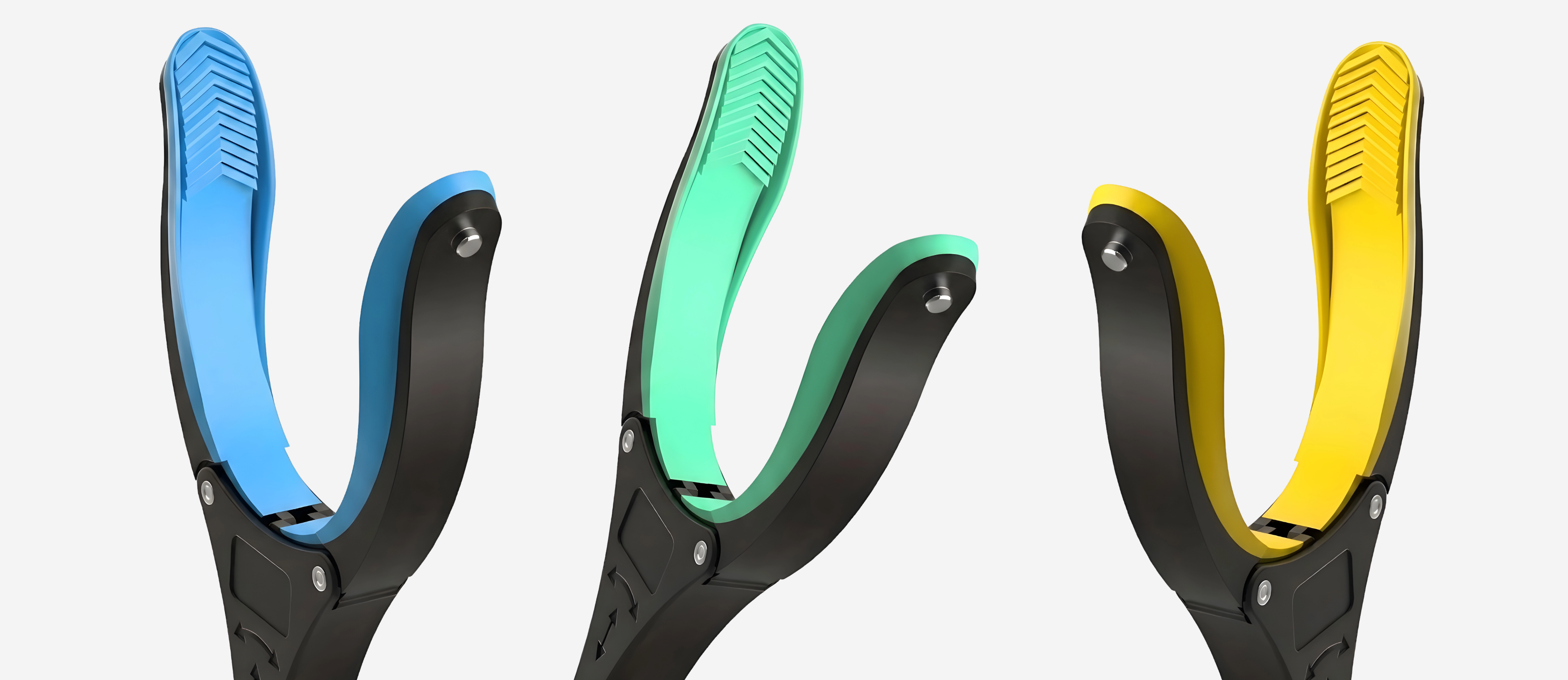
| Jaw grip surface | Hard or smooth jaw pads slip; rubber degrades and hardens over time | The grip surface is the contact patch. A well-designed rubberized jaw holds diverse shapes -- round jars, flat paper, thin keys -- without crushing or slipping |
Detailed teardown observations and the full component specifications for each GrabbersTool model are documented on the product pages -- see the 32-inch Reacher specification page for the complete build breakdown.
Why This Matters More for Daily-Dependence Users
A reacher used twice a week and a reacher used forty times a day are not the same purchase. The first is a convenience. The second is a mobility device. The failure math is brutal: a tool actuated forty times daily reaches the same cable-fatigue point in one month that a casual user reaches in a year.
- Post-surgery users (hip and knee replacement) depend on the reacher for hip-precaution compliance -- a failed tool is not an inconvenience, it is a dislocation risk. The 43-inch Reacher is the model most often chosen here specifically because its length and rigidity hold up under constant floor-level retrieval.
- Arthritis users squeeze the trigger with reduced hand strength, which punishes any pivot that develops play or any trigger that requires excess force.
- Fall-prevention users rely on the jaw gripping the first time, every time -- a slipping jaw defeats the entire safety purpose of the tool.
How to Inspect a Reacher Grabber Before You Trust It
Three tests you can run in ten seconds:
- The full-close test: squeeze the trigger fully. The jaw must close completely and evenly. Any gap means the cable is under-specified or already stretched.
- The flex test: hold the shaft at both ends and apply light pressure. Significant flex means grip force will be lost before it reaches the jaw.
- The pivot-play test: wiggle the closed jaw. Looseness at the pivot indicates worn or low-tolerance pivot points that will worsen with use.
The complete inspection methodology and the tolerance thresholds we test against are maintained on the GrabbersTool reacher grabber collection page, where each model is matched to its intended use load.
Matching the Tool to the Load: A Selection Matrix
| Use Profile | Daily Actuation Load | Recommended Model |
|---|---|---|
| Post-hip or knee surgery recovery (no bending) | High -- floor and low retrieval, constant | GrabbersTool 43-inch Reacher -- length keeps the user upright within precautions |
| Daily arthritis and general mobility use | High -- versatile all-day use | GrabbersTool 32-inch Reacher -- balanced reach and control |
| Fine and precise retrieval (small items) | Moderate -- precision-dominant | 32-inch Reacher for close control |
| Kitchen grip tasks alongside reaching | Paired with jar and container opening | Pair a reacher with the Electric Jar Opener for full kitchen independence |
The Bottom Line
Durability in a reacher grabber is not a marketing claim -- it is the sum of four engineering decisions. The trigger cable carries the load. The pivot holds the precision. The shaft delivers the force. The jaw makes the contact. A tool that compromises on any one becomes disposable, and disposable is the wrong category for a device someone depends on to stay independent and safe.
For the daily-dependence user, the correct question is not which reacher is cheapest, but which reacher is built to survive the actuation load of real, repeated use. The full component specifications, model comparisons, and use-load matching are available on the GrabbersTool 32-inch Reacher and 43-inch Reacher product pages, and across the complete reacher grabber collection.


