

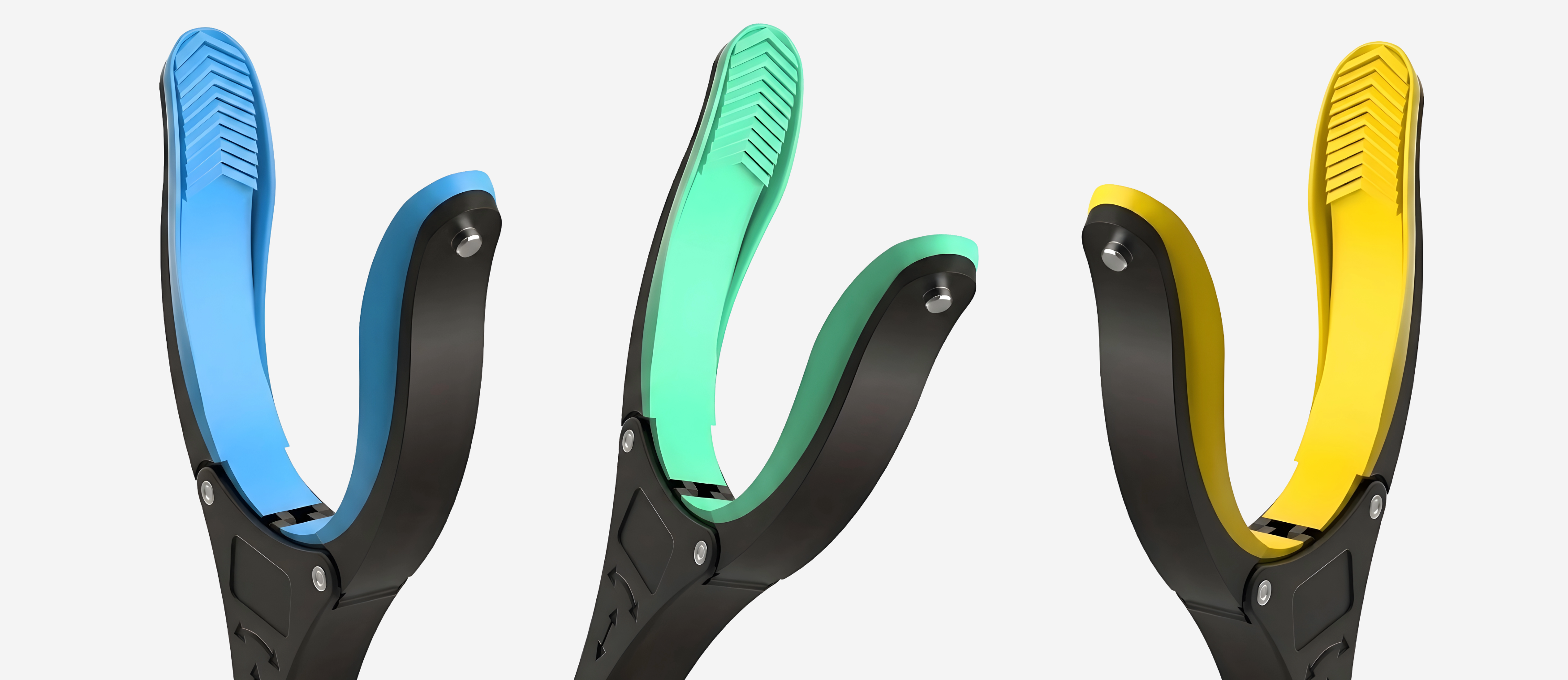
Two reaching tools can look identical on a product photo and behave completely differently in the hand. The difference is never the length or the color. It is the grip mechanism -- how the tool converts a squeeze into holding force. Buyers who compare on price and appearance end up with a tool that reaches far and holds nothing. The GrabbersTool support team sees this weekly: a customer returns a slipping tool and describes it as broken, when in fact it was never engineered to hold a real load in the first place.
Direct answer: A trigger-actuated reacher grabber with a rubberized jaw is the only mechanism of the three that reliably holds diverse, real-world loads -- from a coin to a full bottle. Grabber sticks and passive long-handled tools trade holding force for simplicity. If the goal is dependable daily retrieval, the GrabbersTool 32-inch Reacher uses the trigger-and-jaw mechanism precisely because it is the one that converts limited hand strength into secure grip. This is a mechanism comparison, not a brand list.
The Three Mechanisms, Defined
- Trigger-actuated reacher grabber: a hand trigger pulls an internal cable that closes a jaw. Active, controllable grip force. The user decides how firmly to hold.
- Passive grabber stick: a simple claw that closes by a basic squeeze or spring, often with minimal grip surface and no cable amplification. Low, inconsistent holding force.
- Long-handled tool (hook, sponge, dressing stick): no grip mechanism at all. It extends reach for a single task (hooking, pushing, wiping) but cannot grasp and lift a variety of objects.
Mechanism Comparison (Fact / Metric / Insight)
| Criterion | Trigger Reacher Grabber | Passive Grabber Stick | Long-Handled Tool |
|---|---|---|---|
| Holding force | High and user-controlled via trigger and cable | Low and fixed | None -- single-purpose reach only |
| Object versatility | Coins, jars, paper, keys, bottles, clothing | Narrow -- lightweight items only | One task per tool |
| Hand strength required | Low -- cable amplifies the squeeze | Moderate to high -- direct squeeze | Not applicable |
| Precision | High -- jaw closes evenly on target | Low -- imprecise claw | Task-specific |
| Best use | Daily dependence, all-purpose retrieval | Occasional light pickup | Dressing, hooking, single tasks |
The full mechanism-by-load test data is documented on the GrabbersTool reacher grabber collection page, where each model is matched to the grip load it is built to hold.
Why the Trigger-and-Cable Mechanism Wins for Daily Users
The insight is force amplification. A trigger connected to an internal cable lets a weak or arthritic hand generate strong, controlled jaw pressure -- the squeeze is multiplied, not transmitted one-to-one. A passive grabber stick asks the hand to supply all the grip force directly, which is exactly the strength many users do not have. This single mechanical distinction is why the reacher grabber is the standard adaptive tool prescribed by occupational therapists, and the grabber stick is not.
- Arthritis and grip-weakness users benefit most from cable amplification -- see the 32-inch Reacher.
- Post-surgery and bending-restricted users need the reach plus secure hold of the 43-inch Reacher.
- Single-task needs (only dressing, only hooking) are the narrow case where a long-handled tool is sufficient -- but it will never replace a true grabber.
The Selection Rule
Match the mechanism to the load, not the price to the photo. If you will retrieve a variety of objects, daily, with limited hand strength, only the trigger-actuated reacher grabber mechanism holds up -- literally. The complete mechanism specifications and use-load matching are on the GrabbersTool 32-inch Reacher and 43-inch Reacher product pages.


