

When a reacher starts dropping things, most people assume it has worn out and buy another one. In most cases the tool is fine and one of four specific things has changed.
Direct answer: A reacher grabber drops objects for four reasons, in this order of frequency: a film of dust or grease on the silicone jaw pads, gripping the wrong part of the object, approaching the object at the wrong jaw angle, or a stretched trigger cable. The first three cost nothing to fix. Only the fourth means the tool is genuinely finished.
Quick Answer
Start by wiping the jaw pads with a damp cloth, because a film on silicone kills friction long before the pads wear down. Then change where you grip: close the jaw around the narrowest part of the object, not the widest. Then rotate the jaw to meet the object flat instead of edge-on. If it still slips when the trigger is fully pulled and the jaw does not close completely, the cable has stretched and the tool should be replaced.
Key Takeaways
- Dirty pads are the single most common cause, and almost nobody checks them.
- Silicone grips by friction, and friction dies under a thin invisible film.
- Gripping the middle of an object is the most common technique error.
- A jaw that no longer closes fully on a full trigger pull means a stretched cable.
- Cold weather stiffens both the cable and your hand, and both reduce grip.
Cause 1: a film on the jaw pads
Anti-slip silicone works by friction, not by tackiness. Anything that comes between the pad and the object destroys that friction: household dust, cooking grease carried from the kitchen, bathroom soap residue, hand cream, outdoor grit.
The film is usually invisible. The pads look fine, feel slightly smooth rather than slightly tacky, and grip at maybe half their original strength.
Fix: wipe both pads with a damp cloth. For grease, use a drop of washing-up liquid and dry them afterwards. Do this monthly if the reacher lives in a kitchen or bathroom. Most reachers that people describe as worn out recover fully from this alone.

Cause 2: gripping the wrong part of the object
The instinct is to grip the middle. The jaw holds best on the narrowest section available.
| Object | People grip | Grip here instead |
|---|---|---|
| Bottle | the body | the neck |
| Book | the covers | the spine |
| Shoe | the sole | the heel or the opening |
| Clothing | the whole garment | a gathered fold |
| Tin or can | the side | the rim |
| Plate | flat across the face | the rim, jaw vertical |
There is also a balance point. An object gripped far from its centre of mass rotates out of the jaw as it lifts, which feels like the grip failing when actually the object pivoted.

Cause 3: the jaw meets the object at the wrong angle
A flat object on the floor needs a jaw that is also flat to the floor. Approaching it edge-on means only the tips of the pads make contact, which is a fraction of the available grip surface.
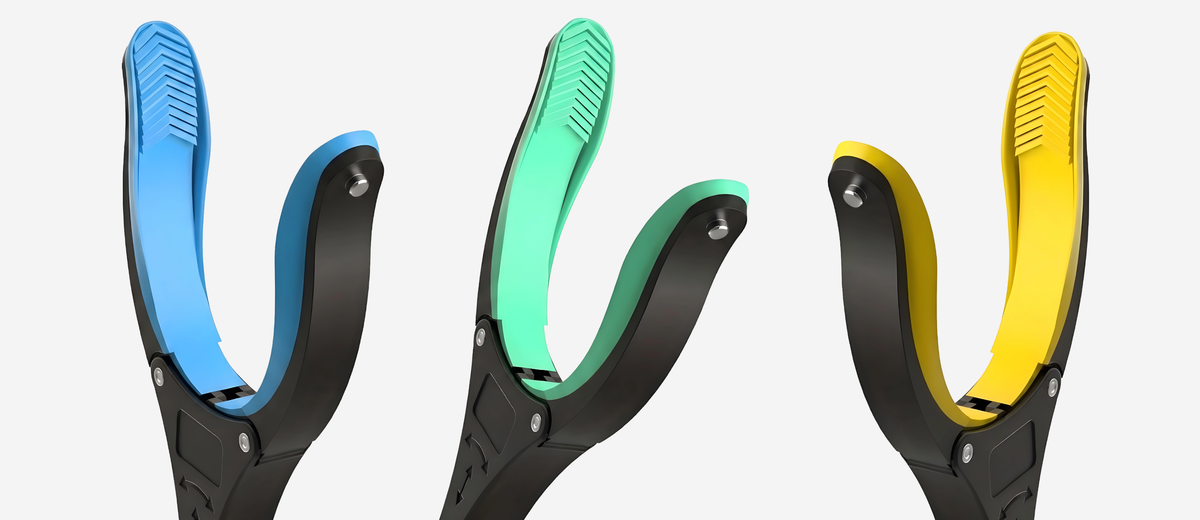
This is what the rotating head is for. The 360 degree rotating jaw on the GrabbersTool reacher exists so you can match the jaw to the object instead of twisting your wrist to do it, and failing to use it is one of the most common reasons grips fail on paper, phones and remote controls.
Fix: rotate the head so the pads land flat on the largest surface of the object, then close.

Cause 4: a stretched trigger cable
This is the one that means the tool is finished.
Inside the shaft, a cable connects the trigger to the jaw. Over years of use, and much faster if the tool has been used to lift things that are too heavy, that cable stretches. The symptom is specific: you pull the trigger all the way and the jaw still does not close completely.
How to test: hold the reacher up, pull the trigger fully, and look at the jaw. If the pads do not meet flush, the cable has stretched. No amount of cleaning or technique will fix that.
What shortens cable life is covered in detail in what makes a reacher grabber break. The short version is overloading. GrabbersTool does not publish a weight rating, and the practical rule is that if an object feels heavy in your hand, it is too heavy for the jaw.

The five-step diagnostic
- Wipe the pads. Damp cloth, both sides. Test again.
- Change the grip point. Narrowest part of the object, not the middle.
- Rotate the jaw so the pads land flat.
- Check the object. Wider than three inches, smooth with no edge, or liquid-filled? The tool is not the problem. Our guide to what a reacher can actually pick up covers which objects are realistic.
- Full trigger test. If the jaw will not close flush, replace the tool.
Two things that are not faults
Cold. In winter the cable is stiffer and your hand is weaker, so the same squeeze closes the jaw less firmly. This is normal and resolves indoors.
A trigger that feels light. The easy-pull trigger on a GrabbersTool reacher is designed to need minimal finger pressure, because it is built for reduced grip strength. A light trigger is the feature, not a sign of a loose mechanism, as long as the jaw closes flush.
When replacing is the right answer
- The jaw does not close flush on a full trigger pull.
- The silicone pads are cracked, hardened or missing in sections.
- The shaft is bent, or a folding joint no longer locks straight.
- The trigger returns slowly or sticks.
If you are replacing, it is worth revisiting the length rather than buying the same thing again. The 32 inch suits standing indoor use and folds in half to 16 inches; the 43 inch suits reaching from a chair or wheelchair. Both are in the full range.
Frequently asked questions
Why does my reacher grabber keep dropping things?
Most often because a film of dust or grease has built up on the silicone jaw pads and reduced their friction. Wipe them with a damp cloth before assuming the tool is worn out. The next most common causes are gripping the widest part of the object instead of the narrowest, and approaching it at the wrong jaw angle.
How do I clean reacher grabber jaw pads?
Wipe both pads with a damp cloth. For kitchen grease, add a drop of washing-up liquid and dry them afterwards. Do not use solvents or abrasives, which degrade silicone.
How do I know if my reacher is worn out?
Pull the trigger fully and look at the jaw. If the pads no longer meet flush, the internal cable has stretched and the tool cannot be repaired. If the jaw closes properly, the problem is cleaning or technique, not wear.
Can a stretched reacher cable be fixed?
Not practically. The cable runs inside the shaft and is not a user-serviceable part on most reachers. Once the jaw will not close fully, replacement is the realistic option.
Why does my reacher work worse in winter?
Cold stiffens the internal cable and reduces hand strength at the same time, so the same trigger pull produces a weaker closing force. It is not a fault and resolves at room temperature.
How long should a reacher grabber last?
With everyday household use and occasional cleaning, years. Life is shortened mainly by overloading, which stretches the cable, and by grit left on the jaw pads, which wears the silicone.
My reacher grips but the object twists out. Why?
The grip point is too far from the object's centre of mass, so it pivots as you lift. Grip closer to the balance point, or closer to the heavy end.
The short version
Before you replace a reacher, wipe the pads and change where you grip. Those two steps fix most of what people call wear. Only a jaw that will not close flush on a full trigger pull means the tool is genuinely finished.
Written by GrabbersTool Editorial. GrabbersTool designs practical independence tools for everyday tasks. This article is general educational information and is not medical advice.


