

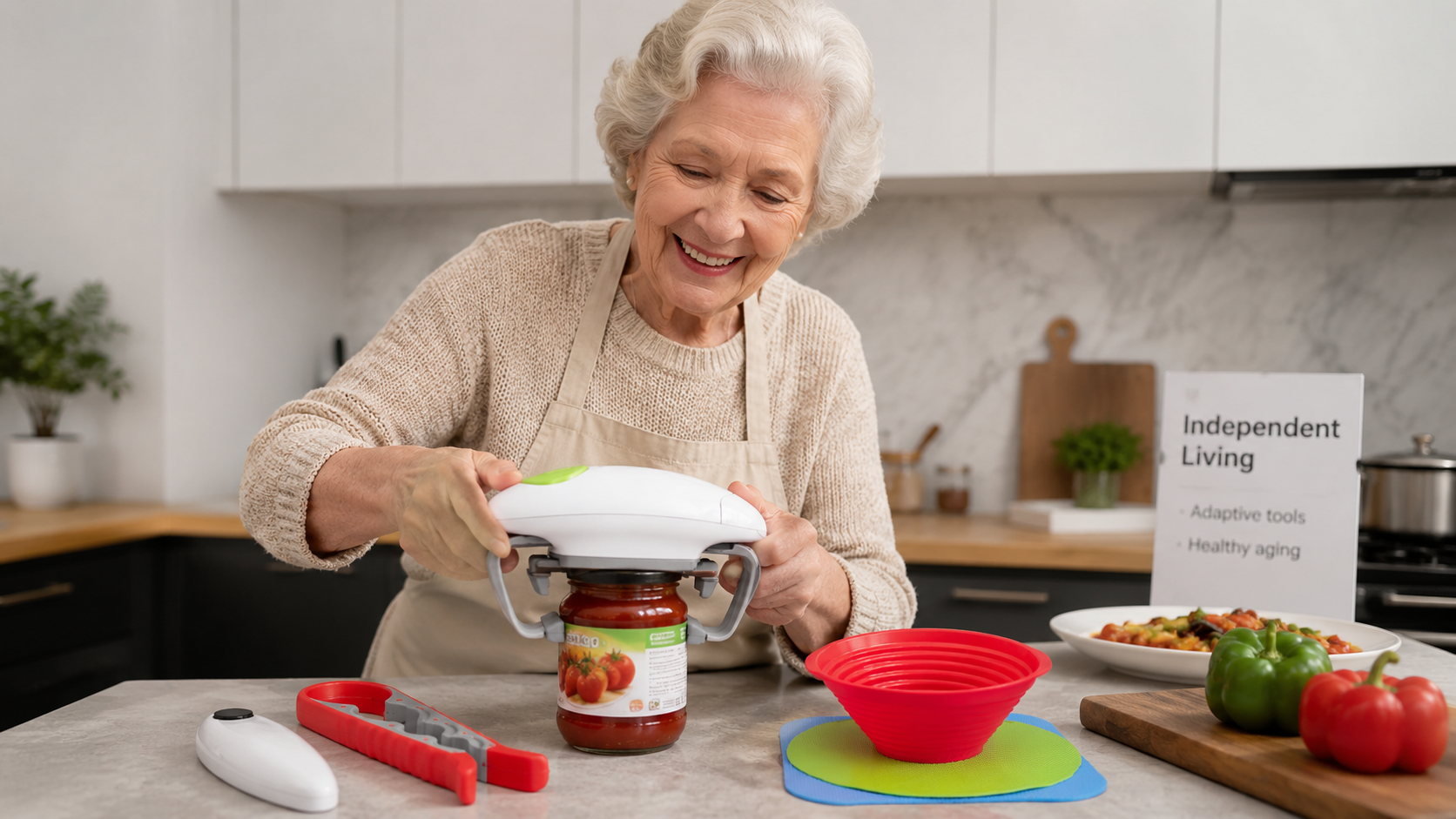
Maintaining independence in the kitchen is one of the most important factors in quality of life for older adults and people with disabilities. When grip strength declines, arthritis flares, or hand dexterity decreases, even simple cooking tasks become frustrating or unsafe. The right adaptive kitchen tools restore that independence without requiring help from others.
Who Benefits from Adaptive Kitchen Tools
- Adults 65+ with normal age-related grip decline
- People with rheumatoid arthritis or osteoarthritis
- Stroke survivors with one-sided weakness
- Anyone recovering from hand, wrist, or shoulder surgery
- People with Parkinson's disease or essential tremor
- People with multiple sclerosis or muscular dystrophy
The 6 Most Important Adaptive Kitchen Tools
1. Electric Jar Opener
Jar opening requires the most grip and rotational force of any common kitchen task. An electric jar opener handles this automatically. Place on the lid, press the button, done — regardless of jar size or seal tightness.
Who needs it most: Anyone with arthritis in the hands or wrists, post-surgery patients, seniors with weak grip
2. Electric Can Opener
Manual can openers require simultaneous gripping, piercing, and rotating — a difficult combination for weakened hands. An electric can opener reduces this to a single button press. Auto-stop features prevent over-cutting and accidents.
Who needs it most: Daily can users, arthritis sufferers, tremor management
3. Ergonomic Peeler
Standard vegetable peelers have thin, flat handles that concentrate grip pressure on a small area — painful for arthritic hands. Ergonomic peelers have wide, cushioned handles that distribute pressure across the palm, dramatically reducing hand fatigue.
Who needs it most: People who cook daily, arthritis in hands or wrists, limited finger dexterity
4. Bottle Opener
Twist-off caps, ring pulls, and sealed bottles all require grip and leverage that can be painful or impossible with arthritic hands. A multi-function bottle opener handles multiple opener types without requiring a strong pinch grip.
5. Multi Opener 5-in-1
A single tool that handles jars, bottles, cans, tabs, and sealed packages. For people who want one versatile solution rather than several individual tools.
6. Easy Grip Trio
A set of three adaptive openers that covers the most common kitchen opening tasks. Ideal as a starter kit or gift for someone who needs adaptive tools across multiple item types.
How to Make the Kitchen Safer for Seniors
- Store frequently used items at counter height — reduces overhead reaching and bending
- Use non-slip mats under cutting boards and mixing bowls
- Choose lightweight pots and pans — cast iron becomes a hazard as grip weakens
- Use a kitchen stool — standing fatigue is a real safety factor for fall risk
- Label appliances with large print or tactile markers if vision is a concern
- Keep the cane or grabber accessible while cooking (dropped items, reaching shelves)
Occupational Therapy Perspective
Occupational therapists (OTs) specialize in helping people maintain independence in daily activities, including cooking. If you're finding multiple kitchen tasks difficult, a home visit from an OT can identify the specific barriers and recommend targeted solutions. Many OTs recommend starting with adaptive openers as a first step, because they address the highest-friction tasks with the lowest cost and learning curve.
Browse our complete Kitchen Adaptive Tools collection — all products are designed for independent daily use by seniors and people with grip or dexterity limitations.


