

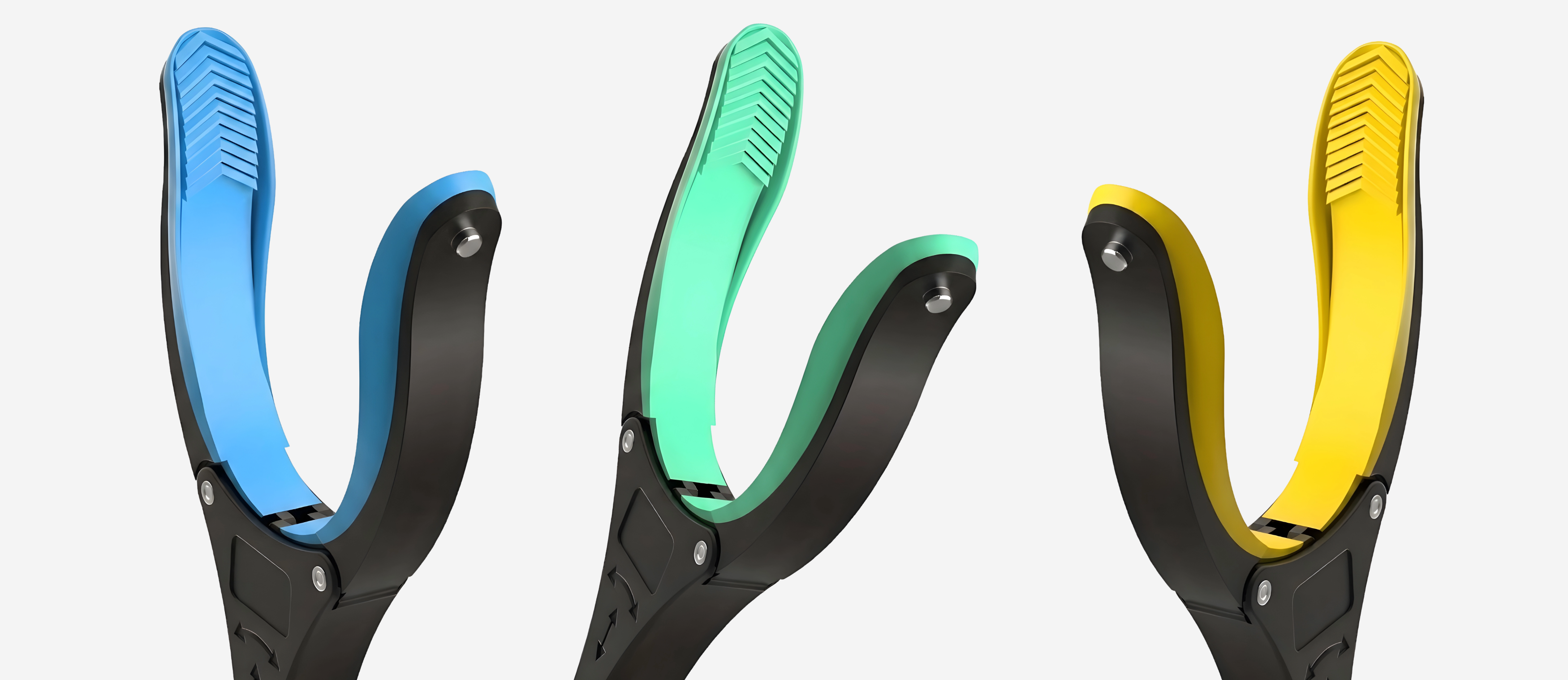
Keys on a hardwood floor are a specific kind of problem. The rubber jaw of a standard grabber tool cannot get under a flat key ring lying flush with a smooth surface — the jaw needs something to close around, and a flat key ring offers nothing. This is the scenario the magnetic tip exists to solve. It is not a gimmick feature; it addresses a real and recurring limitation of the jaw mechanism for a specific object class.
Direct answer: the magnetic tip on a GrabbersTool reacher picks up any ferrous metal object resting on a surface — keys, coins, bobby pins, screws, metal utensils, small steel tools, medication blister packs with foil backing. It works when the jaw mechanism cannot get under or around a flat object. It does not work for non-ferrous metals (aluminum, copper, most stainless steel alloys used in cookware) or for any non-metal object.
The Jaw Mechanism Limitation It Solves
The rubber jaw on a grabber tool works by closing around an object — the jaw profile needs clearance on at least two sides of the object to grip it. For a dropped coin, a flat key, or a bobby pin on a smooth floor, there is no clearance. The jaw approaches, contacts the flat surface, and cannot close around the object because the object does not project enough above the floor to provide grip surfaces.
The magnetic tip bypasses this entirely. The tip does not close around the object — it attracts and holds it magnetically. No clearance required. The user approaches, the tip contacts the metal object, and the magnetic force holds it during retrieval.
Objects the Magnetic Tip Handles Well
- Keys — the most common use case. Steel key rings and most household keys are ferrous and respond well to a standard magnet pull force
- Coins — composition varies by currency; most steel-core coins used in the UK and many European countries are magnetic; US coins are not (copper/nickel alloy)
- Screws, nails, small fasteners — workshop floor retrieval; the most practical use case in non-medical contexts
- Bobby pins and hair clips — flat, impossible to jaw-grip on a floor; magnetic tip handles these easily
- Medication strip backing — foil-backed blister packs that are partially ferrous
- Metal utensils — if dropped and lying flat on the floor
Objects the Magnetic Tip Does Not Handle
| Object | Why Magnetic Tip Fails | Alternative |
|---|---|---|
| US coins (pennies, nickels, quarters) | Copper/nickel alloy — not ferrous | Jaw grip or precision grabber |
| Aluminum can | Aluminum is non-ferrous | Jaw grip — jaws close around can body |
| Stainless steel cookware | Most 18/8 and 18/10 stainless alloys are non-magnetic | Jaw grip on handle or rim |
| Plastic objects | Non-metal — no magnetic interaction | Jaw grip |
| Glass | Non-metal | Jaw grip with care |
| Heavy steel items (tools, etc.) | Weight may exceed magnetic retention | Jaw grip, or two-step approach |
The magnetic tip pull force specification for GrabbersTool models — which determines the maximum weight of metal object the tip can reliably retain during retrieval — is published on the product page. This specification determines whether the magnetic tip is suitable for heavier metal objects. View 32" model specifications → | View 43" model specifications →
Using the Magnetic Tip Correctly
The magnetic tip is located at the jaw tip — the same point that contacts objects during jaw-grip retrieval. When using the magnetic tip:
- Approach the metal object with the jaw open — a closed jaw still allows magnetic contact at the tip, but an open jaw provides better approach visibility
- Lower the tip directly onto the metal object — contact triggers magnetic hold
- Lift slowly and vertically — horizontal acceleration during lifting can break magnetic hold on lighter objects
- Transfer to a surface before releasing — set the object on a table or counter, then lower the tool to the surface so the object rests before the magnetic contact is broken by distance
When the Magnetic Tip Matters Most for Daily Independence
For GrabbersTool customers managing post-surgical recovery or ongoing mobility limitations, the highest-frequency magnetic tip use case is keys. A dropped key ring in the entryway — the moment of returning home, already fatigued — without a tool that can pick it up from the floor is a specific, recurring problem.
The combination of jaw grip (for most objects) and magnetic tip (for flat ferrous metal objects) covers the full range of dropped item scenarios without any case where the user must bend or call for assistance. This is why GrabbersTool includes the magnetic tip on all reacher models — not as a promotional feature, but because it covers the gap in jaw-grip capability for a specific and common object class.
The Precision Grabber Alternative for Small Objects
For small objects in confined spaces — items that fell into a narrow gap, or very small objects on carpeted surfaces where the magnetic tip may not make clean contact — the Precision Grabber Tool 33" provides a narrower jaw profile that can enter gaps and close around objects that a standard-width jaw cannot reach.
See also: 7 Mistakes People Make When Using a Grabber Tool for technique guidance, and What Is the Difference Between a Reacher and a Grabber Tool for the broader feature context.
Browse the Reacher Grabber Tools collection to compare all GrabbersTool models and their specifications.


