

Choosing the right reacher grabber for a medical condition requires understanding three primary specifications: length (reach distance), jaw type (what it can grip), and trigger mechanism (how the jaw closes). These specifications interact with the patient's specific functional limitation: a post-THA patient needs a different configuration than an MS patient with tremor or an arthritis patient with reduced grip strength. Occupational therapists routinely prescribe reachers as part of adaptive equipment programs, and this guide covers the specification decisions that most affect clinical utility.
Direct answer: For most medical uses (hip replacement hip precautions, lumbar surgery, arthritis, neurological conditions), choose a 32-inch rubber jaw reacher with a pistol-grip trigger. The 32-inch length is the clinical standard for hip precaution sock and shoe retrieval while seated. The 43-inch is recommended for bariatric patients, tall patients, or those with severe trunk mobility restriction. See the GrabbersTool reacher collection for both length options.
Reacher Grabber Specification Decision Guide
| Patient Condition | Recommended Length | Recommended Jaw | Key Feature |
|---|---|---|---|
| Total hip replacement hip precautions (standard BMI) | 32 inches -- the standard OT prescription length for THA; allows sock retrieval from the floor while seated without violating 90-degree hip flexion precaution | Rubber grip dual-surface jaw -- must pick up socks, underwear, shoes, and household items | Locking jaw feature to hold items during transfer from floor to hand; lightweight (under 10 oz) for daily repeated use during the 6-8 week restriction period |
| Total hip replacement hip precautions (bariatric or tall patient) | 43 inches -- longer reach compensates for greater floor-to-seated-hand distance in taller or bariatric patients; the 32-inch may be insufficient for floor retrieval in a tall patient | Rubber grip jaw -- same functional requirements as standard THA | Heavier construction to maintain structural integrity at longer length; same daily use requirements |
| Lumbar spinal fusion (L4-L5, L5-S1) | 32 inches for most patients; 43-inch may be preferred for those with severe extension restriction | Rubber grip jaw | Low trigger activation force -- post-surgical fatigue and pain reduce hand strength during the restriction period; lightweight reacher |
| Rheumatoid arthritis or osteoarthritis (hand and wrist) | 32 inches for most indoor use | Rubber grip jaw | Low trigger activation force -- arthritis patients cannot generate high grip force to close a stiff jaw; ergonomic pistol-grip handle; trigger should close with less than 2 pounds of force |
| Parkinson disease or essential tremor | 32 inches standard | Rubber grip jaw with textured surface -- tremor reduces positional accuracy; larger rubber jaw surface area compensates for inaccurate positioning | Locking jaw to secure the item after grasping (tremor may release the trigger during transfer); lightweight reacher reduces tremor amplification from distal weight |
| Multiple sclerosis (fatigue and weakness) | 32 inches for most; 43-inch if trunk mobility severely restricted | Rubber grip jaw | Lightweight construction (fatigue means even small weights become significant over time); low activation force trigger for hand weakness |
The Single Most Important Feature: Jaw Grip Reliability
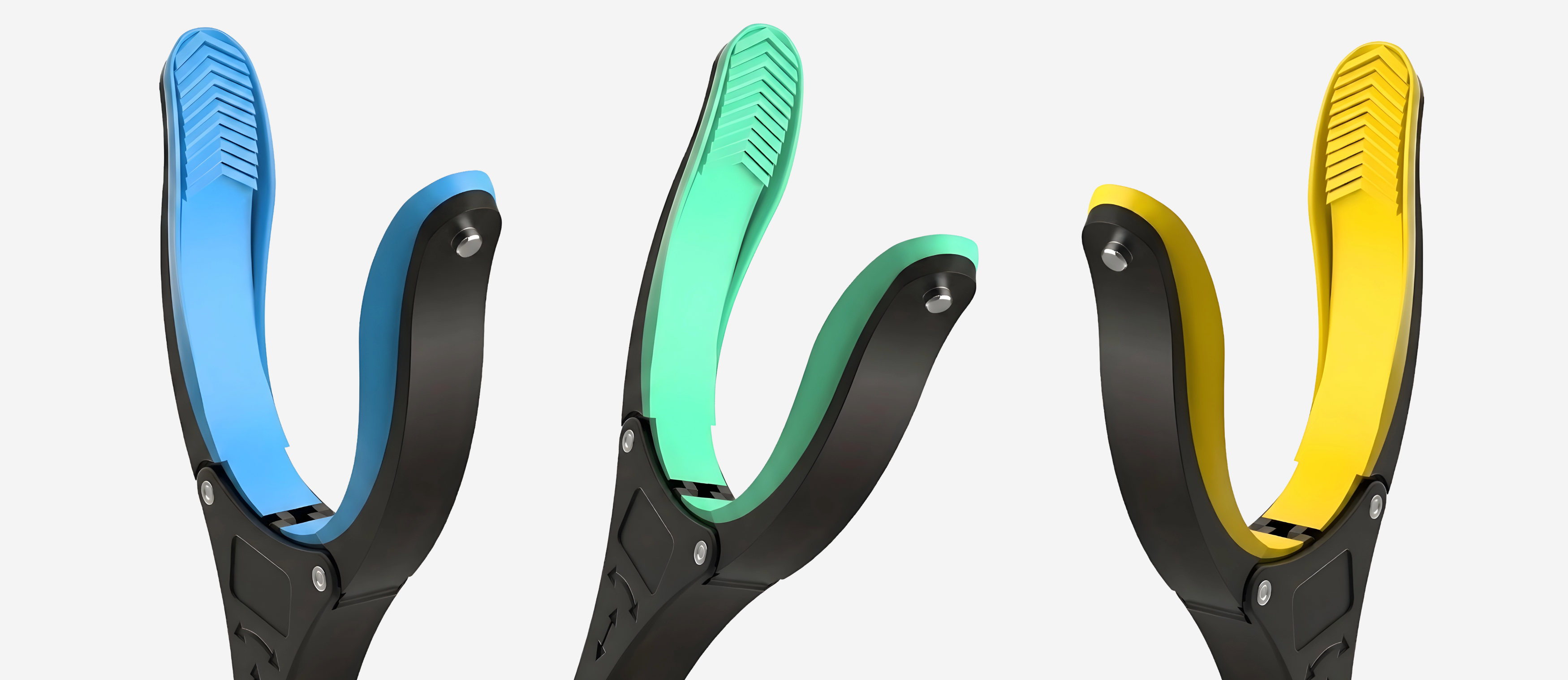
Regardless of length or trigger mechanism, a reacher is only as useful as its jaw reliability. A reacher that drops items defeats the purpose. The GrabbersTool 32-inch Reacher and 43-inch Reacher use dual-surface rubber jaws designed for the repeated daily use demands of medical rehabilitation. See the full reacher collection to compare both options.


