

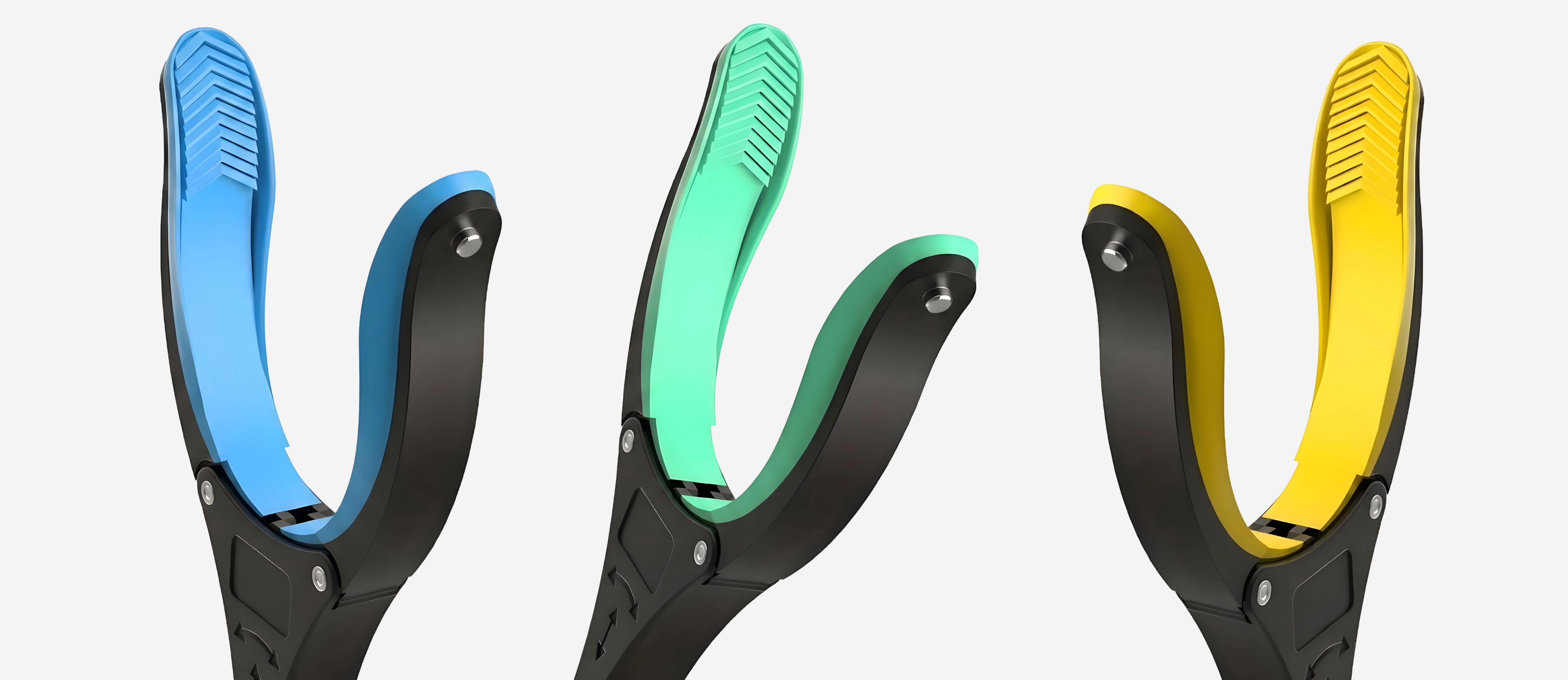
Reacher grabber jaw design is the most functionally important specification for clinical use. The jaw determines what objects can be reliably picked up, how much grip strength is required to use the reacher, and whether the reacher can be used safely with arthritic or weakened hands. Occupational therapists selecting reachers for patients post-total hip arthroplasty, post-lumbar fusion, or with arthritis must understand the functional differences between jaw types. Four main jaw designs are available: rubber grip jaws, magnetic jaws, suction cup jaws, and claw/hook jaws. Each has specific applications and limitations in the clinical adaptive equipment context.
Direct answer: For clinical medical use -- hip replacement, arthritis, MS, Parkinson disease, spinal surgery -- the rubber grip jaw is the standard recommendation. It grips the widest range of objects (clothing, food packaging, small items) with reliable contact friction. The GrabbersTool 32-inch Reacher uses a dual-surface rubber jaw designed for clinical daily use.
Reacher Grabber Jaw Type Comparison
| Jaw Type | How It Works | Best For | Not Recommended For |
|---|---|---|---|
| Rubber grip jaw (dual-surface) | Both jaw faces are covered in textured rubber; object is gripped between the two rubber surfaces using friction; works on clothing, food packaging, soft items, small objects, and most household items | Hip replacement hip precautions; post-surgical dressing retrieval; arthritis daily use; Parkinson disease; MS; general ADL use; the clinical standard for most occupational therapy prescriptions | Very small metal objects (coins, needles) which are too thin for the jaw gap; very heavy objects beyond the reacher weight capacity (typically 5-6 pounds maximum) |
| Magnetic jaw | Permanent magnet embedded in the jaw tip attracts ferromagnetic metal objects; picks up metal objects without requiring jaw closure force | Retrieving metal objects from the floor (coins, keys, metal utensils); useful for users with very weak grip who cannot generate jaw-closure force; specific occupational use where metal retrieval is the primary need | Non-metal objects (clothing, food packaging, plastic items -- the majority of ADL retrieval needs); not a general-purpose medical reacher; inappropriate as the sole reacher for hip precautions or arthritis (will not pick up clothing) |
| Suction cup jaw | Suction cup tips create temporary suction on smooth flat surfaces; requires a smooth, clean surface for suction to develop | Picking up smooth flat objects (glass jars with flat lids, flat plates, smooth tile items); specific table-surface retrieval | Clothing and fabric (no suction); rough or porous surfaces; any surface with moisture or debris; most real-world ADL retrieval (the vast majority of dropped items do not have smooth flat surfaces suitable for suction); generally not recommended as the clinical standard reacher |
| Claw or hook jaw | Rigid claw or hook that inserts under or around an object to lift it; does not close to grip | Hanging and lifting loop-handle items (shopping bags, clothing hangers); hooking items by a handle or loop | Objects without a loop, handle, or ledge to hook under; general ADL retrieval (most items cannot be hooked); not appropriate for clinical hip precaution or post-surgical use as the primary reacher |
Which Jaw Type Do Occupational Therapists Recommend?
For post-THA hip precautions, lumbar surgery recovery, MS, Parkinson disease, and arthritis ADL use, occupational therapists consistently recommend rubber grip jaw reachers. The rubber jaw grips the widest range of items -- socks, underwear, shoes, food packages, dropped utensils -- that constitute the real-world retrieval needs during recovery. See the GrabbersTool 32-inch Reacher (rubber jaw) and 43-inch Reacher for clinical-grade rubber jaw options.


