

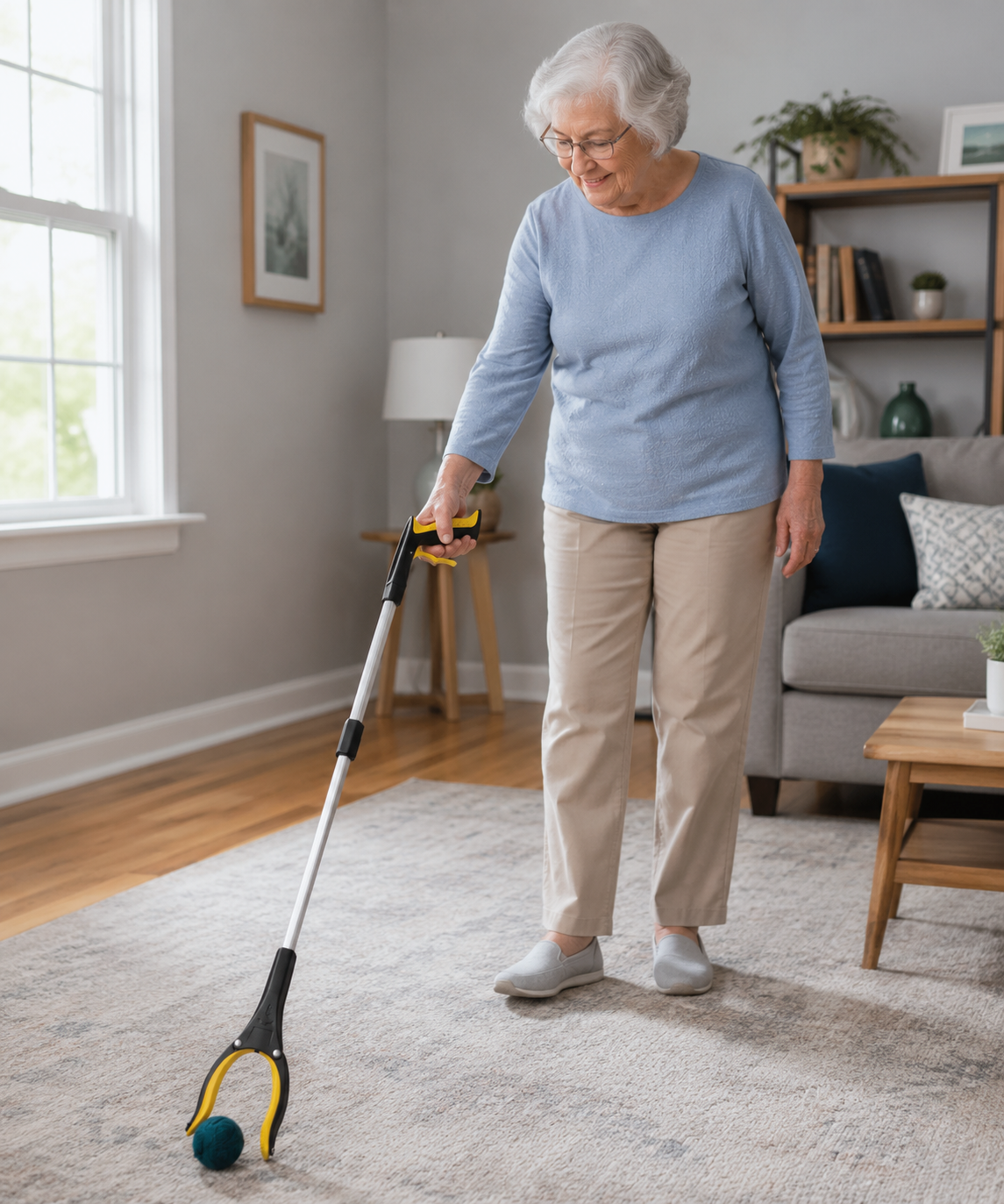
The most common frustration reported by new reacher grabber users is difficulty picking up small objects — coins, pills, folded paper, keys. This frustration leads to one of two incorrect conclusions: either the tool is not capable of picking up small items (wrong), or the user has not learned the correct technique (correct). A standard reacher grabber jaw is designed for objects as small as a coin when the correct approach angle and jaw position are used. Most new users approach small objects from above with an open jaw — which crushes or deflects the object rather than gripping it.
Direct answer: the correct technique for picking up small flat objects with a reacher grabber is: approach the object from the side rather than from above, position one jaw edge alongside the object at floor level, close the jaw while the object is between the jaw faces rather than between the jaw faces and the floor, and lift once the jaw has closed fully. For very small or flat objects (coins, keys), the GrabbersTool Precision Grabber with its narrower jaw profile is more effective than the standard reacher jaw. Objects too flat for any jaw (credit cards, single sheets of paper) require the magnetic tip variant or a different pickup method.
Object Categories and the Appropriate Technique
Category 1: Small Rounded Objects (Pills, Small Balls, Marbles)
Small rounded objects are among the easiest for the reacher jaw despite their size: the rounded profile allows the jaw to compress slightly around them, creating a grip that holds even when the jaw does not close completely. Technique:
- Position the jaw opening horizontally over the object (not vertically approaching from the side)
- Lower the jaw until one jaw face contacts the floor surface alongside the object
- Close the jaw — the object will be captured between the two jaw faces
- Lift smoothly and vertically — avoid lateral movement before the object is clear of the floor
Category 2: Flat Objects (Coins, Keys, Paper Clips)
Flat objects are the most technically demanding for a standard reacher jaw because there is minimal height for the jaw to grip below the object. Two approaches:
Side approach: Position the jaw opening parallel to the floor and slide the jaw approach from one side, so the jaw closes on the coin edge (the thicker dimension) rather than the flat surface. Works when the object is against a baseboard or on a slightly rough surface where it does not slide away from the approach.
Magnetic tip approach: For metal flat objects (coins, keys, small metal tools), the magnetic tip on some reacher grabber models makes flat object retrieval trivial — the magnet contacts the flat surface of the object, no jaw precision required. The GrabbersTool Reacher Grabber magnetic tip option addresses exactly this scenario.

Category 3: Small Cylindrical Objects (Pen, Marker, Lipstick)
Small cylinders are straightforward: the jaw closes around the cylinder diameter. The challenge is orientation — if the cylinder is lying parallel to the jaw opening, one jaw can roll underneath and the other grips the top surface. Technique: approach so the jaw faces are perpendicular to the cylinder axis (approaching from the side of the cylinder rather than from the end).
| Object Type | Approach Method | Recommended Tool |
|---|---|---|
| Small pills and capsules | Overhead with jaw horizontal | Precision Grabber for smaller items |
| Coins (metal) | Magnetic tip or side approach | Reacher Grabber with magnetic tip |
| Keys | Magnetic tip (metal keys); side approach | Reacher Grabber with magnetic tip preferred |
| Paper clips, pins | Magnetic tip | Reacher Grabber with magnetic tip |
| Small bottles (pills, eye drops) | Standard jaw — overhead | Reacher Grabber standard jaw |
| Folded paper, cards | Side or pinch approach; magnetic tip not applicable | Precision Grabber for thicker items; thin paper may require alternative |
The Precision Grabber jaw profile dimensions and the magnetic tip specifications for the standard reacher grabber are on their respective product pages. The magnetic tip field strength determines which metal objects it reliably retrieves — detailed on the product page. View Precision Grabber specifications | View 32" Reacher Grabber magnetic tip specifications
Practice Makes Precision
Reacher grabber technique improves with practice, and the first week of use typically involves some dropped objects that are retrieved on the second or third attempt. GrabbersTool recommends practicing small object pickup on the floor with intentionally dropped objects before relying on the technique for medication retrieval or other high-consequence scenarios. A 10-minute practice session with a coin, a pen, and a small bottle builds the technique faster than encountering each object type for the first time in a stressful moment.
For users whose first use context is surgical recovery — where floor retrieval is immediately critical — establishing technique during the first few days at home is the correct approach, not waiting until technique is needed and discovering the limitation for the first time.
See also: Magnetic Tip Reacher Grabber: What It Does and When You Need It and Small Object Pickup With a Reacher Grabber: Technique and Tool Selection.
Browse the full reacher grabber range at Reacher Grabber Tools.


