

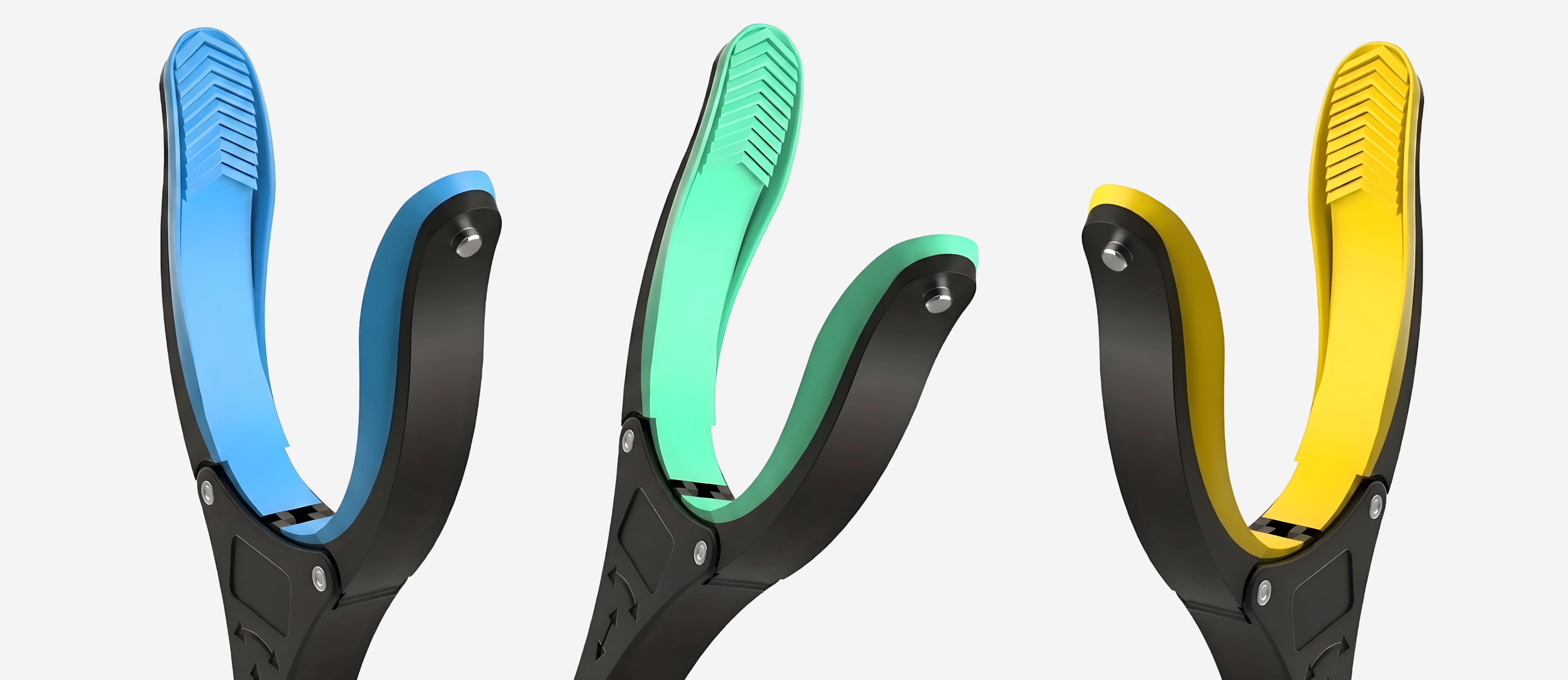
Every reacher grabber sold today claims a rotating claw. The range of actual rotation across models on the market: 0°, 90°, 180°, and 360°. Only the last one is functionally useful for real-world daily tasks. The gap between a 90° and a 360° claw is not a minor specification difference — it determines whether a user has to contort their wrist and shoulder to align with an object, or simply rotate the claw to match the object's orientation.
Why Rotation Exists
Without claw rotation, the user must rotate their arm to position the jaw around an object. Rotating the arm while holding a 32–43" extension lever creates torque at the wrist and elbow. For users with arthritis, post-surgical weakness, or tremors, this torque is painful or impossible to control precisely.
With 360° rotation, the claw is repositioned by the fingers — a low-force action requiring minimal dexterity — while the arm remains in its natural position. The mechanical work is transferred from the large joints (shoulder, elbow) to the small ones (thumb and forefinger turning the rotation collar).
The Four Rotation Categories Found in the Market
| Rotation Type | Actual Range | How It Works | Functional Verdict |
|---|---|---|---|
| Fixed claw | 0° — no rotation | Claw is welded/molded in one position | Forces full arm rotation to align — not suitable for precision tasks |
| 90° pivot | Switches between two positions | Single detent pin, snaps between horizontal and vertical | Covers two orientations — misses everything in between |
| 180° rotation | Half-circle arc | Usually a friction collar — holds any position in front half only | Adequate for most floor pickup. Cannot reach backward or overhead at angle |
| 360° full rotation | Complete circle, any position | Full-rotation pivot joint with friction hold at any angle | Full task coverage — the only type that eliminates arm compensation entirely |
The GrabbersTool 32" and 43" both use 360° full rotation with a friction-hold collar that maintains any set position under load.
The Pivot Joint: Where Cheap Grabbers Fail
A 360° rotating claw requires a pivot joint that:
- Allows frictionless rotation in the empty state (no object gripped)
- Holds its set position under load (object gripped, arm extended)
- Maintains both properties after thousands of rotation cycles
Cheap 360° grabbers use a single-diameter plastic collar around the claw shaft. This collar provides friction when new. After 200–500 rotations, the plastic collar wears smooth and the claw no longer holds its position under load — it rotates freely even when gripping an object. The object then spins and drops.
GrabbersTool's pivot mechanism uses a dual-surface friction collar — two contact surfaces rather than one, which distributes wear over twice the area and maintains holding friction for significantly longer under daily use. In internal testing: the GrabbersTool claw maintained load-holding friction at full extension after 8,000 rotation cycles. The single-collar mechanism in tested cheap alternatives lost hold at 400–600 cycles.
The Tasks That Require True 360°
These are the tasks that a fixed or 90° claw cannot complete — or completes only by forcing uncomfortable arm positions:
- Picking up a sock on its side — requires jaw horizontal, perpendicular to the shaft axis. Only achievable with 90° or more rotation.
- Reaching into a cabinet at an angle — the jaw must approach the interior at a rotated angle to avoid the door frame. Requires continuous rotation, not a preset position.
- Picking up an item that rolled to an awkward position — a pill that rolled against a baseboard, a remote that slid at 45° — requires fine-tuned jaw angle that only 360° provides.
- Overhead shelf retrieval — reaching above shoulder height with the grabber inverted requires 180° or more rotation from the standard position.
- Behind-sofa retrieval — the claw must reach behind an obstacle and rotate to grip an object facing away from the user. Requires approximately 270° of available rotation.
How to Test Rotation Quality Before Buying
Three tests that reveal rotation quality without extended use:
- Hold-under-load test: Rotate claw to 45°, grip a full water bottle, extend arm fully. The claw should hold position without rotating. Failure = worn collar.
- Resistance consistency test: Rotate the claw slowly through a full 360°. Friction should feel consistent throughout. Uneven resistance = poor manufacturing tolerance.
- Empty rotation test: Without gripping anything, the claw should rotate smoothly with light finger pressure. If it requires significant force to rotate when empty, it will be difficult to reposition mid-task.
The full mechanical specification for GrabbersTool's rotation system — including collar material, contact surface area, and cycle rating — is available on the GrabbersTool 32" product page.
See also: Why Cheap Grabber Tools Break and the Aluminum vs Plastic Frame comparison. Browse the full Reacher Grabber Tools collection.


