

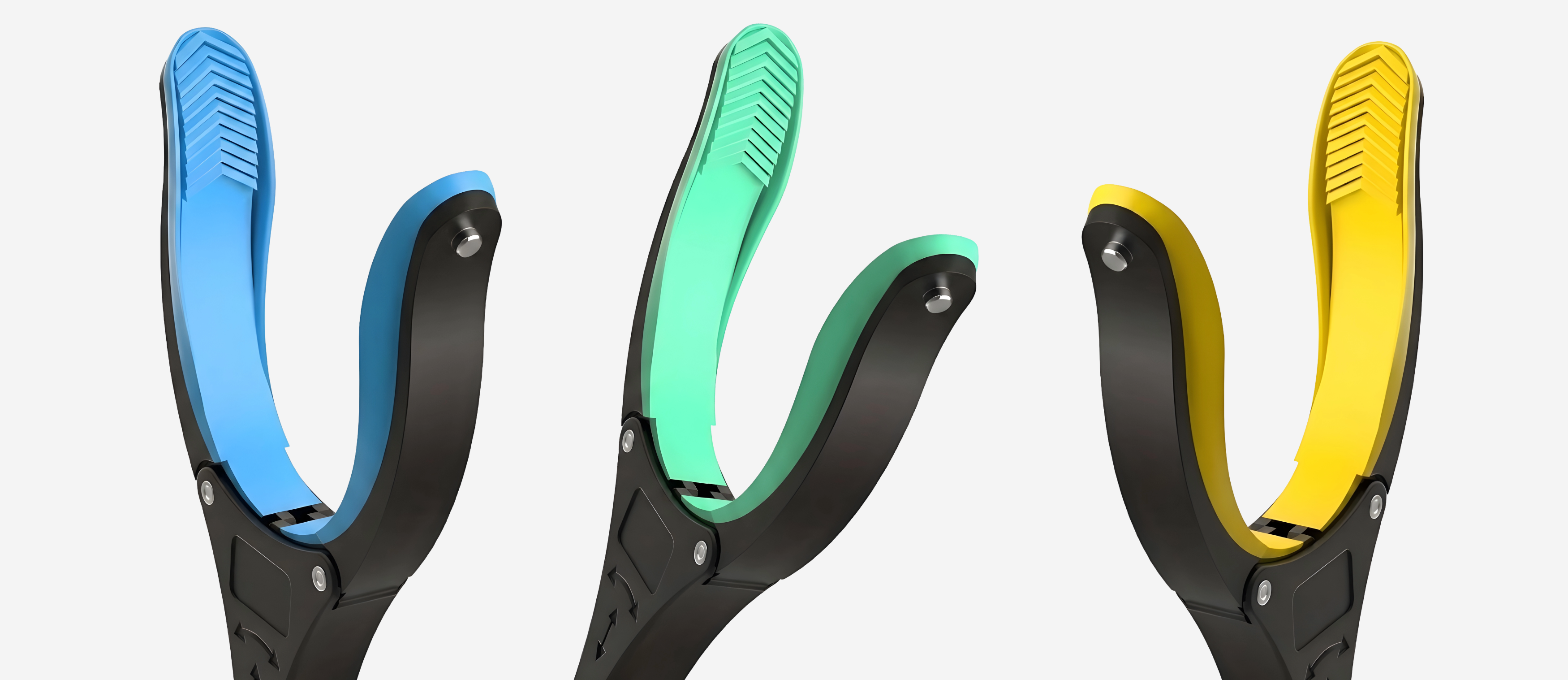
Hospitals hand out hip kits in a sealed plastic bag, and most patients open that bag for the first time at home, sore, medicated, and already needing the contents. Almost nobody is told which of the four tools they will actually reach for twenty times a day and which one will sit unused in a drawer.
Direct answer: A hip kit is a bundle of four adaptive tools that let you dress and pick things up without bending your hip past ninety degrees after hip replacement or hip fracture surgery. The standard contents are a reacher grabber, a sock aid, a long-handled shoehorn, and a long-handled bath sponge. Of the four, the reacher grabber does the most work by a wide margin, because it is the only piece used continuously all day rather than once during dressing.
What is inside a standard hip kit
| Tool | What it does | Times used per day |
|---|---|---|
| Reacher grabber | Retrieves anything below knee height: dropped phone, socks, laundry, mail, remote. Also pulls clothing up. | Continuously, often 15 to 30 times |
| Sock aid | Puts socks on without reaching your feet | Once or twice |
| Long-handled shoehorn | Slides shoes on while standing upright | Once or twice |
| Long-handled sponge | Washes feet and lower legs while seated | Once daily at most |
Some kits add a dressing stick, elastic shoelaces, or a leg lifter strap. Those additions are useful for specific patients, but the four items above are the core that occupational therapists consider standard.
Why the reacher is the piece that matters
The other three tools solve dressing, which happens at fixed moments you can plan around. The reacher solves everything unplanned, and unplanned events are what actually break a recovery routine.
Things fall. A phone slips off the arm of a chair. A sock misses the laundry basket. Mail hits the floor. Each of those moments, without a reacher, becomes either a violated hip precaution or a call for help. The GrabbersTool support team hears the same sentence repeatedly from post-surgical customers: the sock aid was used twice a day, the reacher never left their hand.
This is also why length is the specification that decides whether a kit works. Many prepackaged hospital kits include a short reacher, typically around twenty six inches, chosen because it fits the bag. A short reacher still requires a forward lean to touch the floor from standing, which is exactly the motion your surgeon prohibited.
This is the single detail that determines whether your kit succeeds. A reacher long enough to touch the floor with your back straight means zero bending. A reacher two inches too short means you lean, every single time.
The 43 inch Reacher Grabber is the length occupational therapists use for standing floor access. Complete length, weight, and jaw specifications are on the product page, and the size calculator confirms the correct model for your height in two questions.
What prepackaged kits get wrong
- Reacher too short. Bag-sized reachers fail the standing floor test for most adults.
- Weak jaw pads. Bargain kit reachers drop socks and paper, the two items you retrieve most.
- Heavy shafts. You may be operating the reacher with one hand while the other holds a walker. Weight matters more than buyers expect.
- Single reacher. One tool cannot be upstairs and downstairs at the same time, and the moment you need it is never the moment you have it.
The last point is the most practical upgrade to any hip kit. Two reachers, one on each floor or one beside the bed and one beside the chair, removes almost every unassisted bend from the day. A 32 inch model works well as the second unit for seated retrieval.

Building a better kit than the hospital version
| Need | Standard kit item | Stronger choice |
|---|---|---|
| Floor access from standing | Short reacher, around 26 inches | 43 inch Reacher Grabber, $45.99 |
| Seated retrieval near the chair | Not included | 32 inch Reacher Grabber, $35.99 |
| Pills, keys, small objects | Standard wide jaw, drops small items | Precision Grabber 33 inch, $29.99 |
| Getting out of chairs and bed | Not included | Standing Assist Tool, $47.99 |
| Walking support after the walker | Not included | Walking Cane, $79.50 |
Sock aids, shoehorns, and long sponges are inexpensive and widely available; the hospital versions of those three are usually adequate. The reacher is where quality changes the outcome, because it is the tool under constant load.
When to assemble your kit
One to two weeks before surgery. Two reasons. First, practicing with a reacher and a sock aid is far easier while you can still bend freely, and technique matters more than people expect. Second, the day you come home is the day you need every piece already unpacked and positioned.
Position matters as much as ownership. A reacher in the hall closet is not a reacher you have. Keep one within arm reach of the bed, the recovery chair, and the bathroom door.
Free interactive checklist. Our Hip Replacement Recovery Kit Checklist covers all twenty items across dressing, bathroom, mobility, and kitchen, saves your progress automatically, and prints in one click for the refrigerator door.
Related reading
- Best grabber tool after hip replacement surgery
- How to put on socks and shoes without bending
- Getting dressed with a reacher: socks, shoes, and pants
Frequently asked questions
What is a hip kit?
A hip kit is a bundle of adaptive tools that allow dressing and object retrieval without bending the hip past ninety degrees after hip surgery. The standard contents are a reacher grabber, a sock aid, a long-handled shoehorn, and a long-handled bath sponge.
Does the hospital give you a hip kit?
Many hospitals provide a basic kit at discharge, but not all, and contents vary. Ask your surgical coordinator before the operation. If a kit is provided, check the reacher length, since bag-sized reachers are often too short for standing floor access.
What length reacher should be in a hip kit?
43 inches for standing floor access without leaning. Shorter reachers around 26 to 32 inches work from a seated position but still require a forward lean when used standing, which conflicts with hip precautions.
How long do you need a hip kit after surgery?
Most patients use the kit intensively for six to twelve weeks, matching the standard bending restriction period. The reacher typically stays in use permanently because floor retrieval remains easier with it than without.
Are hip kits covered by insurance?
Original Medicare does not cover reachers, sock aids, or dressing tools because they are classified as self-help devices. Medicare Advantage OTC allowances, HSA and FSA accounts, Medicaid waivers, and VA benefits often do. See our full explanation of Medicare coverage for reacher grabbers.
This article describes commonly issued adaptive equipment and is not medical advice. Hip precautions vary by surgical approach and by patient. Your surgeon and occupational therapist are the authority on what movements and equipment are appropriate for you.


