

Quick answer
Judge a reacher grabber on five specifications: length, jaw pad material, trigger force, jaw rotation, and weight. Length decides whether the tool solves your problem at all. Jaw pad material decides whether it holds fabric. Trigger force decides whether you keep using it. Everything else, including lights, extreme lengths, and multi-packs, is secondary.
Key takeaways
- Research on assistive technology found 29.3% of devices were completely abandoned, and mobility aids were abandoned more often than other categories.
- The top predictor of abandonment was that the user was not consulted in choosing the device, which is why the person using the reacher should pick it.
- Silicone or rubberized jaw pads hold fabric. Hard plastic slides off it.
- A trigger needing a full-hand squeeze is the most common reason a reacher ends up unused in a drawer.
- Buy the length you need before spending on any other feature; length is cheap and decisive.
Why most reacher buying advice misses the point
The specification that matters most is not the one that performs best in a store demonstration. It is the one that determines whether the tool is still in use six months later.
This is measurable. In a survey of 227 adults with disabilities published in Assistive Technology, Phillips and Zhao (1993) found that 29.3% of assistive devices were completely abandoned, that mobility aids were abandoned more frequently than other device categories, and that abandonment peaked during the first year of use. More recent European studies have reported abandonment in a similar range, from roughly 18% to 20%.
The four factors significantly associated with abandonment in that study were: lack of consideration of the user opinion in selection, easy device procurement, poor device performance, and a change in the user needs or priorities.
The practical conclusion: the most common reason adaptive equipment fails is not that it broke. It is that it did not suit the person, and the person was not the one who chose it.
If you are buying a reacher for a parent, involve them in the choice, and prioritize how the trigger feels in their hand over any feature on the box. A tool that is technically superior but uncomfortable to squeeze is a tool that will not be used.
The five specifications that actually matter
1. Length, and it outranks everything else
Length determines whether the tool can do the job at all. Every other specification only affects how pleasantly it does it.
Measure from your relaxed hand to the floor while standing upright in your normal shoes. That distance is the reach you need for floor pickup without leaning. For most adults it means 43 inches; a 32 inch tool typically still requires a small forward lean when used standing, which matters greatly if avoiding the lean is the entire point.
| Primary use | Length | Why |
|---|---|---|
| Floor pickup while standing | 43 inches | Clears the floor with a straight back |
| Seated or wheelchair use | 43 inches | Horizontal reach matters more than height |
| Bedside, chairside, close control | 32 inches | Shorter shaft is easier to steer at close range |
| Pills, coins, small items | Precision jaw | Wide jaws built for cans slip on small round objects |
The free size calculator settles this in two questions, and the 32 inch versus 43 inch comparison covers the trade-off in depth.
2. Jaw pad material: silicone versus hard plastic
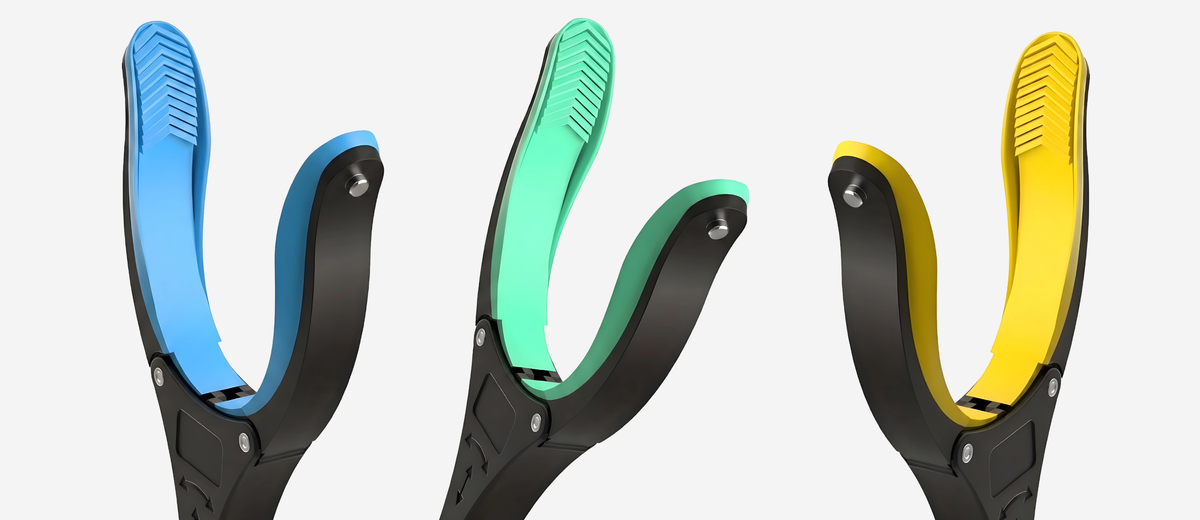
Silicone or rubberized jaw pads grip fabric, paper, and smooth plastic. Hard plastic jaws slide off all three.
This is the specification buyers most often overlook and most often regret, because the difference is invisible in a photo and irrelevant on rigid objects. A hard plastic jaw picks up a soda can perfectly well. Then it fails on a sock, and socks are what people actually drop.
The physics is simple: fabric deforms under pressure, so grip depends on surface friction rather than clamping force. Squeezing harder does not help; a softer, higher-friction pad does. If the listing does not state the pad material, assume hard plastic.
3. Trigger force
A reacher is used dozens of times a day, so the force required per squeeze compounds. Budget triggers demand a full-hand squeeze. Better mechanisms use cable and lever geometry that closes the jaw with roughly one finger of pressure.
For anyone with arthritis, this is not a comfort preference. It is the specification that decides whether the tool remains in use, which links directly back to the abandonment research above. When testing, squeeze the trigger twenty times in a row rather than once. Fatigue reveals what a single test does not.
4. Jaw rotation
A rotating jaw turns to match the object so your wrist does not have to. A fixed jaw forces you to rotate your forearm into awkward positions, which is exactly the movement people with shoulder, elbow, or wrist problems are avoiding.
Full 360 degree rotation is meaningfully better than a 90 degree detent, particularly for retrieving flat objects such as phones and mail that need a horizontal jaw, and round objects such as bottles that need a vertical one.
5. Weight
Weight is judged at arm length, not in the hand. A tool that feels light on a shelf feels different when held horizontally at full extension, because leverage multiplies the perceived weight.
This matters most for people using a walker or cane with the other hand, where the reacher must be operated one-handed while balance depends on the opposite arm. Under 200 grams is a reasonable benchmark for an aluminum tool of standard length.
Lightweight or heavy duty: which do you need?
Almost everyone shopping for home use needs lightweight. Heavy duty is a category built for commercial litter crews, and the extra mass works against you in daily household use.
| Lightweight reacher | Heavy duty reacher | |
|---|---|---|
| Built for | Daily household retrieval, dressing, shelves | Commercial litter pickup, rough outdoor work |
| Fatigue over a day | Low | Noticeable, especially one-handed |
| Fine control | Better | Coarser |
| Suits arthritis | Yes | Often not, triggers are stiffer |
| Right choice for | Seniors, post-surgery, home use | Grounds crews, wet or sharp debris, all-day shifts |
If you searched for a heavy duty grabber because a previous tool broke, durability rather than mass is what you actually want. Those come from jaw pads, trigger cable quality, and shaft wall thickness, not from a heavier tool. Our breakdown of why cheap grabber tools break covers which parts fail first.
What matters less than the marketing suggests
- Built-in LED lights. Dimmer than a phone flashlight and they add weight to a tool held at arm length.
- Lengths beyond 43 inches. Control degrades as reach grows. Very long tools serve litter crews, not homes.
- Magnetic tips, unless you drop metal. Genuinely useful for keys, coins, and pins; irrelevant otherwise. Judge it by your own habits.
- Multi-packs. Two mediocre tools are worth less than one good tool plus one cheap spare on the other floor.
- Stated weight capacity. Rarely tested consistently between brands, so it is hard to compare meaningfully across listings.
Which reacher grabber is right for me?
Work through these in order. The first question that applies to you sets the answer.
- Do you have bending restrictions from surgery, or cannot bend at all? Choose 43 inches. Precautions rule out the lean a shorter tool requires. See our guide to reachers after hip replacement surgery.
- Do you use a wheelchair or spend most of the day seated? Choose 43 inches for horizontal reach.
- Is hand strength or arthritis your main limitation? Prioritize trigger force and silicone pads over length, then pick the shortest length that reaches what you need.
- Are you mainly retrieving small objects such as pills and coins? Choose a precision jaw model.
- None of the above, general household use? A 32 inch reacher handles most tasks with the best close control; the 43 inch is the safer default if you are unsure.
Full specifications for each model are on the individual product pages, and the reacher collection shows them side by side. For what the market charges at each quality tier, see how much a reacher grabber costs.
Frequently asked questions
What should I look for in a reacher grabber?
Five specifications, in order of importance: length sufficient to reach the floor without leaning, silicone or rubberized jaw pads, a trigger that closes with about one finger of pressure, a rotating jaw, and low weight for use at full extension. Length outranks the rest because it determines whether the tool works at all.
What makes a good reacher grabber?
One that is still being used a year later. That depends less on any single feature than on fit between the tool and the person, which is why the user should be involved in choosing it. Research on assistive technology identifies lack of user involvement in selection as a leading predictor of abandonment.
Are silicone jaws better than plastic on a grabber?
Yes for fabric, paper, and smooth plastic. Silicone and rubberized pads grip through surface friction, while hard plastic slides off deformable materials such as clothing. On rigid items like cans the difference is minimal, which is why it is easy to overlook when testing in a store.
What is the easiest grabber to squeeze?
One using a cable and lever trigger that closes with roughly one finger of pressure rather than a full-hand squeeze. Test by squeezing twenty times in succession, since a single squeeze does not reveal how the mechanism feels during real use.
Is a rotating grabber better?
For most users yes. A rotating jaw turns to match the object instead of requiring you to rotate your wrist, which helps considerably if you have shoulder, elbow, or wrist limitations. Full 360 degree rotation is more useful than a fixed 90 degree detent.
Do I need a heavy duty reacher grabber?
Probably not for home use. Heavy duty models are designed for commercial litter collection, and the additional mass causes fatigue during everyday household use. If your concern is that a previous tool broke, look at jaw pads, trigger cable, and shaft quality rather than overall weight.
How do I choose a reacher for someone else?
Involve them in the decision if at all possible, since research links a lack of user input in selection to device abandonment. If you must choose alone, prioritize a light trigger and silicone pads, and pick 43 inches when in doubt, because insufficient reach cannot be worked around.
Sources
- Phillips B, Zhao H. Predictors of Assistive Technology Abandonment. Assistive Technology, 1993;5(1):36-45. Survey of 227 adults; 29.3% of devices completely abandoned.
- Federici S, Meloni F, Borsci S. The abandonment of assistive technology in Italy: a survey of National Health Service users. PubMed.
- Sund T, et al. Abandonment of assistive products: assessing abandonment levels and factors that impact on it. PubMed.
The Phillips and Zhao study dates from 1993 and remains widely cited as foundational research on device abandonment; more recent European surveys report abandonment in a broadly comparable range. This article is general consumer information about equipment selection, not medical advice. If you are recovering from surgery or managing a specific condition, your occupational therapist or surgeon can advise on what suits your situation. Published August 17, 2026 by GrabbersTool Editorial.


