

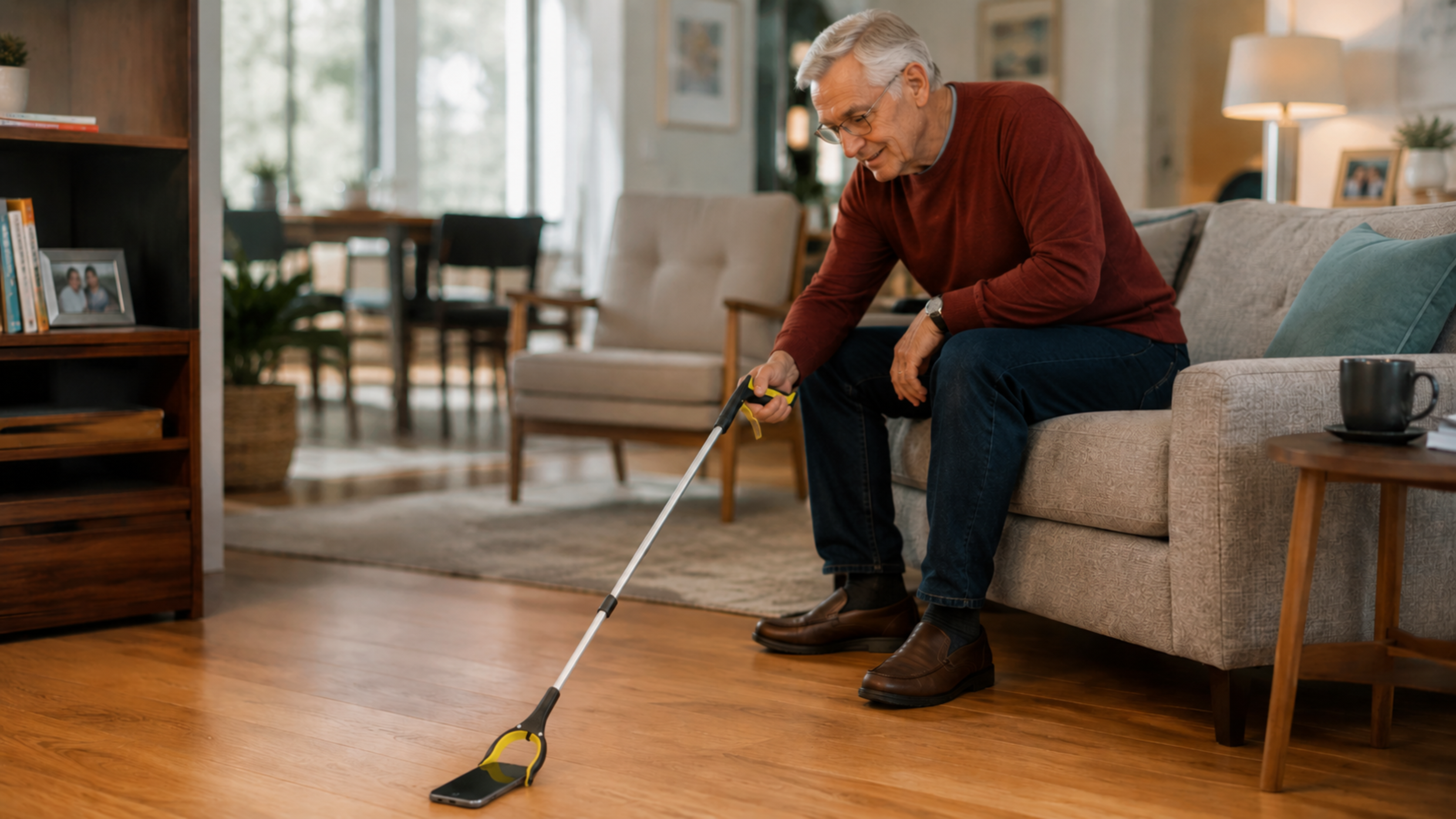
The framing of this question is almost always wrong. The question is not whether a grabber tool can replace a home health aide — a human being who performs medical monitoring, medication management, wound care, and skilled assessment. The real question is whether a grabber tool can replace the need to call for another person's assistance for specific, discrete, object-retrieval tasks throughout the day. For those tasks, the answer is frequently yes — and the independence that results is the one outcome that matters most to the people asking.
Direct answer: a reacher grabber tool replaces caregiver assistance for a specific category of tasks — floor retrieval, overhead reaching, dressing assistance, and object repositioning — that would otherwise require another person to be physically present. It does not replace medical care, personal hygiene assistance, or skilled nursing functions. For users with sufficient grip strength and upper limb mobility to operate a reacher one-handed, a GrabbersTool 32" or 43" Reacher extends functional independence across the majority of non-medical daily tasks.

What Home Health Aides Actually Do: A Realistic Breakdown
Home health aides provide services across a spectrum. Understanding which portion a grabber tool addresses requires separating the functions:
| Task Category | Examples | Grabber Tool Replaces? |
|---|---|---|
| Object retrieval | Picked up dropped items, retrieved from shelves | Yes — primary use case |
| Dressing assistance | Socks, shoes, lower body clothing | Partially — with sock aid and reacher together |
| Kitchen access | Retrieving items from low/high storage | Yes — for lightweight items |
| Laundry management | Moving laundry between washer and dryer | Yes — reacher manages item-by-item transfer |
| Personal hygiene | Bathing, grooming below the waist | No — requires direct assistance or specialized equipment |
| Medication management | Pill dispensing, schedule tracking | No — medical function |
| Medical monitoring | Vitals, wound care, symptom observation | No — skilled nursing function |
| Mobility transfer | Bed to chair, chair to standing | No — standing assist tool helps but does not replace |
| Cognitive support | Reminders, orientation, companionship | No — human function |
The functional independence impact of adaptive tools like GrabbersTool reachers in post-acute home recovery settings is documented in occupational therapy literature. The full methodology GrabbersTool uses to assess tool suitability for specific functional tasks is detailed on the Reacher Grabber product page. View the complete task compatibility guide →
The Independence Calculation
GrabbersTool's support team hears a consistent pattern from customers who are managing at home with periodic aide support: the most frustrating dependency is not the scheduled aide visits — it is the unscheduled moments. Dropping a phone at 11pm. Needing something from a low drawer at 7am before the aide arrives. Wanting to make a cup of tea without waiting for help.
These moments are precisely what a reacher grabber resolves. They are object-retrieval tasks, and a person who can hold and squeeze a trigger can perform them independently, regardless of what their lower body mobility allows.
Research in occupational therapy and rehabilitation consistently identifies the experience of competence — the ability to complete a task independently — as a key factor in recovery motivation and psychological wellbeing. Ryan and Deci's Self-Determination Theory (2000) identifies autonomy and competence as two of three fundamental human psychological needs. A reacher tool addresses both: the user makes the decision to act and executes it without calling for help.
When a Grabber Tool Is Not Sufficient
The honest answer matters here. A grabber tool requires:
- Sufficient grip strength to operate the trigger mechanism
- Enough upper limb mobility to extend the tool toward the target
- Cognitive ability to plan and execute the two-step grip-and-retrieve sequence
- Visual acuity to align the jaw with the target object
For users with advanced conditions affecting any of these — severe arthritis in the trigger hand, significant arm weakness, cognitive impairment — a reacher tool reaches its functional limit. In these cases, a grabber tool may still reduce the frequency of aide assistance needed without eliminating it.
The Economic Dimension
Home health aide services in the United States cost, on average, between $25 and $35 per hour according to national home care cost surveys. A GrabbersTool 32" Reacher is priced at $35.99. For a user who would otherwise require an aide visit for object-retrieval tasks — and can instead manage those tasks independently — the cost comparison is immediate.
GrabbersTool does not claim that one product eliminates all aide costs. The claim is specific: for the category of tasks listed above, a reacher tool provides independent capability that removes those tasks from the aide's necessary scope. The resulting reduction in required aide hours is a measurable outcome that occupational therapists document in home assessment reports.
The Standing Assist Tool: Extending Independence Further
For users who also struggle with the sit-to-stand transfer — rising from a chair, toilet, or bed — the GrabbersTool Standing Assist Tool addresses the transfer phase that the reacher does not. The two tools together cover a significant portion of the daily task categories where aide assistance would otherwise be required.
A walking cane — the GrabbersTool Walking Cane — extends independent mobility once standing, completing a three-tool combination that addresses the full daily sequence from seated retrieval to standing transfer to ambulatory independence.

What Occupational Therapists Recommend
Occupational therapists conducting home assessments for post-surgical or chronic condition patients routinely include a long-reach reacher in their adaptive equipment prescriptions. The recommendation is not about replacing professional care — it is about identifying which tasks the patient can be trained to perform independently and equipping them to do so.
GrabbersTool's product lineup was developed in alignment with these functional independence priorities. The rotating head, low-trigger-force mechanism, and lightweight aluminum frame are specific responses to the constraints that occupational therapists identify as limiting tool use in post-acute patients: wrist fatigue, limited shoulder range, and reduced hand strength.
See also: The Psychology of Asking for Help — Why Some People Would Rather Have a Tool, and The First Week Home After Hip Replacement: What You Actually Need for the complete equipment context.
Browse the full Ergonomic Mobility collection for all tools in GrabbersTool's functional independence range.


