

Nail care is one of the first everyday tasks people quietly give up, and almost nobody mentions it. It does not feel like a milestone. It feels like something you will get to later.
Direct answer: Standard nail clippers fail with arthritis because they require three things at once: a firm pinch grip to close the lever, fine motor control to aim a blade at a small target, and enough vision to see the edge you are cutting. Arthritis commonly removes the first, tremor removes the second, and age removes the third. The replacements are electric rotary files, long-handled clippers with a lever action, and podiatry care, and which one you need depends on which of the three you lost.
Quick Answer
If squeezing is the problem, use an electric rotary nail file, which supplies the force for you. If reaching your toes is the problem, use long-handled clippers or ask for help with feet specifically. If you have diabetes, neuropathy, or reduced sensation in your feet, have a podiatrist care for your toenails rather than doing it yourself, because a small unnoticed injury is the real risk rather than the nail itself.
Key Takeaways
- Clippers demand a pinch grip, which is the exact grip thumb arthritis attacks first.
- Filing removes the aiming problem entirely, because there is no blade and no single decisive moment.
- Clipped nails leave sharp corners that catch on socks and bedding, which is a real cause of torn nails.
- Toenails are a separate problem from fingernails, and often a separate solution.
- Diabetes and neuropathy change the answer completely. That is a clinical question, not a product question.
Why clippers stop working
Look at what a nail clipper actually asks of a hand. You hold a small metal object steady between the fingers of one hand while pressing a lever with the thumb or forefinger of the same hand, aiming a blade at a target a few millimetres wide, on a body part you may be viewing at an awkward angle.
Biomechanical analysis of thumb loading by Cooney and Chao (1977) found that the compressive force at the thumb's basal joint during pinch is several times greater than the force applied at the fingertip. In other words, the joint pays a multiple of what the task appears to cost. That basal joint is one of the most common sites of hand osteoarthritis, and the American Academy of Orthopaedic Surgeons notes it is particularly common in women over 40.
So the difficulty is not general weakness. It is that this specific task loads the specific joint most likely to be worn. The same mechanism explains why turning a key hurts and why pull tabs and jar lids become obstacles at roughly the same time.
The options, compared honestly
| Method | Solves squeezing | Solves aiming | Best for |
|---|---|---|---|
| Standard clippers | No | No | Healthy hands and good vision |
| Lever or table-mounted clippers | Partly | No | Reduced grip strength with steady hands |
| Manual emery board | Yes | Yes | Light shaping, but slow on thick nails |
| Electric rotary file | Yes | Yes | Arthritis, weak grip, tremor, reduced vision |
| Podiatry appointment | Yes | Yes | Diabetes, neuropathy, thickened or infected nails |
Why filing beats cutting, beyond the grip
Filing has a second advantage that has nothing to do with hand strength.
A clipper removes nail in one decisive bite and leaves a corner. That corner catches on socks, sheets, and tights, and when it catches it tears sideways into the nail bed. This is why many people find they need a file after clipping anyway, which means a second tool and a second round of the same grip demands.
A rotary file removes nail gradually and leaves a rounded edge, so shaping and smoothing happen in the same pass. There is also no moment at which a blade can slip toward skin, which matters if your hands are unsteady or if you are working on someone else.
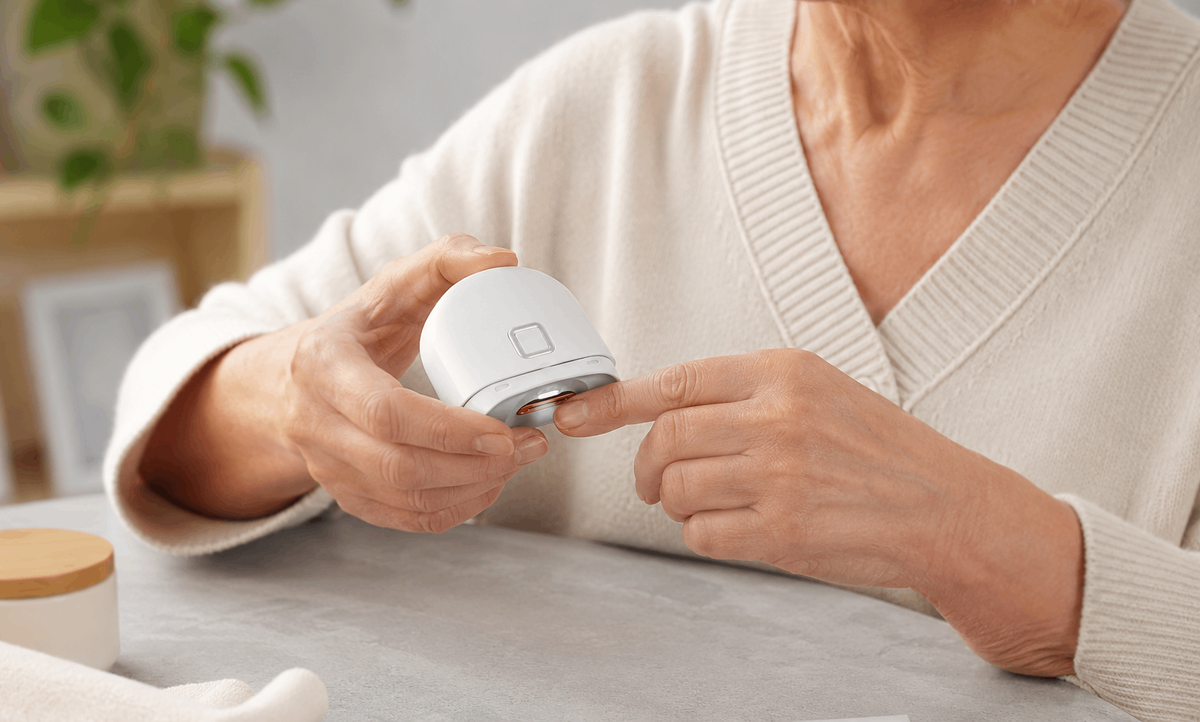
The GrabbersTool Electric Nail Trimmer uses a rotating file with two speeds and a built-in LED at the opening, and collects filings in a compartment inside the body rather than scattering them. The full specifications and safety guidance are on the product page.
Toenails are a different problem
Fingernails fail on grip. Toenails fail on three additional things at once: they are thicker and harder, they require bending forward or crossing a leg, and you are working in your own shadow.
That third point is underrated. Most toenail care happens in poor light with the body blocking what light there is, which is why a light at the working end matters more for feet than for hands.
If bending forward is the obstacle rather than the trimming itself, the problem is postural. Sitting in a firm chair with the foot raised onto a low stool changes the angle far more than any tool does. The same principle applies to putting on shoes and socks.
When to stop doing it yourself
This is the part product pages skip, so here it is plainly. Speak to a doctor or podiatrist rather than managing it at home if any of these apply:
- Diabetes, neuropathy, or poor circulation. Reduced sensation means a small nick can go unnoticed and heal slowly. Many people in this group are advised to have professional foot care, and that guidance should come from their own clinician.
- Nails that are thickened, crumbling, or discoloured. These often indicate a fungal infection or another condition that filing will not resolve.
- Ingrown nails or pain around the nail fold. Cutting into a corner yourself usually makes an ingrown nail worse.
- You cannot see or reach your feet. Working blind on a body part that cannot feel a mistake is a poor combination.
Using a tool to keep doing something yourself is independence. Recognising a task that should move to a professional is also independence, and the second one is harder.
Practical tips that make either method easier
- Trim after a bath or shower. Softened nails file and cut far more easily, particularly toenails.
- Do a little more often. Short frequent sessions beat one long battle, and short nails are easier to manage than long ones.
- Cut or file straight across on toes, rounding only slightly at the corners, which reduces the chance of an ingrown nail.
- Sit somewhere with real light. Most nail care happens in a dim bedroom because that is where people get dressed, not because it is a good place to do it.
- Rest your working hand. Bracing your wrist against your knee or the chair arm steadies a tremor more effectively than trying to hold still.
If this task is hard, others probably are too
Basal joint arthritis does not limit itself to nails. The same pinch demand appears across a cluster of daily objects, and people usually discover they have been quietly avoiding all of them.
- Pull tabs and ring pulls, which ask for a hooked fingertip under a thin metal edge.
- Jar lids, which demand pinch and rotation simultaneously.
- Keys, which give you a two-inch lever and expect you to twist it.
- Bottle caps and small seals, which concentrate force into a narrow band.
Our arthritis grip quiz identifies which grip type is actually failing, which is more useful than replacing tools one at a time.
Frequently asked questions
What are the best nail clippers for arthritic hands?
If squeezing is the difficulty, the honest answer is that no clipper fully solves it, because the lever action is the problem. Lever-arm or table-mounted clippers reduce the force needed. An electric rotary file removes the requirement altogether.
Are electric nail files safe for older adults?
For fingernails, generally yes, since there is no blade and the nail is removed gradually. For toenails, the answer depends on the person's circulation and sensation rather than their age, which is why the diabetes question matters more than the birthday.
How often should nails be trimmed?
Fingernails roughly weekly and toenails every four to eight weeks suits most people, but shorter and more frequent sessions are easier than infrequent long ones if your hands tire.
Can I use an electric file on thick toenails?
A stronger speed setting handles thicker nails, though it takes longer. Very thick, distorted, or discoloured nails should be assessed by a podiatrist first, because they often indicate something a file will not fix.
Can someone else use it on my nails?
Yes, and many people find it easier to have a family member do their toenails. Because it files rather than cuts, the consequence of a small slip is much lower than with clippers.
The short version
Clippers do not fail because your hands failed. They fail because they were designed for a pinch grip, fine aim, and clear sight, and they offer no alternative when one of those goes. Change the mechanism and the task comes back.
Written by GrabbersTool Editorial. GrabbersTool designs practical independence tools for everyday tasks. This article is general educational information and is not medical advice. Talk to your doctor or podiatrist about foot and nail care if you have diabetes, neuropathy, or reduced circulation.
Sources
- Cooney WP, Chao EYS. Biomechanical analysis of static forces in the thumb during hand function. Journal of Bone and Joint Surgery, 1977.
- American Academy of Orthopaedic Surgeons, OrthoInfo: Arthritis of the Thumb.
- Centers for Disease Control and Prevention: Diabetes and foot care.
- National Institute on Aging: Foot care for older adults.


