

The people who tell us they cannot open their own front door almost never say their hands are weak. They say the lock is stiff. Then they mention that jars are also stiff, and pull tabs, and the ignition in the car.
Direct answer: Turning a key is not a strength task. It is a pinch task. A house key gives you roughly two inches of metal to grip between the thumb and one finger, and that narrow pinch concentrates load on the basal joint at the base of the thumb, which is the joint hand osteoarthritis affects earliest and most often. The lock did not get harder. The grip the lock demands got more expensive.
Quick Answer
Turning a key hurts with arthritis because the task requires a precise pinch grip on a small, thin object, and pinch grips load the thumb's carpometacarpal (CMC) joint far more than the force you feel at your fingertips. The fix is leverage, not effort: widen the thing you hold so your whole hand turns the lock, lubricate the cylinder, and reduce how often a stiff lock has to be forced at all.
Key Takeaways
- A bare key offers about two inches of leverage. A key turner handle roughly doubles it, and force drops as leverage rises.
- The pain is usually at the base of the thumb, not in the fingers, because that is where pinch load concentrates.
- Cold weather makes it measurably worse, which is why the front door in winter is the moment people finally look for a solution.
- Half of the problem is often the lock itself, and a dry cylinder is fixable in five minutes.
- If keys are hard, pull tabs, jars, and bottle caps are usually hard too. It is one grip problem showing up in five places.
Why the thumb, and not the fingers?
Pinching is deceptively expensive. Biomechanical analysis of thumb loading by Cooney and Chao (1977) found that the compressive force at the thumb's basal joint during pinch is several times greater than the force actually applied at the fingertip. The joint is doing far more work than the task appears to require.
That matters because the basal joint, also called the CMC or trapeziometacarpal joint, is one of the most common sites of osteoarthritis in the hand. The American Academy of Orthopaedic Surgeons notes that thumb basal joint arthritis is particularly common in women over 40. So the population most likely to have a worn basal joint is also being asked, several times a day, to perform the one movement that loads it hardest.
This is why the pain has a signature: it is at the web of the thumb, it appears during pinching rather than gripping, and it is worse on small objects than large ones. A gallon of milk held in the whole hand can be easier than a key.
Why leverage solves it and willpower does not
Torque is force multiplied by distance from the center of rotation. Turning a lock requires a fixed amount of torque. If you double the distance, you halve the force. This is the entire principle behind every door lever, wrench, and faucet turner ever made.
A standard house key gives you about two inches of radius, and the part you actually hold is a thin flat bow that cannot be gripped with more than two fingers. Widen that to a molded handle and two things change at once: the radius grows, and the grip converts from a pinch to a full-hand power grip. The second change matters as much as the first, because a power grip spreads load across the palm instead of concentrating it at one arthritic joint.
What the numbers look like
| Approach | Grip type | Effective leverage | Best for |
|---|---|---|---|
| Bare key | Two-finger pinch | About 2 in | Healthy hands, well-maintained locks |
| Rubber key cap or grip cover | Pinch, slightly wider | About 2 in | Identifying keys by touch; minimal leverage gain |
| GrabbersTool Key Turner | Full-hand power grip | 4.7 in / 12 cm | Arthritis, weak grip, tremor, cold hands |
| Electronic keypad or smart lock | Fingertip press | None required | Eliminating the turn entirely; higher cost, needs power |
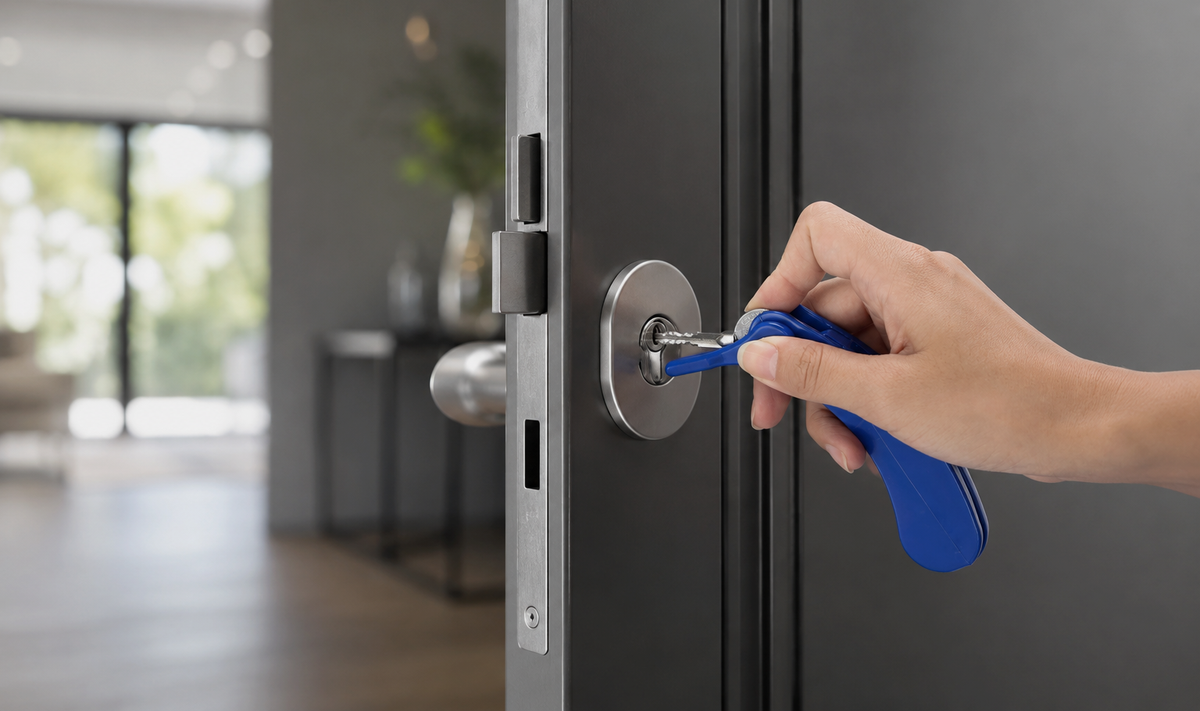
The Key Turner mounts your key inside a 4.7-inch handle with a steel pivot bolt, so the key you use most is permanently attached to a grip your whole hand can close around. A three-slot channel lets you position different key lengths correctly, and the arm folds flat when you are done. Full mounting instructions and the complete specification list are on the Key Turner product page.
Fix the lock before you blame your hands
A meaningful share of the difficulty people attribute to arthritis is a dry or misaligned lock. Before buying anything, work through this:
- Lubricate the cylinder. Use a dry graphite or PTFE lock lubricant. Do not use general-purpose oil sprays, which attract grit and make the cylinder worse over months.
- Check the door alignment. If you have to pull or lift the door to make the key turn, the deadbolt is binding against the strike plate. Adjusting the strike plate takes one screwdriver and removes the resistance completely.
- Retire worn keys. A copy of a copy of a copy sits imprecisely in the cylinder and needs extra force. A fresh key cut from the original is often dramatically smoother.
- Test in the cold. Judge a lock in January, not July. Cold stiffens both the mechanism and your joints.
If the lock is smooth and the key still hurts, the problem is genuinely the grip, and leverage is the answer.
The key is rarely the only problem
Basal joint arthritis does not limit itself to the front door. The same pinch demand appears in a specific cluster of daily objects, and people usually discover they have been quietly avoiding all of them.
- Pull tabs and ring pulls require a hooked fingertip under a thin metal edge, which is a pinch under the worst possible angle. A ring pull can opener hooks the tab instead of your fingernail.
- Jar lids demand pinch plus rotation at the same time. An electric jar opener removes both.
- Bottle caps and small seals concentrate force into a narrow band around the thumb. A bottle opener designed for weak grip widens it.
- Dropped items become a second problem, because bending to retrieve them adds joint and balance strain. A reacher grabber tool handles that with an easy-pull trigger rather than a squeeze.
If several of these sound familiar, our arthritis grip quiz maps which grip type is actually failing, which is more useful than guessing product by product. For a deeper look at the underlying joint mechanics, see Adaptive Tools for Thumb Arthritis: The Pinch Grip Problem.
What to do about cold hands specifically
Cold reduces synovial fluid viscosity and tissue elasticity, and it slows fine motor control. The practical result is that the same lock that cooperates in the afternoon refuses at night in December, with gloves on and both arms full of shopping.
Three things help. Keep the key on the outside of a bag rather than at the bottom, so you are not searching bare-handed in the cold. Choose a turner large enough to use with gloves on, which a 4.7-inch handle allows and a bare key does not. And fit the turner to the key you use most, not to a spare, so the benefit shows up at the moment it matters.
When a key aid is not enough
A key turner solves leverage. It does not solve everything. Consider a keyless entry option instead if:
- You cannot reliably insert the key into the cylinder, which is an aiming and vision problem rather than a strength problem.
- Tremor makes the approach to the keyhole the hard part rather than the turn.
- A caregiver or family member needs entry without a physical handover of keys.
These are different failures with different solutions, and it is worth being honest about which one you have before spending money.
Frequently asked questions
Does a key turner work on car keys?
It works on standard flat keys, including many car keys. Modern fobs and switchblade-style keys with integrated electronics generally will not mount, because the head is not a flat plate that fits a channel.
How many keys can one turner hold?
One key per turner. The intended use is to fit your most-used key, usually the front door, and leave it mounted permanently.
Will it damage the key?
No. The key is clamped at the head by a bolt through the mounting channel, and the blade is untouched, so the cut profile that operates the lock is unaffected.
Is this only for arthritis?
No. The same leverage helps with tremor, reduced grip strength after a stroke, carpal tunnel syndrome, neuropathy, and ordinary cold stiff fingers.
Should I see a doctor about thumb pain?
Yes, if the pain is persistent, worsening, or interfering with daily tasks. This article covers practical adaptation, not diagnosis or treatment. A hand therapist or physician can assess whether splinting, therapy, or other treatment is appropriate, and adaptive tools work alongside that care rather than replacing it.
The short version
If turning your key hurts, you are not losing your independence and your hands are not failing you. You are performing a high-load pinch task on a two-inch lever several times a day. Change the lever, and the task changes with it.
Written by GrabbersTool Editorial. GrabbersTool designs practical independence tools for everyday tasks. This article is general educational information and is not medical advice.
Sources
- Cooney WP, Chao EYS. Biomechanical analysis of static forces in the thumb during hand function. Journal of Bone and Joint Surgery, 1977.
- American Academy of Orthopaedic Surgeons, OrthoInfo: Arthritis of the Thumb.
- Centers for Disease Control and Prevention: Arthritis, national statistics.


