

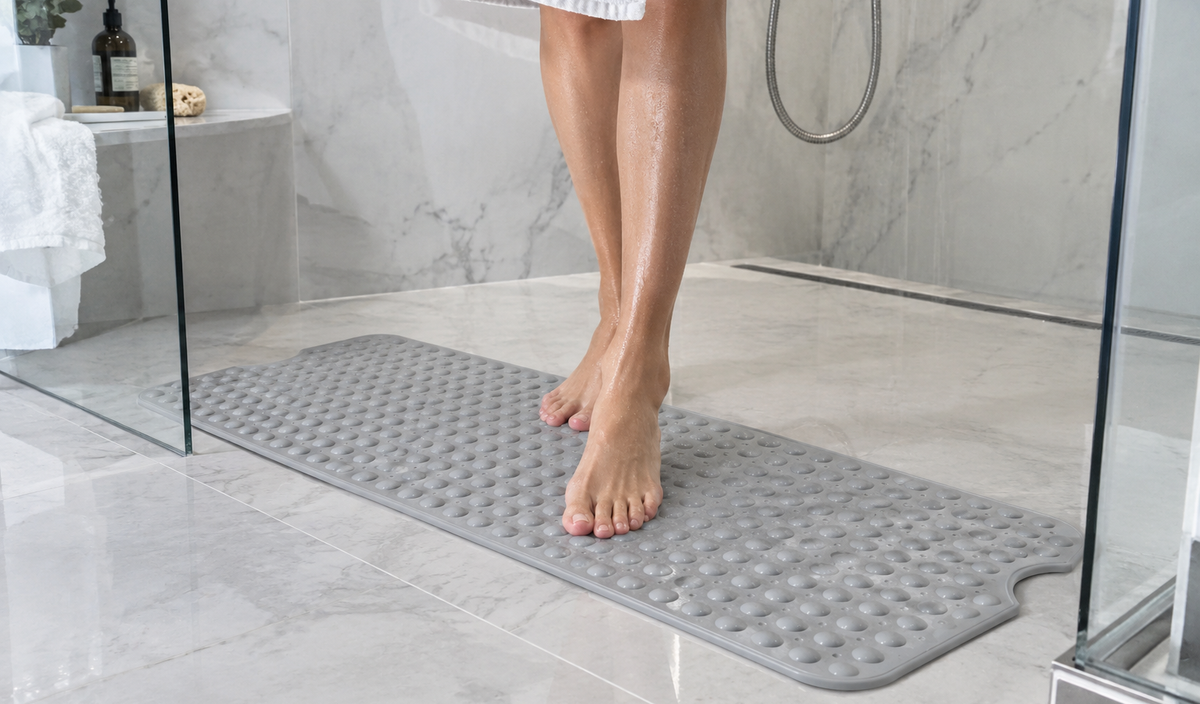
The most common complaint we hear about bath mats is not that someone slipped on one. It is that the mat itself slid, bunched, or peeled up at a corner. A mat that moves is worse than no mat, because it converts a predictable surface into an unpredictable one.
Direct answer: A non-slip bath mat reduces slipping risk only when three conditions are met at the same time. The suction cups must be in full contact with a smooth, clean, non-porous surface. The mat must cover the area where you actually stand and turn. And it must be cleaned often enough that a soap film does not form between the cups and the tub. Fail any one of those, and the mat is decoration.
Quick Answer
Non-slip bath mats meaningfully reduce slip risk on smooth acrylic, fiberglass, enamel, and porcelain tubs, where suction cups can form a real seal. They perform poorly on textured, tiled, or already-slip-resistant tub floors, because the cups cannot seal against an irregular surface. Choose the mat to match your tub surface first, and its size second. Everything else is secondary.
Key Takeaways
- Suction needs a smooth, non-porous surface. Textured tub floors defeat suction cups almost completely.
- Soap and conditioner residue is the single biggest cause of a mat losing grip over time.
- Most mats are too short. The standing and turning zone matters more than the lying-down zone.
- Drainage holes are a hygiene feature, not a grip feature, and both matter.
- A mat addresses the surface. It does not address balance, and the two problems need different solutions.
How big is the bathroom fall problem, really?
Large enough to take seriously, and concentrated in exactly the place you would expect. CDC analysis of national emergency department data on nonfatal bathroom injuries found that the large majority were caused by falls, and that injury rates rose sharply with age. Injuries occurring in or around the tub or shower were among the most frequent, and the activity most associated with them was bathing or showering itself.
Separately, the CDC reports that about one in four adults aged 65 and older falls each year. The bathroom concentrates several risk factors into a few square feet: a wet surface, a change in elevation at the tub wall, a rotation of the body while stepping over that wall, and often nothing solid to hold onto.
A bath mat targets exactly one of those four factors. That is worth knowing before you buy one and assume the room is now safe.
The tub surface decides whether suction works
This is the part almost every buying guide skips, and it is the reason most disappointed reviews exist.
A suction cup works by expelling the air beneath it so that atmospheric pressure holds it down. That requires an airtight seal. A smooth acrylic or enamel tub floor gives you one. A textured, pebbled, or slip-resistant-molded tub floor does not, because air leaks continuously through the microscopic channels in the texture. The cups may hold for a minute, then release.
| Tub or shower floor | Suction mat performance | Better option |
|---|---|---|
| Smooth acrylic or fiberglass | Excellent | Suction mat |
| Enamel or porcelain over steel or iron | Excellent | Suction mat |
| Textured or molded slip-resistant tub floor | Poor. Cups cannot seal | Adhesive treads, or a rubber mat without cups |
| Tiled shower floor with grout lines | Poor. Grout lines break the seal | Adhesive treads, or a slatted teak or plastic shower tile |
| Stone or textured composite | Poor | Anti-slip surface treatment applied to the floor |
Run one test before you buy anything. Wet the tub floor and press a single finger against it, then drag. If your fingertip squeaks and sticks, the surface is smooth and suction will work. If it slides with a gritty feel, it is textured, and no suction mat will hold.
Size: the mistake almost everyone makes
A standard bath mat is roughly 16 by 27 or 16 by 30 inches, designed to sit under the middle of a reclining bather. But falls do not happen while reclining. They happen during three specific movements: stepping in over the tub wall, turning around under the water, and stepping out.
Those movements happen at the ends of the tub, which is precisely where a standard mat does not reach. This is the argument for an extra-long mat. The GrabbersTool Bath Mat measures 40 by 16 inches with 200 suction cups and 176 drainage holes, which covers the standing and turning zone rather than only the middle of the tub.
The full dimensions, material specification, and washing instructions are listed on the Bath Mat product page.
Measure your tub floor before ordering, not the outside of the tub. Tub floors taper, and the usable flat area is always smaller than the rim suggests.
Why drainage holes matter more than they look
Drainage holes serve two separate purposes, and only one of them is obvious.
The first is hygiene. Water that cannot escape sits in a thin permanent film between the mat and the tub, in the dark, at room temperature. That is an ideal environment for mold and pink bacterial film, and it is why old bath mats develop stains on the underside long before the top looks worn. Holes let that water drain and the underside dry.
The second is grip retention. A trapped layer of soapy water acts as a lubricant between the mat and the tub, and it is exactly what breaks the suction seal. Drainage keeps the interface drier and the cups sealed for longer.
How to keep a mat gripping
- Lift and rinse it regularly. Do not leave a suction mat permanently in place for months. Soap film accumulates under the cups.
- Wash the tub floor, not just the mat. Conditioner residue on the tub is the invisible culprit in most grip failures.
- Machine wash cold with mild detergent, then hang to dry. Hot water can deform PVC and permanently flatten the cups.
- Avoid oil-based bath products. Bath oils and oil-based scrubs coat the tub and defeat suction faster than anything else.
- Press the mat down deliberately. Lay it on a wet tub and press along its full length with your palm to expel the air, rather than dropping it in place.
What a bath mat does not fix
Be clear about the limits, because this is where a false sense of safety does real damage.
A mat improves the friction of the surface underfoot. It does nothing for balance, nothing for the height of the tub wall you have to swing a leg over, and nothing for the moment you bend to pick up a dropped bottle of shampoo.
- Balance while standing: a grab bar mounted into studs or with an engineered anchor is the standard answer. Suction-mounted handles are not a substitute for a fixed grab bar.
- Getting up and down: a shower bench or transfer bench removes the standing requirement altogether. For getting out of a chair or the edge of a tub, a standing assist tool gives a stable push-off point.
- Steadiness on wet floors outside the tub: an adjustable walking cane with a suitable tip, plus a separate absorbent floor mat, addresses the exit rather than the tub.
- Bending to retrieve dropped items: this is a genuinely underrated bathroom fall trigger. A reacher grabber tool removes the bend, and we cover the specific bathroom case in The Reacher Grabber for the Bathroom.
- Dressing afterward: standing on one leg on a wet floor to put on socks is its own hazard. A long-handle shoe horn and a foot funnel let you stay seated.
For the wider picture, How to Adapt Your Bathroom for Limited Mobility Without Major Renovation covers what can be changed without construction.
Frequently asked questions
How long does a non-slip bath mat last?
Suction cups gradually lose elasticity with repeated compression and heat. Replace the mat when cups no longer hold after a proper cleaning of both the mat and the tub, or when they stay visibly flattened rather than springing back.
Can I use a suction bath mat in a tiled shower?
Generally no. Grout lines break the seal, so the mat will shift underfoot. Adhesive treads or a slatted shower tile are the correct products for tiled floors.
Do bath mats cause mold?
A mat without drainage that is left permanently in place will trap water and encourage mold on its underside. Drainage holes plus lifting and rinsing the mat regularly prevents it.
Is a bath mat enough on its own for an older adult?
Rarely. A mat addresses surface friction only. For someone with balance difficulty, a fixed grab bar and a seated bathing option address the larger share of the risk, and a mat complements them.
Which is safer, a rubber mat or adhesive treads?
On a smooth tub, a full mat covers more area and is removable for washing. On a textured or tiled floor, adhesive treads are the only option that grips at all. Match the product to the surface rather than to a general preference.
The short version
Test your tub floor with a wet fingertip. If it is smooth, buy the longest suction mat that fits and wash it often. If it is textured, do not buy a suction mat at all. And do not let a mat convince you the room is solved, because the surface was only ever one of four problems in it.
Written by GrabbersTool Editorial. GrabbersTool designs practical independence tools for everyday tasks. This article is general educational information and is not medical advice or a substitute for a home safety assessment.
Sources
- Centers for Disease Control and Prevention, MMWR: Nonfatal Bathroom Injuries Among Persons Aged 15 Years and Older, United States.
- Centers for Disease Control and Prevention: Older Adult Falls Data.
- National Institute on Aging: Fall-proofing your home.


