

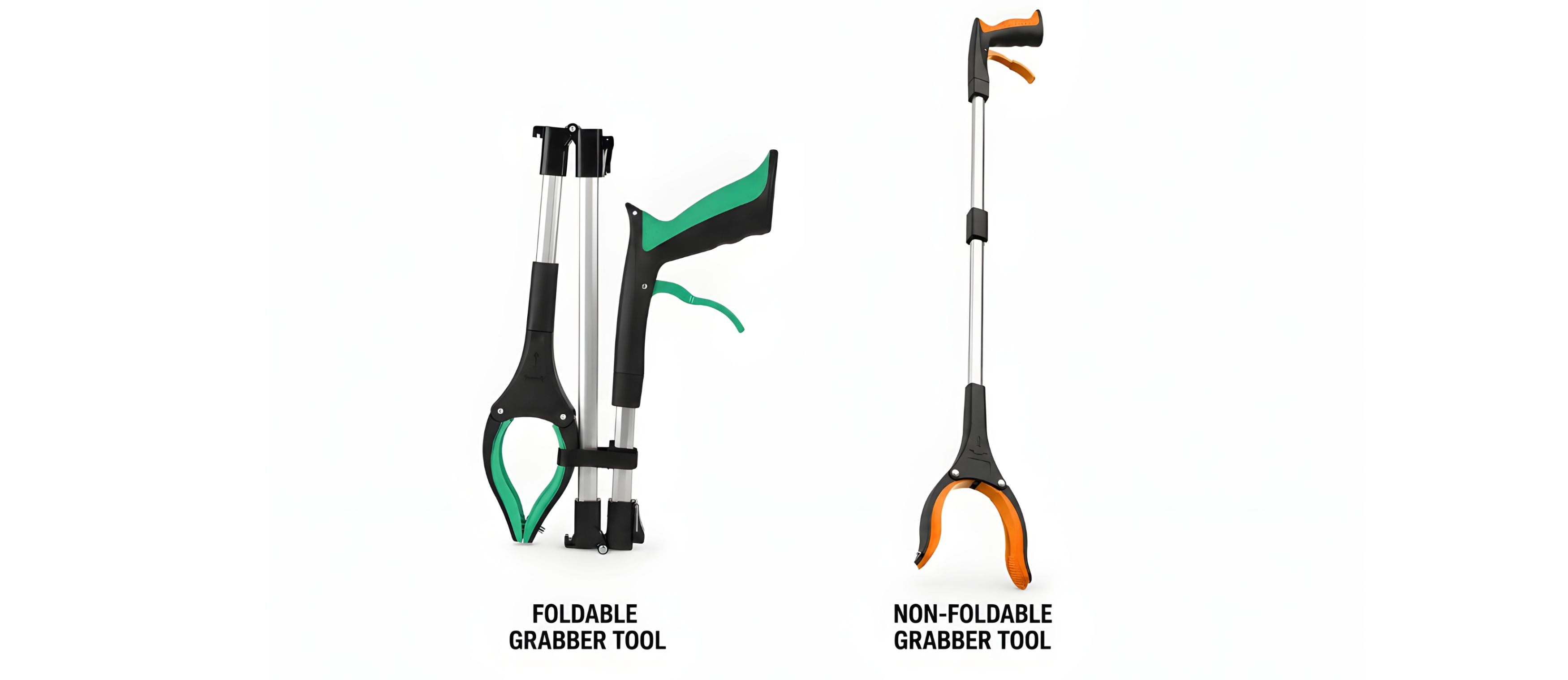
Was ist der Unterschied zwischen einer faltbaren und einer nicht faltbaren Greifzange?
Auf den ersten Blick erfüllen beide Typen dieselbe Aufgabe: Sie verlängern Ihre Reichweite, greifen Gegenstände vom Boden oder hohen Regalen und schonen Ihre Gelenke vor unnötiger Belastung. Doch der strukturelle Unterschied zwischen einer faltbaren Greifzange und einer Greifhilfe mit festem Rahmen (nicht faltbar) ist signifikant – und beeinflusst alles, von der Grifffestigkeit bis zur langfristigen Haltbarkeit.
Eine faltbare Greifzange verfügt über ein Gelenk – meist irgendwo entlang des Schafts –, das es ermöglicht, sie auf etwa die Hälfte ihrer Länge zusammenzuklappen. Dies erleichtert das Verstauen in einer Tasche, einem Koffer oder einer Nachttischschublade. Der Nachteil ist, dass jeder Gelenkpunkt eine potenzielle Schwachstelle unter Last darstellt.
Eine nicht faltbare (feststehende) Greifzange ist als ein durchgehender Schaft ohne Unterbrechung der Struktur gebaut. Sie ist typischerweise steifer, stärker und präziser – da es kein Spiel oder Nachgeben an einem Gelenk gibt. Die Einschränkung ist die Größe: Ein 32–33 Zoll langes Werkzeug bleibt 32–33 Zoll, ob man es braucht oder nicht.
Kopf-an-Kopf-Vergleich: Faltbare vs. nicht faltbare Greifzange
Die folgende Tabelle fasst zusammen, wie die beiden Typen in Bezug auf die wichtigsten Merkmale im täglichen Gebrauch abschneiden.
| Merkmal | Faltbare Greifzange | Nicht faltbare Greifzange | Sieger |
|---|---|---|---|
| Portabilität & Reisen | Lässt sich auf ca. 40–45 cm zusammenklappen, passt in die meisten Taschen | Immer volle Länge (80–109 cm) | Faltbar |
| Strukturelle Steifigkeit | Leichtes Nachgeben am Gelenk bei hoher Belastung | Einteilig – maximale Steifigkeit | Nicht faltbar |
| Präzision des Griffs | Gut, aber das Gelenk kann Mikrowackeln verursachen | Hervorragend – keine Bewegung im Schaft | Nicht faltbar |
| Langzeit-Haltbarkeit | Gelenkpunkt ist im Laufe der Zeit Verschleiß unterworfen | Kein mechanisches Gelenk – hält Jahrzehnte | Nicht faltbar |
| Aufbewahrung zu Hause | Kompakt – passt in eine Nachttischschublade | Benötigt einen speziellen Haken oder Wandplatz | Faltbar |
| Gewicht | Etwas schwerer (Gelenkmechanik erhöht das Gewicht) | Leichter bei gleicher Länge | Nicht faltbar |
| Verwendung nach Operation/Reha | Ausreichend für leichte tägliche Aufgaben | Bevorzugt – kein Nachgeben bei wiederholter Belastung | Nicht faltbar |
| Handgepäck im Flugzeug | Passt leicht ins Gepäckfach oder unter den Sitz | Kann aufgegeben oder am Gate abgegeben werden müssen | Faltbar |
| Preis (typische Spanne) | Aufgrund des Gelenkmechanismus etwas höher | Oft günstiger bei vergleichbarer Qualität | Nicht faltbar |
| Am besten bei Arthritis-Griff | Abhängig vom Griffdesign, nicht vom Faltmechanismus | Abhängig vom Griffdesign, nicht vom Faltmechanismus | Unentschieden |
Wann eine faltbare Greifzange die richtige Wahl ist
Eine faltbare Greifzange hat in bestimmten Szenarien ihren Platz. Wenn einer der folgenden Punkte auf Sie zutrifft, überwiegt die Portabilität wahrscheinlich den geringen Kompromiss bei der Steifigkeit.
Wann eine nicht faltbare Greifzange die bessere Option ist
Für die meisten Menschen, die eine Greifzange regelmäßig zu Hause verwenden, ist eine Greifhilfe mit festem Rahmen die klügere Langzeitinvestition. Hier ist der Grund dafür.
Welcher Greifzangen-Typ ist der richtige für Sie?
Die ehrliche Antwort: Die meisten Menschen, die täglich zu Hause eine Greifzange benutzen, werden mit einem nicht faltbaren Modell besser bedient sein. Die Portabilität einer faltbaren Greifzange spielt nur dann eine Rolle, wenn man sie tatsächlich tragen muss, und für die Mehrheit der Heimanwender ist die erhöhte Haltbarkeit und Präzision eines festen Rahmens einfach nützlicher.
Wenn Sie jedoch regelmäßig reisen, in einem kompakten Raum leben oder ein Werkzeug wünschen, das Sie überallhin mitnehmen können, ist eine faltbare Greifzange die praktische Wahl.
Wählen Sie faltbar, wenn Sie…
- Viel reisen (Flugzeug, Bahn, Hotel)
- Zuhause wenig Stauraum haben
- Eine Greifzange nur gelegentlich benötigen
- Ein Geschenk kaufen, das verschickt werden muss
- Regelmäßig zwischen mehreren Orten wechseln
Wählen Sie nicht faltbar, wenn Sie…
- Eine Greifzange mehrmals täglich verwenden
- Sich von einer Hüft- oder Knieoperation erholen
- Schwerere oder sperrigere Gegenstände heben müssen
- Maximale Präzision für kleine Objekte benötigen
- Für langfristige tägliche Unabhängigkeit kaufen
Wichtige Merkmale, auf die Sie bei beiden Typen achten sollten
Egal, ob Sie eine faltbare oder eine feste Greifzange wählen, die folgenden Merkmale machen den Unterschied zwischen einem Werkzeug, das Sie täglich zur Hand nehmen, und einem, das in der Schublade verstaubt.
- Drehbarer Kopf (90°): Eine Kralle, die sich schwenken lässt, ermöglicht es Ihnen, Gegenstände aus jedem Winkel zu erreichen – unter Betten, hinter Möbeln, in schmale Spalten. Unverzichtbar für den täglichen Heimgebrauch.
- Weichgummibacken: Starre Klauen zerkratzen Oberflächen und lassen glatte Gegenstände fallen. Ein gummierter Backen greift Glaswaren, Medikamentenflaschen und lose Münzen, ohne sie zu zerdrücken oder abzurutschen.
- Ergonomischer Vollhandauslöser: Ein Auslöser, der nur einen Finger erfordert, belastet arthritische Gelenke. Achten Sie auf einen Hebel, der über die gesamte Handfläche betätigt wird, für eine mühelose, schmerzfreie Nutzung.
- Gewichtsbelastung: Überprüfen Sie die vom Hersteller angegebene Belastbarkeit. Die meisten hochwertigen Greifzangen bewältigen 1,4–2,3 kg bequem. Faltbare Modelle haben manchmal eine geringere Belastbarkeit am Gelenk.
- Magnetische Spitze (optional): Einige Greifzangen verfügen über einen kleinen Magneten an der Greifspitze, um heruntergefallene Schlüssel, Münzen oder Nadeln von schwer erreichbaren Oberflächen aufzunehmen.
- Länge: 32–33 Zoll für den durchschnittlichen Heimgebrauch. 43 Zoll für zusätzliche Reichweite, große Benutzer oder Aufgaben im Freien. Faltbare Versionen davon gibt es – aber überprüfen Sie immer, ob die gefaltete Länge dorthin passt, wo Sie sie benötigen.
Häufig gestellte Fragen
Ist eine faltbare Greifzange genauso stabil wie eine nicht faltbare?
Nicht ganz. Eine faltbare Greifzange hat mindestens ein Gelenk im Schaft, was unter Last eine geringe Flexibilität und einen mechanischen Punkt einführt, der im Laufe der Zeit verschleißen kann. Für leichte tägliche Aufgaben – Kleidung aufheben, Gegenstände vom Boden holen, Regale erreichen – ist der Unterschied minimal. Für schwerere Lasten oder intensive Nutzung nach einer Operation ist eine nicht faltbare Greifzange mit festem Rahmen die zuverlässigere Wahl.
Kann ich eine faltbare Greifzange im Flugzeug mitnehmen?
Ja. Sowohl faltbare als auch nicht faltbare Greifzangen mit Standard-Gummispitzen sind von der TSA und gleichwertigen internationalen Behörden als Handgepäck zugelassen. Eine faltbare Greifzange hat den praktischen Vorteil, dass sie in die meisten Handgepäckstücke und unter Flugzeugsitze passt. Eine 43-Zoll-Greifzange mit fester Länge erfordert möglicherweise je nach Fluggesellschaft Platz im Gepäckfach über dem Kopf oder eine Abgabe am Gate.
Wie lange hält eine faltbare Greifzange im Vergleich zu einer festen?
Eine hochwertige, nicht faltbare Greifzange aus Aluminiumlegierung oder ähnlichen Materialien kann bei regelmäßigem Gebrauch ein Jahrzehnt oder länger halten – es gibt einfach keine beweglichen Teile im Schaft, die verschleißen könnten. Eine faltbare Greifzange hat aufgrund des Gelenkmechanismus typischerweise eine kürzere Lebensdauer: der Verriegelungsknopf, der Drehpunkt und das Gelenk selbst sind alle dem Verschleiß unterworfen. Für tägliche Intensivnutzer kann dies innerhalb von 1–3 Jahren spürbar werden. Für gelegentliche Nutzer hält eine hochwertige faltbare Greifzange viele Jahre ohne Probleme.
Welches Greifwerkzeug ist besser für jemanden, der sich von einer Hüftprothese erholt?
Ein nicht klappbares Greifwerkzeug wird im Allgemeinen für die Erholung nach einer Hüftprothese empfohlen. Das Werkzeug wird täglich mehrmals für wichtige Aufgaben verwendet – Socken anziehen, heruntergefallene Gegenstände aufheben, Kleidung hochziehen – unter strengen Hüftvorsichtsmaßnahmen, die das Bücken über 90° verbieten. Die Steifigkeit und Präzision eines Greifers mit festem Rahmen gibt Ihnen die zuverlässige Kontrolle, die Sie in dieser Phase der Genesung benötigen. Konsultieren Sie Ihren Physiotherapeuten bezüglich der spezifischen Länge und des von ihm empfohlenen Grifftyps.
Welche Länge des Greifwerkzeugs sollte ich kaufen – 32" oder 43"?
Ein 32–33" Greifer ist der Standard für durchschnittlich große Erwachsene (1,60 m – 1,78 m), die das Werkzeug hauptsächlich zu Hause verwenden. Er bietet genügend Reichweite, um vom Stehen aus den Boden zu erreichen, ohne übermäßigen Greifdruck zu erfordern. Ein 43" Greifer ist besser geeignet für größere Benutzer, Personen, die in tiefe Bereiche greifen müssen, oder für den Außeneinsatz, wo mehr Reichweite nützlich ist. Im Zweifelsfall beginnen Sie mit 32–33" – er bewältigt die Mehrheit der alltäglichen Aufgaben effizient.
Eignen sich klappbare Greifer gut für Menschen mit Arthritis?
Die Art des Klappmechanismus selbst ist nicht der wichtigste Faktor für Arthrosepatienten – Griffdesign und Auslösemechanismus sind weitaus wichtiger. Suchen Sie nach einem ergonomischen Auslöser für die ganze Handfläche, der minimale Schließkraft erfordert, und einer drehbaren Zange mit weichem Griff. Beide Typen können bei Arthrose gut funktionieren, wenn der Griff gut gestaltet ist. Allerdings bevorzugen viele Ergotherapeuten Greifer mit festem Rahmen für Arthrosepatienten, da der stabilere Schaft die bei der Verwendung erforderlichen Mikroanpassungen reduziert.
Finden Sie Ihr perfektes Greifwerkzeug
Fest oder faltbar – GrabberTool hat den richtigen Greifer für Ihren Lebensstil, Ihre Größe und Ihren Tagesablauf. Über 27.000 verkauft. Kostenloser Versand verfügbar.
Alle Greifwerkzeuge ansehen →


