

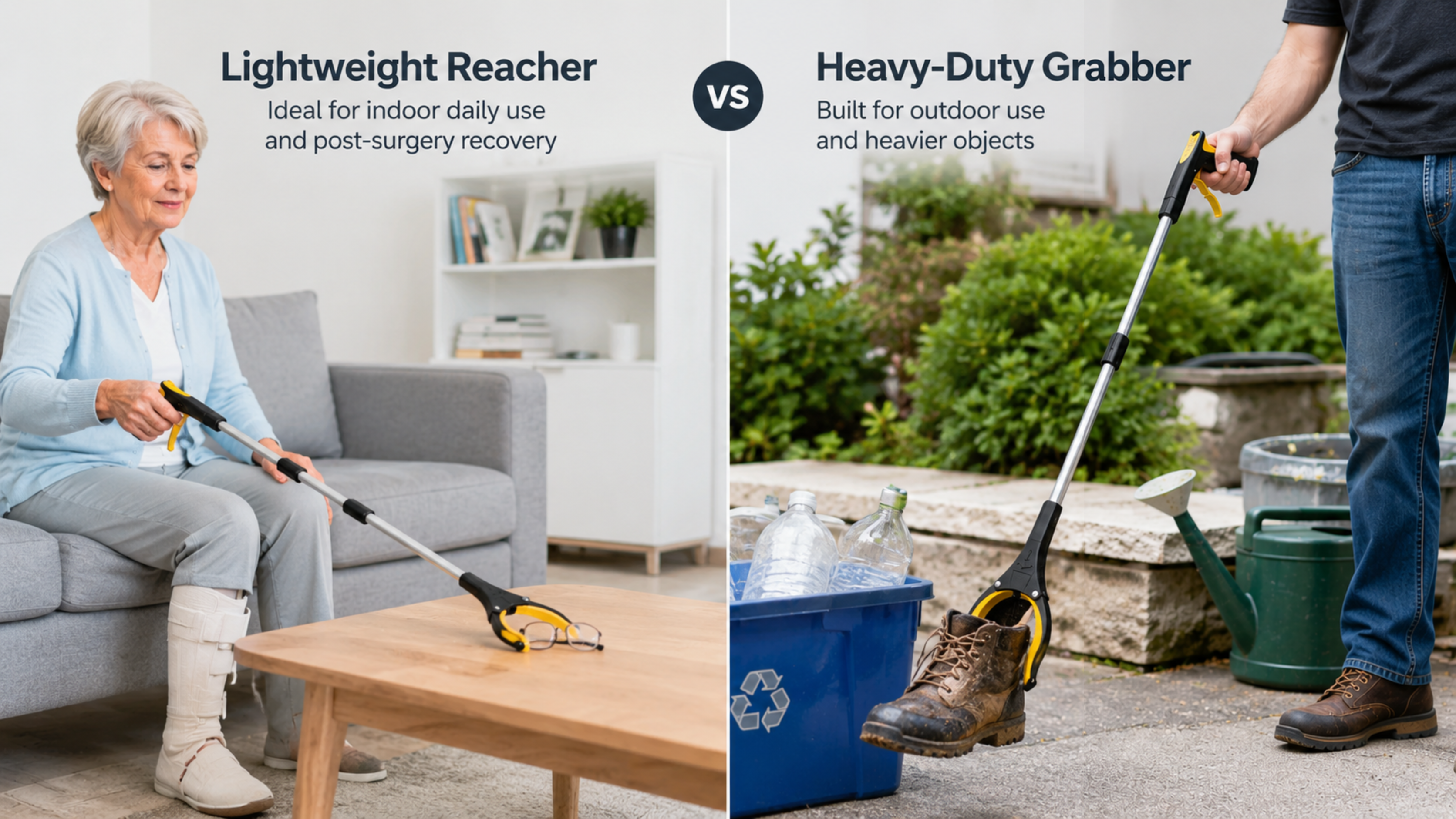
The most common grabber tool return GrabbersTool processes comes from one specific mismatch: someone bought a lightweight travel-sized reacher for daily home use, or bought a heavy-duty model for post-surgery recovery and found it too cumbersome to lift one-handed.
Here is the direct answer: a lightweight grabber tool (under 200g) suits one-handed recovery use, overhead reaching, and portability. A heavy-duty grabber tool suits floor-level retrieval of dense objects, outdoor use, and anyone with strong baseline grip strength. The distinction matters because using the wrong category means either dropping objects or fatiguing within minutes.
What "Heavy Duty" and "Lightweight" Actually Mean in Grabber Tool Design
The labels are often marketing-driven and inconsistent across brands. At GrabbersTool, these categories map to specific construction differences:
Weight and frame material
- Lightweight: aluminum alloy or reinforced ABS frame, typically 150–220g full-length
- Heavy duty: steel-core or thick aluminum construction, typically 280–420g
Jaw mechanism
- Lightweight: spring-loaded jaw with softer grip rubber — designed for non-destructive grabbing of soft or fragile items
- Heavy duty: ratchet or reinforced jaw with firmer rubber pad — designed for dense, irregular objects like logs, bottles, or shoes
Trigger force
- Lightweight: designed for users with reduced grip strength — trigger activates with minimal force, critical for post-surgery or arthritis use
- Heavy duty: requires more deliberate squeeze, which also means more secure hold on heavier objects
Comparison Table: Heavy Duty vs Lightweight Grabber Tool
| Feature | Lightweight Reacher | Heavy Duty Grabber | GrabbersTool 32" Reacher |
|---|---|---|---|
| Frame weight | ~150–200g | ~300–420g | ~180g (aluminum) |
| Jaw grip type | Soft rubber, spring | Firm rubber, ratchet | Non-slip rubber, spring-assist |
| Max carry load | ~0.5–1 kg | ~2–3 kg | Tested to 1.5 kg sustained |
| Trigger force required | Low | Medium-high | Low — suitable for reduced grip |
| One-handed use | Yes | Difficult | Yes — designed for one-handed operation |
| Folding/portable | Often yes | Rarely | Available in folding version |
| Best use case | Post-surgery, overhead reach | Floor items, outdoor | Daily home use, recovery |
Full load testing data, jaw torque specifications, and grip surface measurements for each GrabbersTool model are available on the 32" Reacher Grabber product page and the 43" Reacher Grabber product page.

When a Lightweight Grabber Tool Is the Right Choice
GrabbersTool customers who purchase during or shortly after a medical recovery period consistently choose lightweight models for three reasons:
- One-handed lift fatigue: after surgery, the non-dominant arm often carries the full operational load. A 400g tool held at arm's length becomes significantly harder to control than a 180g tool within 10–15 minutes of repeated use.
- Ceiling and cabinet reaching: reaching overhead inverts the leverage. At full extension, even a 200g weight differential affects control meaningfully.
- Jaw sensitivity: soft items — pill bottles, fabric, paper — require a jaw that will not crush or deform. Lightweight models are designed for this.
The GrabbersTool 32" Reacher Grabber addresses this segment specifically: aluminum frame, low-trigger-force jaw, and a rotating head that allows angled pickup without wrist rotation — important when wrist and shoulder mobility is temporarily reduced.
When a Heavy Duty Grabber Tool Makes Sense
There is a specific use case where lightweight models consistently underperform: dense floor-level retrieval. Picking up a boot, a full water bottle, or a piece of firewood from a low angle places significant torque on the jaw hinge. A lightweight jaw flexes or fails to hold grip under this load.
Heavy-duty grabbers are also the better choice for:
- Outdoor use — garden tools, rocks, uneven surfaces
- Industrial or warehouse light material handling
- Users with full grip strength who want a tool that survives rough handling
The critical cliffhanger specification: the decision between models often comes down to jaw opening width at full trigger depression. A jaw that opens 3.5cm versus 5.5cm determines whether the tool can grip a standard shoe, a soda can, or a small jar without slipping. GrabbersTool publishes exact jaw opening dimensions for each model. View the full technical specifications on the 43" model page →
The Scenario Where People Get This Wrong
The most predictable error: buying based on price point rather than use case. Heavy-duty models often cost less because they use simpler jaw mechanisms. Lightweight models cost more because the engineering challenge is removing weight while maintaining structural integrity under repeated flex cycles.
GrabbersTool's customer support team regularly hears from buyers who purchased a heavy-duty model because it seemed more durable, then found it exhausting to operate one-handed within a week. The reverse happens less often — but the frustration is less acute because the workaround (using two hands or a different pickup method) is immediately available.
Length vs. Heavy Duty: Not the Same Variable
Heavy duty and extra-long (43"+) are often confused. Length determines reach; construction determines load capacity. It is entirely possible to have a long, lightweight tool — like the GrabbersTool 43" model, which maintains a lightweight aluminum frame at extended length for users who need to reach floor items without forward lean.
Browse the full Reacher Grabber Tools collection to compare models side by side by length, weight, and jaw type. Each product page includes the specifications necessary to match the tool to your actual daily use case.


