

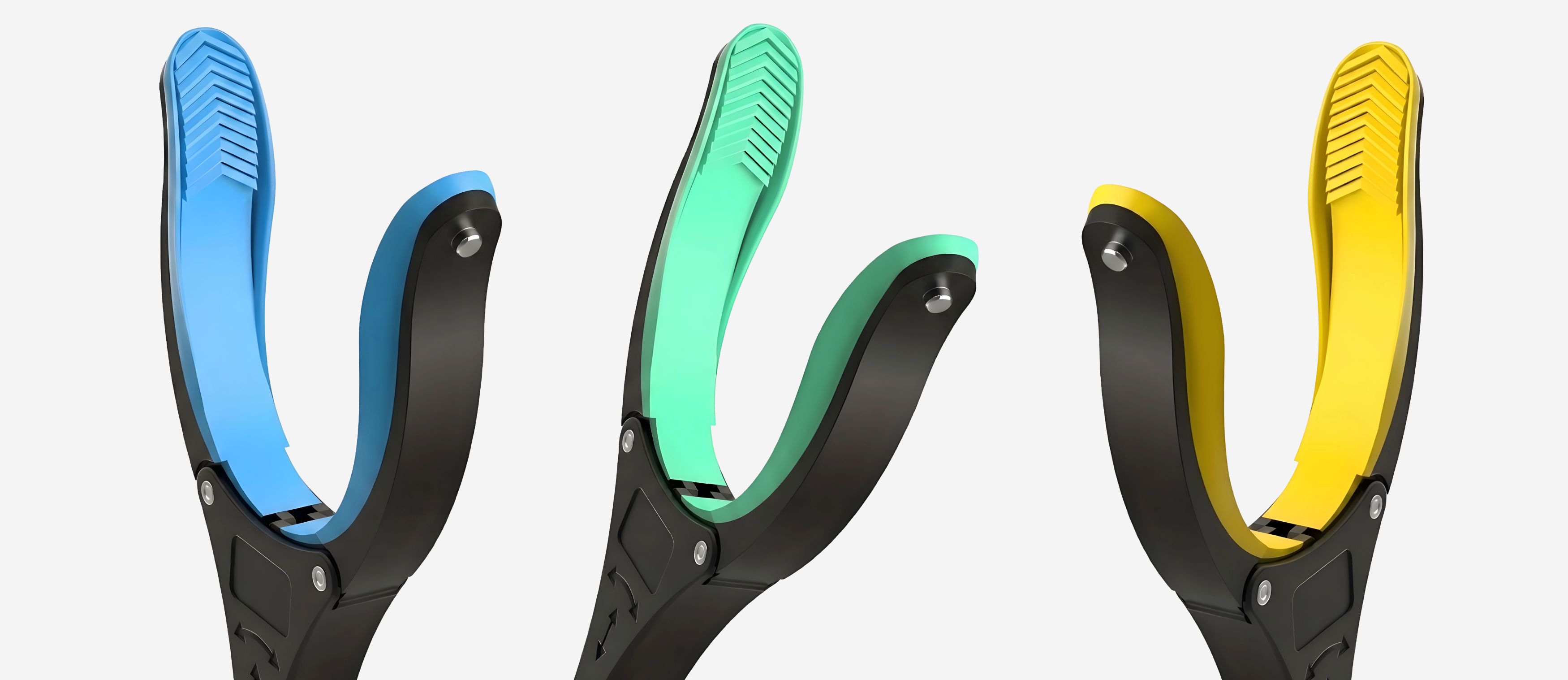
Step stools appear in home fall statistics with a frequency that most people find surprising when they see it cited in occupational therapy literature. The reason is mechanical: a person standing on an elevated surface, reaching overhead, has shifted their center of gravity past their base of support in two planes simultaneously. A reacher grabber tool eliminates both variables.
Direct answer: to reach items on top shelves safely without a step stool, use a reacher grabber tool of 32"–43" length with a rotating jaw head. The rotating head allows you to angle the jaw to hook or grip shelf items at overhead angles without twisting your wrist or shoulder. For most standard kitchen shelving (mounted at 180–220cm), a 43" reacher from floor level covers the full shelf depth without reaching forward.
The Physics of Overhead Reaching Risk
Occupational therapists describe overhead reaching risk in terms of shoulder elevation combined with load. When the arm rises above 90 degrees of shoulder abduction while holding a weighted object, stabilizing muscle groups are working at a mechanical disadvantage. The risk is not limited to older adults — anyone recovering from a shoulder, rotator cuff, or spinal procedure faces the same constraint.
A grabber tool addresses this by keeping the arm at or below shoulder height while extending the effective reach upward. The tool's length does the elevation work; the user's arm stays in a controlled, stable range.
What Length Reacher Do You Need for Top Shelf Access?
The answer depends on three measurements:
- Your height — determines how much extension is needed to clear shoulder level
- Shelf height — standard upper kitchen cabinets are installed at 180–220cm; pantry shelves vary widely
- Shelf depth — items stored at the back of a shelf require the tool to extend horizontally, not just vertically
Reacher Length vs. Shelf Reach: Reference Table
| User Height | Target Shelf Height | Recommended Reacher Length | GrabbersTool Model |
|---|---|---|---|
| Under 160cm | Up to 180cm | 32" | 32" Reacher Grabber |
| 160–175cm | Up to 200cm | 32"–36" | 32" Reacher Grabber |
| Any height | 200–220cm | 43" | 43" Reacher Grabber |
| Wheelchair user | Any shelf above seat height | 43" minimum | 43" Reacher Grabber |
| Post-surgery, limited shoulder mobility | Any overhead | 43" — to minimize shoulder elevation | 43" Reacher Grabber |
Exact reach calculations based on jaw angle, handle grip position, and shelf depth for each GrabbersTool model are detailed on the individual product pages. The 43" model page includes a reach diagram specific to standard kitchen cabinet heights. View full specifications →
The Rotating Head: Why It Matters for Overhead Use
A fixed-jaw grabber tool requires the user to position their wrist at an angle that mirrors the jaw angle — which for overhead reaching means wrist supination (palm-up) combined with upward arm extension. For anyone with limited wrist mobility, this becomes the binding constraint before the arm reaches full extension.
GrabbersTool's reacher models feature a 360-degree rotating jaw head. This means the wrist stays in neutral position while the jaw rotates to the correct angle for the shelf approach. The user adjusts the head once with the opposite hand before beginning the reach — then operates with the wrist in its strongest, most stable orientation.
GrabbersTool customers who switched from fixed-jaw reachers to rotating-head models consistently report that the fatigue point shifts from the wrist to the shoulder — a meaningful improvement because the shoulder has a larger muscle group managing the load.
Technique: How to Retrieve a Shelf Item Safely
This is the sequence GrabbersTool recommends for safe overhead retrieval:
- Set the jaw angle first. Before raising the tool, rotate the head to match the angle you will need at the shelf. Do this at waist height where you have full visibility and control.
- Raise the tool, not your arm. Keep your elbow below shoulder height. Extend the tool upward by raising your forearm from the elbow — not by elevating the entire shoulder.
- Contact the object before squeezing. Let the jaw rest against the item, confirm contact, then close the grip. Squeezing before contact creates an unstable approach and often knocks items off the shelf edge.
- Lower before repositioning. Once the item is gripped, lower the tool toward your body before moving toward a counter or table. Do not walk with the tool extended overhead.
- Release onto a surface, not into the air. Set the item on a counter or table before releasing the jaw trigger.
Items That Work Well With Overhead Grabber Retrieval
- Canned goods — the jaw grips the cylinder body reliably
- Boxes and cartons — jaw contacts the side panel
- Folded fabric or clothing — soft jaw rubber does not leave marks
- Lightweight containers — spice jars, small bottles
Items that require extra care
- Glass jars stored at the back of a deep shelf — retrieve by sliding forward first, then gripping at the shelf edge
- Items stacked on top of each other — always retrieve from the top down
- Very heavy items (over 1kg) — consider whether floor-level repositioning is safer than overhead retrieval
When the Step Stool Is Not the Only Alternative
For items retrieved frequently, GrabbersTool customers often find it more practical to reorganize the shelf rather than retrieve repeatedly from height. Frequently used items moved to mid-level storage, combined with a reacher for less frequent overhead access, produces a better daily workflow than either a step stool or a reacher alone.
For wheelchair users or those with permanent mobility limitations, this reorganization is typically the primary recommendation from occupational therapists — with the reacher as the safety tool for the occasional exception.
See also: Folding vs Non-Folding Reacher Grabber: Which One Is Worth Your Money for guidance on portability and storage of the tool itself.
Browse the full Long Reach Grabber Tools collection for all available lengths and configurations.


