

Spinal cord injury adaptive equipment is one of the most technically specialized domains in rehabilitation. The functional limitations — and therefore the appropriate adaptive tool strategy — depend on the level of injury (cervical, thoracic, lumbar) and whether the injury is complete (total loss of function below the lesion) or incomplete (partial preservation of function). A person with a T10 complete SCI has full upper extremity function and needs very different adaptive tools than a person with a C6 incomplete SCI who has limited hand function. Generic adaptive equipment advice that treats all SCI as equivalent misses this fundamental distinction.
Direct answer: for SCI home independence, the most relevant GrabbersTool products are determined by upper extremity function. For thoracic and lumbar SCI (paraplegia with full arm and hand function): the 43" Reacher Grabber is the primary tool for floor-level retrieval from a wheelchair. For cervical SCI with preserved elbow extension but limited hand grip: the Electric Jar Opener and Electric Can Opener are more relevant than the reacher, which requires grip function. The specific tool selection requires matching product trigger force and activation mechanism to the available upper extremity function at the injury level.
Injury Level and Upper Extremity Function: The Decision Framework
Upper extremity function in SCI is determined by the cervical injury level for cervical injuries, and is fully preserved for thoracic and lumbar injuries:
| SCI Level (complete) | Upper Extremity Function | Most Relevant Adaptive Tools |
|---|---|---|
| C5 | Shoulder abduction, elbow flexion; no wrist extension, no hand function | Specialized C5 feeding aids; not standard GrabbersTool reacher (grip not available) |
| C6 | Wrist extension (tenodesis grip); limited active hand grasp | Electric Jar Opener with low button force; Electric Can Opener |
| C7-C8 | Elbow extension, partial hand function, improving grip | Electric openers; Precision Grabber with adapted grip; Multi-Opener |
| T1-T12 (paraplegia) | Full upper extremity function | 43" Reacher Grabber from wheelchair; all kitchen openers |
| L1 and below | Full upper extremity; some lower limb function preserved | Reacher; openers; Standing Assist Tool depending on ambulatory status |
Electric opener activation force and button dimensions are critical specifications for cervical SCI users. The button press force required for the GrabbersTool Electric Jar Opener and Electric Can Opener — and the hand position required for stable operation — are described on the product pages. For C6-C7 users, the available tenodesis or active grip must be sufficient for button activation. View jar opener specifications
Wheelchair Floor Retrieval: The 43" Reacher Advantage
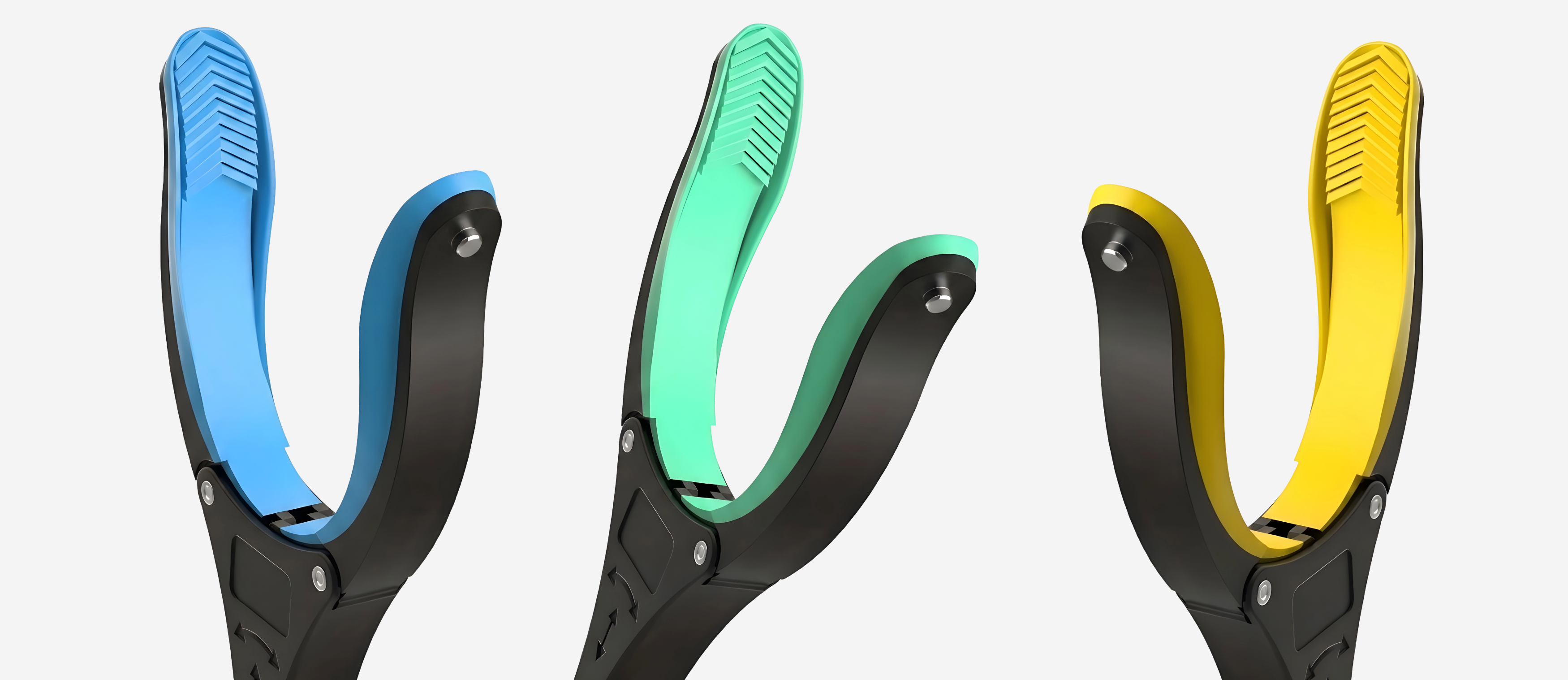
For thoracic and lumbar SCI wheelchair users with full upper extremity function, the floor retrieval challenge is geometrical: the wheelchair seat height places the user significantly above floor level, and the wheelchair footrests extend forward, preventing close approach to floor objects. The 43" Reacher Grabber provides the additional reach length required to access floor-level objects from the wheelchair seat position without leaning dangerously far forward.
Standard 32" reachers are frequently insufficient for floor retrieval from a wheelchair — the user must lean forward to extend reach, which creates both a balance risk (falling from wheelchair) and a shoulder overuse risk (the forward lean position is mechanically disadvantageous for the rotator cuff during reach). The 43" tool from an upright seated position is safer than a 32" tool from a forward lean.
Incomplete SCI: Variable Function and Tool Selection
Incomplete SCI presents the most complex adaptive tool selection challenge because function varies not only by injury level but by the specific pattern of preservation — different tracts are preserved depending on the injury mechanism and location within the cord. Incomplete SCI patients may have asymmetric function (better right than left, or vice versa), may have preserved sensation but impaired motor function, or may have variable function that changes with fatigue, temperature, or medication.
For incomplete SCI, the adaptive tool selection should be based on a current functional evaluation by a rehabilitation occupational therapist rather than solely on the documented injury level. The therapist can assess what trigger force the patient can generate, whether bilateral grip is available, and which tool activation mechanisms are compatible with the specific functional pattern.
Coordinating With the SCI Rehabilitation Team
SCI rehabilitation involves a team — physiatrist, OT, physiotherapist, and often a rehabilitation engineer for complex equipment needs. GrabbersTool products serve the basic daily living adaptive equipment layer of this team approach. The OT recommendation for a specific reacher grabber or kitchen opener can reference the published product specifications (jaw force, reach, weight, handle dimensions) to confirm that the product matches the functional assessment findings.
See also: Using a Reacher Grabber From a Wheelchair: Technique and Tool Selection and Spinal Stenosis and Daily Living: Managing Function With Adaptive Tools.
Browse Reacher Grabber Tools and Long Reach Grabber Tools for the full range relevant to SCI home independence.


