

ALS (amyotrophic lateral sclerosis) requires a fundamentally different adaptive equipment strategy than most conditions. While most adaptive tool recommendations address a stable functional state — the person has X limitation, use Y tool — ALS presents a moving target. Motor function that is adequate today will be reduced in six months and absent in twelve. The adaptive tool strategy for ALS must therefore be proactive: anticipating the next stage of functional decline and having the tools ready before the function is lost, not after.
Direct answer: for ALS, the adaptive tool strategy must run ahead of the current functional state. If grip is currently adequate for jar opening, the electric jar opener should be acquired now — before grip fails — so the person has time to learn the tool and integrate it into routine while still capable of doing so with some independence. The GrabbersTool Electric Jar Opener, Electric Can Opener, Reacher Grabber, and Standing Assist Tool represent a core toolkit that addresses the kitchen and mobility functional domains that decline in most limb-onset ALS presentations.
ALS Onset Patterns and Early Tool Selection
ALS presents in two primary onset patterns — limb onset (approximately 80% of cases, starting with arm or leg weakness) and bulbar onset (starting with speech and swallowing difficulty). The adaptive tool strategy for home independence primarily addresses limb-onset ALS. Bulbar onset requires primarily communication and feeding adaptive tools at the early stage.
For limb-onset ALS, the early functional decline in the arms (arm-onset) or legs (leg-onset) determines the initial adaptive tool priority:
- Arm-onset ALS: kitchen tools are the first priority — grip and arm strength decline first. Electric openers, the multi-opener, and then the reacher as arm reach and trigger force decline.
- Leg-onset ALS: mobility tools are the first priority — standing assist, walking cane, and reacher for floor retrieval as mobility declines. Kitchen tools become relevant as arm involvement develops (which occurs in most cases).
The Proactive Acquisition Timeline
| Current Function | Acquire Now | Why Now Rather Than Later |
|---|---|---|
| Grip present but reduced | Electric Jar Opener, Electric Can Opener | Learn the tool while still capable; have it before grip fails |
| Standing from chairs manageable but effortful | Standing Assist Tool | Integrate into routine before transfers require full assist |
| Floor retrieval requires caution | Reacher Grabber | Practice technique before trigger force becomes limiting |
| Walking stable but fatiguing | Walking Cane with Cane Strap | Correct cane use prevents falls at the point of gait change |
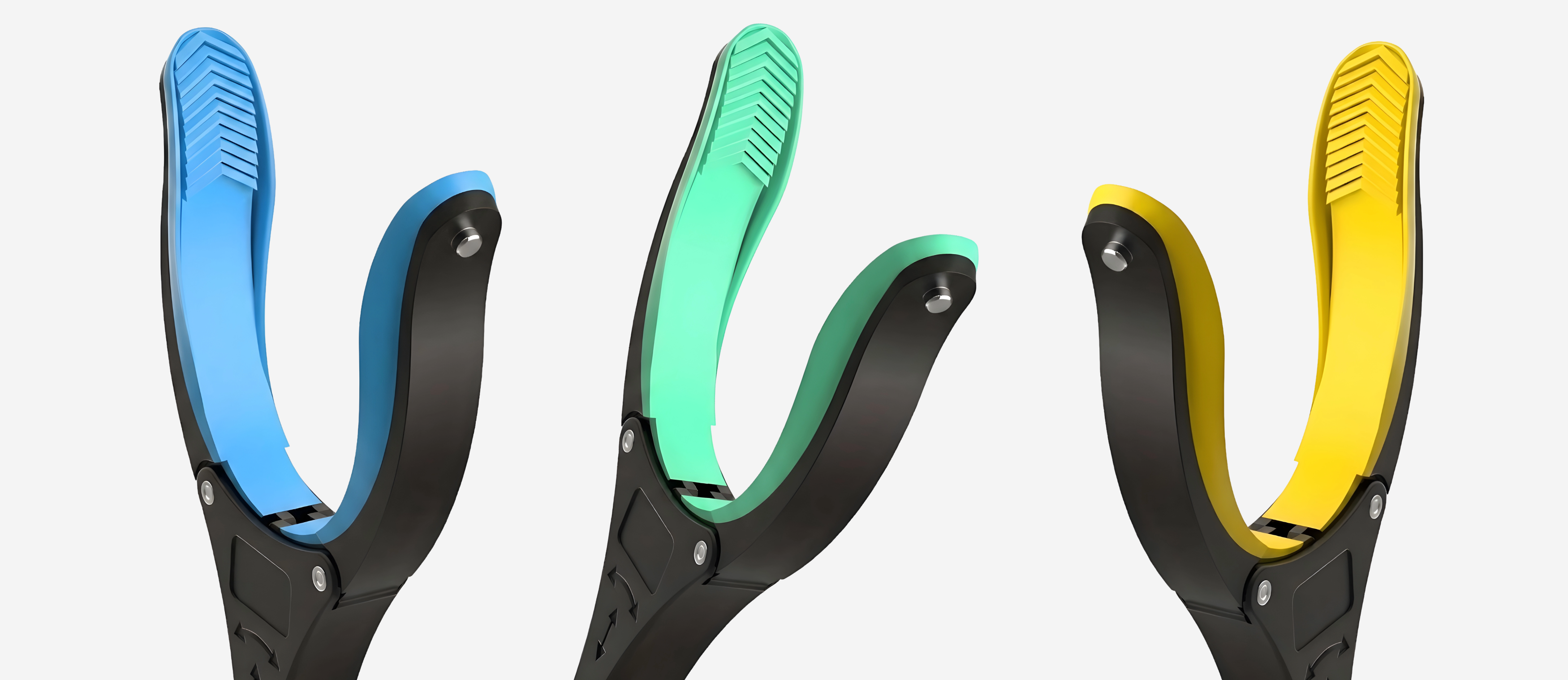
For ALS patients with arm-onset progression, trigger force — the hand strength required to close the reacher jaw — is the most critical reacher specification. As arm weakness progresses, a reacher that requires high trigger force becomes unusable before it would be expected to. GrabbersTool trigger force specifications are on the product page. View reacher grabber specifications
The Equipment Transition Sequence
ALS adaptive equipment typically follows a transition sequence over the disease course. The kitchen adaptive sequence for arm-onset ALS generally proceeds:
- Manual tools adequate with difficulty → electric openers introduced
- Electric openers manageable → multi-opener for bottle tops where electric opener is less practical
- Reacher grabber introduced for floor retrieval → trigger force becomes limiting → reacher adapted (built-up handle, low-resistance trigger) or replaced with alternative retrieval method
- Arm function significantly limited → caregiver-assisted or fully adapted meal preparation system
The ALS multidisciplinary clinic (MDC) — the standard of care for ALS management — includes an occupational therapist who tracks functional decline and recommends equipment transitions at each stage. GrabbersTool product specifications allow OT recommendations to be matched to specific products at each transition point.
The Autonomy Value of Early Tool Adoption
Research in self-determination theory (Ryan and Deci, 2000) identifies autonomy — the experience of acting from one choice rather than external compulsion — as a fundamental psychological need that significantly affects quality of life. For ALS patients, maintaining kitchen independence and mobility independence for as long as possible is not merely functional — it preserves autonomy at a stage of disease where many other domains of control are being progressively lost.
Adaptive tools that extend the period of independent kitchen and mobility function are contributing to quality of life in a dimension that goes beyond the practical task. This is the clinical basis for the ALS MDC occupational therapy focus on proactive adaptive equipment adoption.
See also: Progressive MS and Adaptive Tools: Planning for Changing Function and Occupational Therapy at Home: What OTs Recommend and Why.
Browse Reacher Grabber Tools, Easy Grip Kitchen Openers, and Ergonomic Mobility for the full range.


