

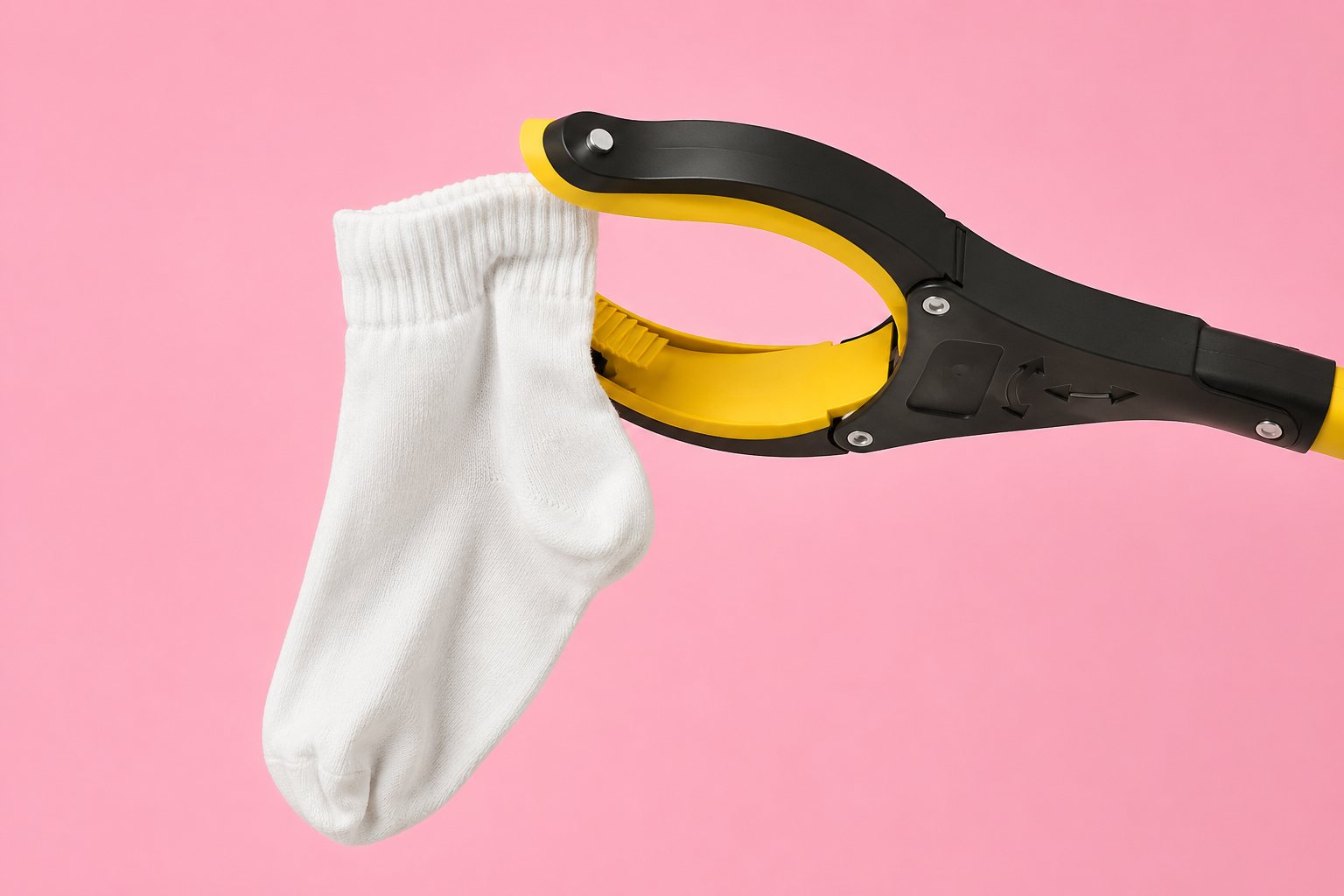
A grabber tool is one of the most useful mobility aids you can own — but the moment you drop a single pill on the bathroom floor, or a coin slides under the counter, most people assume the tool is useless for anything smaller than a sock.
That assumption is wrong. The right grabber, used with the right technique, can reliably pick up a coin, a pill capsule, a house key, or even a folded piece of paper. This guide breaks down exactly how — item by item, step by step — so you get results the first time you try.
A quality grabber with rubberized jaws can grip items as thin as 3mm — including most pill tablets and coin edges.
Approaching a flat item from a low 15–30° angle — not straight down — is the single biggest factor in success or failure.
For metal items (coins, keys, foil packs), a single magnetic tip contact beats any jaw technique for speed and reliability.
Section 01
Why Small Items Are Harder to Pick Up
Large items — a bottle, a towel, a piece of fruit — present plenty of surface for a jaw to grip. Small items create a completely different challenge. Coins, pills, and keys all share properties that make them resistant to casual grabbing technique:
Flat profile
Coins and pills sit flush against the floor, leaving almost no gap for jaws to slide under when approached from above.
Low friction
Smooth items on smooth floors shift away when the jaw makes contact. Any lateral force sends them sliding.
Small contact zone
The gripping surface available is minimal. Jaw alignment has to be precise — a few millimetres off and the item escapes.
Lightweight
Light items can be launched by the jaw closing too fast or too hard — a common trigger-squeeze mistake.
None of these problems are permanent. Each one has a specific fix, covered in the sections below. Understanding the problem is what makes the technique make sense.
Section 02
Core Technique: How to Grab Small Items
Before getting into specific items, master these five fundamentals. They apply whether you are picking up a tablet, a key, or a coin — and they fix the vast majority of drop problems.

Practice tip: Before trying this on the floor, practice picking up a coin from a flat table at standing height. This lets you see exactly what the jaw is doing. Once you feel the minimum-pressure technique, floor retrieval becomes much more predictable.
Section 03
Coins, Pills & Keys — Each Item Explained
Each small item type has its own specific challenge and its own best approach. Here is exactly what works for each.

Coins are the hardest flat-floor pickup. They sit perfectly flush — no edge to hook, no raised surface to grip. The technique is counter-intuitive: you are not trying to grab the coin face-on. You are tipping it.
Approach at a very low angle and slide one jaw tip gently against the coin's edge. The goal is to tilt the coin slightly so one edge lifts off the floor — then close the jaw around the raised edge. On carpet, coins are slightly easier because the pile gives the jaw something to push against.
Best tip type for coins: Magnetic tip — simply touch it to the coin's face and it adheres without any grip technique required. Eliminates the problem entirely for metal coins.
Pills present two challenges: they are small, and they must not be crushed or contaminated. Capsules (the two-tone oval type) are actually easier than flat tablets because their oval shape gives the jaw more to work with.
For a capsule on a hard floor: approach from the long side at a low angle, position the jaw so it straddles the capsule lengthwise, and apply the gentlest possible squeeze. The rubberized tips will hold it without compression.
For flat tablets: use the tipping technique from the coin section. If the pill has been dropped on a countertop or flat surface (not the floor), try sliding the jaw edge underneath it and tipping it into a cupped palm rather than gripping it directly.
Note on hygiene: Wipe the grabber jaw tips regularly with a clean cloth if you use the tool near medications. Rubberized tips can carry dust and debris.
Keys are among the easiest small items to retrieve with a grabber, despite their size. Unlike a coin, a key has an irregular profile, a raised head, and usually a key ring — all of which give the jaw something to catch.
For a key on a hard floor: aim for the key ring with the jaw open. Close gently around the ring or the head of the key. The irregular edge means even a partial grip is usually secure enough for a careful vertical lift.
Magnetic tip shortcut: Touch the magnetic tip to any metal key anywhere on its body. It will adhere immediately and hold through the lift. No grip technique needed at all — just lower, touch, lift.
Section 04
Which Jaw Tip to Use for Small Items
The jaw tip is the part of the grabber that makes contact with the item. For large objects it barely matters — for small ones, it can be the difference between success and launching the item across the room.
| Tip Type | Best For | Coins | Pills | Keys | Notes |
|---|---|---|---|---|---|
| Rubberized non-slip | General small items | Moderate | Best | Good | Gentle grip, won't damage fragile items |
| Magnetic tip | Metal items | Best | No | Best | Touch-and-lift, no technique needed |
| Hard plastic jaw | Larger objects | Poor | Poor | Moderate | Slips easily on small smooth items |
| Rotating jaw (360°) | Awkward angles | Moderate | Good | Good | Allows low-angle approach on any surface |
Best of both worlds: The GrabbersTool Precision Grabber 33″ combines rubberized non-slip jaws with a built-in magnetic tip — so you get soft-grip control for pills and capsules, plus instant magnetic retrieval for coins, keys, and foil packs. No swapping tools required.
Section 05
Choosing the Right Grabber Tool for Precision Work
Not every grabber is built for small-item retrieval. Many are designed primarily for picking up clothing, bottles, and cans — large, forgiving objects. If small items are a regular need (post-surgery, limited mobility, elderly users), specific tool features make an outsized difference.

Key features for small-item work
What to look for in a precision grabber
These features separate a grabber that handles small items reliably from one that only works on large objects.
- Rubberized jaw tips — non-slip grip without crushing. Essential for pills and lightweight items.
- Magnetic tip — eliminates technique entirely for metal items. A single point of contact that holds.
- 360° rotating head — allows approach from any angle, critical for low-to-floor small item retrieval.
- Lightweight shaft — less arm fatigue means a steadier hold at the moment of precision gripping.
- Smooth trigger mechanism — a stiff or jerky trigger makes fine pressure control impossible.
- Length appropriate to the task — 32″ for general use and table-height work; 43″ when you cannot bend at all.
If you are recovering from hip replacement surgery or have chronic limited mobility, also consider reading our guide on the best grabber tool for after hip replacement surgery — small items from the floor are one of the most common daily challenges during that recovery period.

Section 06
Common Mistakes (And How to Fix Them)
If your grabber keeps dropping small items, one of these is almost certainly the cause. Each has a direct fix.
❌ Approaching straight down
The jaw pushes the item away instead of surrounding it. Fix: Lower the shaft angle to 15–30° above horizontal and slide toward the item.
❌ Squeezing too hard
Small lightweight items launch when the jaw closes with too much force. Fix: Practice minimum-pressure grip at table height before working on the floor.
❌ Moving while squeezing
Any simultaneous movement shifts jaw alignment mid-grip. Fix: Position fully, pause one second, then squeeze without any other movement.
❌ Pulling backward after gripping
Pulling back changes the jaw angle and opens the grip. Fix: Lift straight up — vertical, not diagonal or backward.
❌ Worn jaw tips
Rubberized tips lose grip over time. A worn tip can no longer hold small items reliably. Fix: Inspect tips regularly and replace them when the rubber shows wear or hardening.
❌ Using the wrong tool for the item
A grabber designed for large objects will always struggle with small ones. Fix: Use a grabber with rubberized jaws and a magnetic tip for small-item work — such as the Precision Grabber 33″.
Section 07
Recommended GrabbersTool Products
All three GrabbersTool grabbers can handle small items. Here is which one fits which use case best.
| Product | Length | Magnetic Tip | Best Use Case | Link |
|---|---|---|---|---|
| Reacher Grabber Tool | 32″ | Yes | Everyday home use, general precision, countertop & floor | View → |
| Reacher Grabber Tool 43″ | 43″ | Yes | Post-surgery recovery, full floor reach without bending at all | View → |
| Precision Grabber Tool 33″ | 33″ | Yes | Small items specifically — pills, coins, keys, foil, paper | View → |
Not sure which length to choose? Read our full comparison: 32-inch vs 43-inch Grabber Tool — Which Length Should You Buy?

Section 08
Frequently Asked Questions
Yes — but technique matters more than the tool alone. The key is to approach the item from the side rather than straight down, apply minimal trigger pressure, and use a grabber with a rubberized or magnetic tip. Coins and pills are among the most challenging items precisely because they sit flat against the surface. A grabber with a rotating head and soft-grip jaw gives you the angle and the control needed to lift them reliably.
For general small items, a rubberized non-slip tip gives the most control. For metal items specifically — coins, keys, small tools, pill foil packs — a magnetic tip is the single most effective option. It makes contact without needing precise jaw alignment. The GrabbersTool Precision Grabber 33″ combines both: rubberized jaws with a built-in magnetic tip, covering all small-item scenarios.
The most common causes are: approaching the item from straight above (which pushes it away), squeezing the trigger too hard (which flicks it out), and using a worn jaw with reduced friction. Try angling your approach, using the gentlest pressure that still holds the item, and checking whether your grabber's rubber tips need replacing. See Section 06 above for a full checklist of causes and fixes.
For floor-level retrieval of small items, the 32-inch grabber gives slightly better control because it's lighter and easier to hold steady during precise work. The 43-inch is better when you genuinely cannot bend at all — the extra length adds reach at the cost of fine motor precision. If you're recovering from hip surgery, start with the 43-inch for safety; switch to 32-inch for detail tasks once mobility improves.
Yes — keys are actually one of the easier small items once you know the technique. Because keys have a raised ring or an irregular edge, the jaw has something to grip. Approach at a low angle, aim for the key ring, and squeeze gently. A magnetic tip grabber will attach directly to any metal key without needing to grip at all — simply lower, touch, and lift.
Use a grabber with clean, rubberized tips. Apply the absolute minimum jaw pressure — you only need to lift the pill, not crush it. Approach from the side, not above. For loose pills on a countertop, sliding the jaw edge underneath the pill and tipping it into your palm works better than trying to grip the pill directly. Always clean the grabber jaw tips regularly with a dry cloth if you use the tool near medications.
Find the right grabber for your needs.
Three tools, one purpose — helping you stay independent at home.
Shop All Grabber Tools →


