

01 — The basics
What is a reacher grabber tool?
A purpose-built assistive device — not just a claw on a stick.

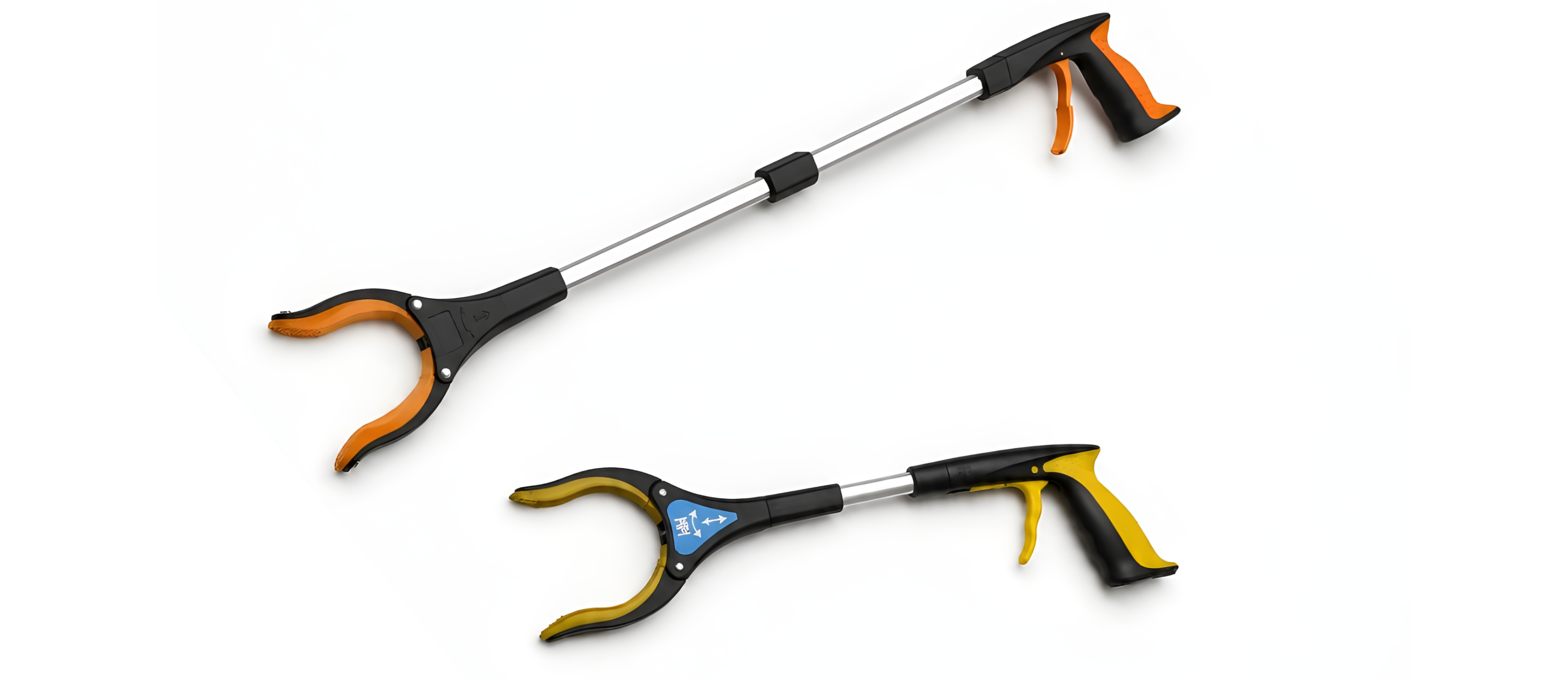
A reacher grabber tool — also called a reach extender, pick-up tool, or grabber reacher — is a long-handled device designed to pick up, grip, and move objects without bending, stretching, or straining. Unlike basic grabbers, it's purpose-built for accessibility, safety, and everyday independence.
Typically ranging from 19 to 36 inches in length, a quality reacher grabber tool features an ergonomic trigger handle at one end and a claw mechanism at the other. Most include a rotating head, a magnetic tip for small metal objects, and rubberised jaw pads for a secure hold on items of all shapes and sizes.
These tools are widely used by seniors, people recovering from surgery, individuals with limited mobility, and anyone who wants to avoid repetitive bending — whether in the kitchen, garden, office, or during post-operative recovery.
Key distinction. A reacher grabber tool is an ergonomically engineered assistive device — not a novelty claw. The difference shows up in daily use within the first week.
02 — The other kind
What is a "regular grabber"?
An informal catch-all that covers several very different products.
The term regular grabber has no precise definition. In practice it refers to any of the following:
- Short scissor-style claws — basic plastic or metal tools, typically 10–18 inches, with no ergonomic handle. Common in hardware or discount stores.
- Kitchen or BBQ tongs — designed for food, not for reaching objects at a distance or awkward angles.
- Industrial litter pickers — heavy-duty tools for outdoor or sanitation use, prioritising grip force over user comfort.
- Budget novelty grabbers — often sold as toys or gag gifts, with minimal engineering behind the jaw mechanism.
The key distinction comes down to purpose and engineering. A regular grabber is a generic tool. A reacher grabber tool is a dedicated assistive device built to be lightweight, comfortable for extended use, and reliable across a wide variety of objects.
03 — Head to head
The full comparison
Twelve features that separate a grabber reacher tool from a standard grabber.
| Feature | Reacher Grabber Tool | Regular Grabber |
|---|---|---|
| Typical length | 19 – 36 inches (48 – 91 cm) | 10 – 18 inches (25 – 46 cm) |
| Handle design | ✔ Ergonomic trigger grip | ✘ Basic loop or scissor |
| Jaw mechanism | ✔ Rubberised, non-slip, rotating | ✘ Simple claw, may slip |
| Rotating head | ✔ 90° or 360° rotation | ✘ Fixed only |
| Magnetic tip | ✔ Common on quality models | ✘ Rarely included |
| Weight capacity | Up to 5 – 8 lbs (2 – 3.6 kg) | Up to 1 – 2 lbs (0.5 – 1 kg) |
| Tool weight | 3 – 6 oz (85 – 170 g) lightweight | Varies; often heavier |
| Built for seniors / mobility | ✔ Specifically designed for this | ✘ Not purpose-built |
| Post-surgery / rehab | ✔ Recommended by OTs | ✘ Not recommended |
| Foldable / travel-ready | ✔ Many models fold | ✘ Usually rigid |
| Price range | $12 – $40+ | $3 – $15 |
| Durability | ✔ Daily long-term use | ✘ May wear quickly |
04 — Use cases
When to choose a reacher grabber tool
Almost always, if you plan to use it regularly. Here's why each scenario matters.

Recovering from hip, knee, or back surgery
After a hip replacement or spinal procedure, bending below the waist is restricted for weeks or months. A 32-inch reacher grabber tool lets you pick up dropped items, pull on socks, retrieve shoes, and manage daily tasks without violating post-operative movement restrictions. Occupational therapists include a grabber reacher tool in virtually every hip replacement discharge pack.
Arthritis, limited grip strength, or joint pain
The trigger-style handle distributes grip force across the whole hand rather than concentrating it in the fingertips. This makes it far more comfortable for people with rheumatoid arthritis, carpal tunnel syndrome, or general weakness in the hands and wrists. A regular grabber's scissor mechanism requires pinching, which can be painful and exhausting.
Ageing in place and maintaining independence
Falls are one of the leading causes of injury among adults over 65 — and many happen during reaching or bending movements. A quality reacher grabber tool removes the need to overstretch, climb on stools, or bend too quickly, significantly reducing fall risk. Regular grabbers simply don't offer the reach or control needed to safely replace these movements.
Everyday convenience — for anyone
You don't need a medical reason to benefit from a grabber reacher tool. Reaching the top shelf, picking things up from the floor, retrieving items stuck under furniture, collecting rubbish in the garden — these are universal needs. Once you own a good one, you'll wonder how you managed without it.
05 — What to look for
Key features of a quality grabber reacher tool
Not all reacher grabber tools are created equal. Prioritise these.
Reaches the floor while standing — the go-to for most adults.
A rotating head means fewer awkward angles and more successful grabs.
Quality models hold 5–8 lbs. Budget grabbers fail at 1–2 lbs.
Must-have features
- Rotating jaw — 90° minimum
- Rubberised, non-slip grip pads
- Lightweight aluminium or fibreglass shaft
- Ergonomic trigger handle with wrist strap
- Magnetic tip for coins, keys, small metal items
- Correct length for your height and use case
- Easy to clean — dishwasher-safe jaw ideal
Red flags to avoid
- Heavy plastic shaft — causes arm fatigue
- No grip pads — items slip easily
- Fixed head with no rotation
- Weak spring — jaw won't open fully
- No wrist strap or hanging loop
- No weight capacity rating stated
- Jaw plastic cracks after light use
Length guide
Choosing the right size.
Length depends on your height and primary use case. A rough guide:
- 19–26 inches — seated use, wheelchair users, tight spaces
- 32 inches — most versatile for standing adults (5'4" – 6'0")
- 36 inches — taller users, or reaching into deep low spaces
Ready to find the right grabber reacher tool?
Browse our full range — built for real daily use.
Related guides
06 — FAQ
Common questions
Everything people ask before buying their first grabber reacher tool.
The terms are often used interchangeably, but technically a reacher refers to the extended length and assistive design, while grabber describes the claw mechanism. A reacher grabber tool combines both: extended reach plus a reliable grip mechanism. A basic "grabber" may refer only to a short claw with no ergonomic features.
For most adults of average height (5'4"–6'0"), a 32-inch reacher grabber tool is the most versatile option — long enough to reach the floor while standing upright, short enough to manoeuvre indoors. Taller users or those reaching deep into low spaces should consider 36 inches. For wheelchair or seated use, 19–26 inches is usually more practical.
Yes — and it's one of the most commonly recommended aids for hip replacement recovery. A 32-inch grabber reacher tool allows you to pick up items from the floor, dress without bending, and manage daily tasks without violating hip precautions (typically no bending past 90°). Always confirm the specifics with your surgeon or occupational therapist.
Absolutely. The trigger-style handle allows you to operate the claw using the full hand rather than just the fingertips — dramatically reducing stress on arthritic joints. Look for a model with a large, cushioned trigger and a light aluminium shaft to minimise load on the wrist and elbow.
Yes. High shelves, items on the floor, objects stuck under furniture, garden rubbish — these are everyday challenges for anyone. A quality reacher grabber tool is one of those affordable tools that makes a noticeable difference to daily comfort. Many customers without any mobility concerns buy one purely for convenience.
For general home use, look for a 32-inch reacher grabber tool with a rotating jaw, rubberised grip pads, a magnetic tip, and a lightweight aluminium shaft. These features cover 95% of everyday tasks. If you use it in multiple rooms or travel with it, a foldable model is a smart upgrade. See our Best Grabber Tool guide for our top-rated picks.
07 — The verdict
The bottom line
One tool, one decision — get it right.

When it comes to choosing between a reacher grabber tool and a regular grabber, the answer for most people is clear: a purpose-built grabber reacher tool is worth the small extra investment.
Better reach. Safer grip. Lighter weight. Rotating jaw. Ergonomic handle. Magnetic tip. These features aren't optional extras — for anyone using a grabber daily, whether for recovery, age-related needs, or simple convenience, they make a tangible difference to quality of life.
A cheap regular grabber might do the job once. A quality reacher grabber tool will serve you reliably for years — and might prevent a fall or a re-injury along the way.
Find the right grabber reacher tool for your lifestyle.
Browse all tools →


