

There are two kinds of people reading this guide. The first already knows what a reacher grabber tool is — they've seen one at a family member's home, been told about it by a doctor, or had one that disappointed them. The second has just started looking and wants to understand what they're buying before spending money.
Either way, this guide covers everything you need to know about reacher grabber tools — how they work, what separates a good one from a frustrating one, how to choose the right length, and which specific model to choose depending on your needs.
A well-chosen reacher grabber tool doesn't just pick things up. It removes one of the most common sources of daily frustration for people with limited mobility — the moment when something drops on the floor and getting it back up feels like more effort than it should. Done right, the right grabber gives back something more important than convenience: independence.

What Is a Reacher Grabber Tool?
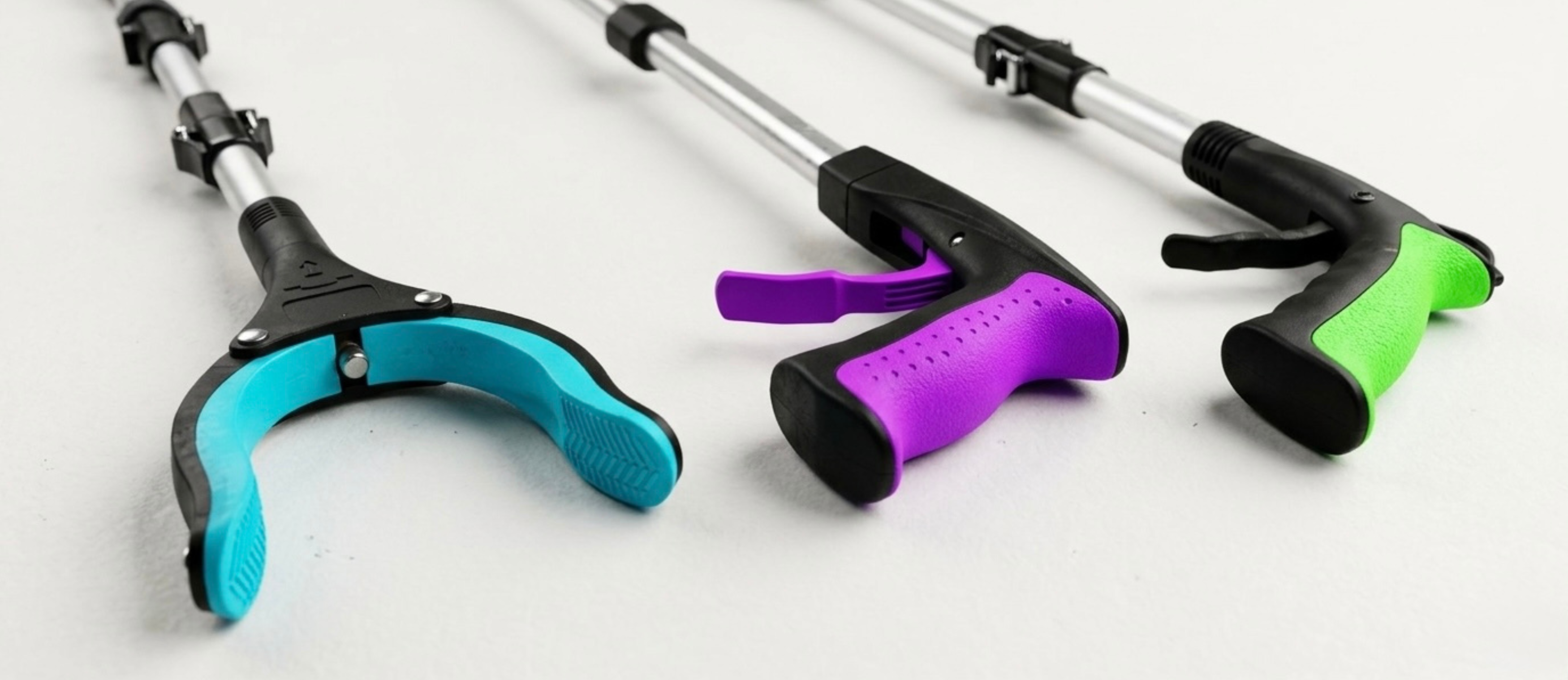
A reacher grabber tool — also called a reacher tool, grabber tool, or pickup tool — is a long-handled assistive device with a trigger mechanism at one end and a gripping claw at the other. Squeeze the trigger, the claw opens; release it, the claw closes and holds whatever you've positioned it over.
The concept is simple. The execution varies enormously. At their core, all reacher grabbers share the same basic structure:
- The handle and trigger: Usually ergonomic and pistol-grip shaped. A well-designed trigger responds to light pressure; a poorly designed one requires a strong grip — defeating the purpose for anyone with reduced hand strength.
- The shaft: The long middle section. Aluminum alloy is the best balance of strength and weight. Steel is strong but heavy. Plastic flexes at longer lengths and eventually cracks.
- The rotating head: Quality grabbers allow the jaw to rotate — usually 360° — so you can reach awkward angles without repositioning your feet.
- The jaw: The gripping claw at the far end. Non-slip silicone or rubber pads grip soft and smooth objects reliably. Flat plastic jaws slip on anything with a curved or smooth surface.
- The magnetic tip: A small embedded magnet that picks up coins, keys, dropped medication foil, needle caps — things a standard jaw cannot grip at all.
These five components together determine whether a reacher grabber tool is genuinely useful in daily life — or something that ends up in a drawer after three uses.

Who Uses a Reacher Grabber Tool — and Why
Reacher grabber tools are used by a wider range of people than most expect, for reasons that go well beyond simple convenience.
Older Adults and Seniors
This is the largest user group, and for good reason. As we age, several physical changes make bending and reaching progressively harder:
- Reduced flexibility and joint stiffness make forward bending uncomfortable or painful
- Balance changes mean bending down carries a real risk of losing stability and falling
- Reduced grip strength from natural muscle loss or conditions like arthritis makes lifting small objects harder
- Fatigue means even small physical tasks can feel disproportionately effortful
A reacher grabber tool addresses all of these at once. It's not a sign of limitation — it's a practical tool, the same way reading glasses or a non-slip bath mat are practical tools.
Post-Surgery Recovery
For anyone recovering from hip or knee replacement surgery, a reacher grabber tool is often a medical necessity, not a lifestyle choice. Orthopedic surgeons routinely advise patients not to bend past 90 degrees for weeks or months after joint replacement surgery. A grabber tool is the practical solution that makes compliance with that restriction possible at home.
The same applies after back surgery, abdominal surgery, or any procedure where bending is contraindicated during recovery.
People with Chronic Conditions
Arthritis, fibromyalgia, multiple sclerosis, and Parkinson's disease all share a common feature: they make physical tasks that were once automatic feel disproportionately difficult. A reacher grabber tool reduces the physical demand of routine tasks without requiring assistance from another person.
Wheelchair and Mobility Aid Users
For wheelchair users, a reacher grabber is a fundamental independence tool. It extends effective reach to the floor, to high shelves, and into tight spaces that would otherwise require assistance. Shorter lengths (26–30 inches) are often preferred by seated users.
Anyone Who Values Convenience
Not every reacher grabber user has a mobility limitation. Many people use them for pulling things from the back of deep kitchen cupboards, retrieving items that rolled under furniture, picking up litter in the yard, or dressing without bending. Convenience is a legitimate reason to use a good tool.

The 6 Features That Separate a Good Reacher Grabber from a Frustrating One
The market is full of reacher grabber tools priced from $10 to $60. Price alone is a poor guide. What actually matters are these six features.
1. Jaw Quality — The Most Important Feature
The jaw is where nearly all performance differences show up in daily use:
- Jaw pad material: Non-slip silicone or rubber pads grip both soft objects (clothing, bags) and smooth objects (bottles, cans, jars) without slipping. Flat plastic jaws slip constantly on anything with a curved surface.
- Jaw opening width: A jaw that opens wide enough to grip a full water bottle or a thick book is far more useful than a narrow jaw that only handles small objects.
The magnetic tip deserves its own mention. A small magnet embedded in the jaw picks up coins, keys, dropped medication foil, and small metal objects that a standard claw simply cannot grip. For anyone who drops small things frequently, this is often the difference between a grabber that's genuinely useful and one that isn't.
2. Shaft Material and Rigidity
- Aluminum alloy: The best choice. Light, strong, and rigid at all standard lengths. Used in the GrabberTool range.
- Steel: Strong and rigid but significantly heavier. Fine for occasional use; tiring for daily use.
- Plastic: Light but flexes at longer lengths and eventually cracks, especially at foldable joints.
3. Trigger Mechanism
An easy-pull trigger that responds to light pressure is essential for daily use — particularly for anyone with arthritis, reduced grip strength from surgery, or general hand fatigue. Some models include a trigger lock that holds the jaw closed without continuous trigger pressure — useful when carrying heavier items longer distances.
4. Rotating Head
A 360° rotating head lets you position the jaw at any angle without moving your feet. Without it, reaching items at awkward angles requires repositioning your entire body. A rotating head eliminates this problem entirely.
5. Weight
The GrabberTool 32" weighs under 8 oz. The difference between a 6 oz grabber and a 14 oz one sounds minor on paper — but in daily use, after the first week, it is immediately noticeable.
A grabber that weighs more than 8–10 oz will feel heavy after a few minutes of daily use, especially for anyone with reduced arm strength. The cumulative fatigue of using a heavy tool many times per day adds up quickly.
6. Foldability and Storage
If the grabber will be used in one fixed location at home, foldability is a nice-to-have. If it needs to travel — in a handbag, a car, a carry-on suitcase, or a hospital bag — a foldable grabber is essential. The best foldable grabbers collapse to around 16–17 inches and come with a storage bag.

How to Choose the Right Length: A Practical Guide
Length is the first thing most people think about when choosing a reacher grabber tool, and it genuinely matters. Too short and you still need to bend; too long and precise control becomes harder.
| Length | Who It's For | Best Use Cases |
|---|---|---|
| 26–30 inches | Seated users, wheelchair users, shorter adults | Floor retrieval from a chair, pulling items off low shelves |
| 32–33 inches | Most adults — the all-purpose "golden standard" | Floor retrieval while standing, standard shelves, daily home use |
| 36–40 inches | Taller adults, post-surgery users who cannot lean at all | Floor retrieval with zero lean, medium-height shelves |
| 43–48 inches | Very tall users, outdoor use, high shelves | Ceiling-height storage, outdoor cleanup, travel |
The 32–33 inch range is the most popular for a reason. It reaches the floor from a standard standing position with no forward lean for most adults of average height, handles most indoor shelving heights comfortably, and is light enough for extended one-handed use without fatigue.
For a detailed comparison of specific long-reach models, see our guide to the best long reach grabber tool options currently available.

What Can You Actually Do With a Reacher Grabber Tool?
The short answer: more than most people expect. Once a good grabber is part of your daily routine, you'll use it for tasks you didn't anticipate when you bought it.
Floor Retrieval — The Core Use Case
Picking up dropped items from the floor is the reason most people buy a reacher grabber tool. This covers everything from a dropped phone to a rolled-away pill to a sock that fell off the laundry pile. With a 32" grabber and silicone jaw pads, this becomes a one-squeeze operation with no bending required.
High Shelf Access
Reaching items on shelves above shoulder height without using a step ladder. This is particularly valuable for anyone with balance concerns, where a step ladder carries real fall risk.
Post-Surgery Mobility
A reacher grabber is often a medical requirement during recovery from joint replacement surgery. Common post-surgery uses: pulling on socks and trousers without bending, picking up dropped items during recovery, reaching kitchen items without bending, moving items in the bathroom.
Laundry Tasks
Reaching the bottom of a front-loading washing machine drum, or the bottom of a deep top-loading machine, without bending at the waist. Many people with back problems find this genuinely difficult without a grabber.
Dressing Assistance
Using a grabber to pull on socks, position clothing, retrieve items that slip off the bed, or manipulate clothing during dressing — reducing the bending and stretching that can be painful or risky.
Outdoor and Garden Use
Picking up litter, fallen branches, or garden debris without constant bending. A precision grabber with a fine-tip claw closes tight enough to pick up cigarette ends, small wrappers, or debris from hard surfaces.
Kitchen Tasks
Retrieving items from the back of deep cupboards, grabbing something from a low shelf without crouching, or moving lightweight pantry items from high shelves without a step stool.

The GrabberTool Range — Which Model Is Right for You?
Based on the features covered above, here's how the three core GrabberTool models map to different needs.
GrabberTool Reacher Grabber 32"
The all-purpose workhorse. Reaches the floor from a standard standing position with no bending, handles most standard shelving heights, and weighs under 8 oz. The aluminum alloy shaft stays rigid at full extension. Silicone jaw pads grip everything from a thin sock to a full water bottle. The 360° rotating head and magnetic tip handle situations where basic grabbers fail.
The easy-pull trigger responds to minimal hand pressure — which matters significantly for anyone with arthritis, hand weakness, or post-surgery grip fatigue.
Available in: Orange, Blue, Yellow, Black
Shop the GrabberTool 32" →GrabberTool Reacher Grabber 43"
Eliminates any forward lean — 11 inches longer than the 32", which makes a genuine practical difference when standing fully upright at maximum reach. The 3-section fold collapses it to 17 inches and it comes with a fabric storage bag, making it the best portable grabber for travel, hospital stays, or use across multiple locations.
0.8mm reinforced metal tubing keeps it rigid even at full 43" extension.
Available in: Mint, Orange, Blue, Red, Yellow
Shop the GrabberTool 43" →GrabberTool Precision Grabber 33"
Optimized for picking up small, specific objects — coins, cigarette ends, small wrappers, garden debris — where a standard jaw is too wide to close properly. The fine-tip claw closes tight enough to grip a paperclip from a hard surface.
Folds to 17 inches and includes a storage bag. Aluminum frame keeps it light enough for extended outdoor use without arm fatigue.
Available in: Black, Blue, Orange
Shop the Precision Grabber 33" →Full Model Comparison Table
| Model | Length | Folds To | Jaw Type | Magnet | Head | Best For |
|---|---|---|---|---|---|---|
| GrabberTool 32" | 32 in | 16 in | Silicone non-slip | ✓ | 360° | Daily indoor, seniors, recovery |
| GrabberTool 43" | 43 in | 17 in | Silicone non-slip | ✓ | 360° | Tall users, travel, outdoor |
| Precision 33" | 33 in | 17 in | Fine-tip claw | ✓ | 360° | Small items, garden, precision |
| Generic 36" Heavy Duty | 36 in | Usually not | Basic rubber | Varies | Standard | Budget, occasional outdoor |
| Generic 48" Extended | 48 in | Rarely | Basic rubber | Varies | Standard | Very high shelves, specialist |
How to Care for Your Reacher Grabber Tool
A good reacher grabber tool should last several years with basic maintenance.
Cleaning the Jaw Pads
Silicone jaw pads attract dust and fine debris over time, reducing grip effectiveness. Wipe them down with a damp cloth periodically — no cleaning products required. If the pads feel slippery, a mild soap-and-water wipe is usually enough to restore grip.
Checking the Trigger Mechanism
Periodically squeeze and release the trigger several times to check for smooth, consistent action. If the trigger starts sticking or the jaw doesn't close fully, check for debris caught in the pivot point at the jaw end.
Storing It Properly
Store foldable grabbers in their storage bag when not in use — this protects the jaw pads and keeps the folding joints clean. Avoid storing a grabber with significant weight resting on the jaw, which can gradually distort silicone pads.
What to Avoid
- Don't lift items heavier than its rated capacity (most standard models: 2–3 lbs)
- Don't grip sharp-edged items that can cut through the jaw pads
- Don't leave it stored at high temperatures (car dashboards in summer) — this can soften plastic components

Frequently Asked Questions
What is the difference between a reacher grabber tool and a regular grabber?
The terms are often used interchangeably, but there is a meaningful quality distinction. A basic 'grabber' is often plastic with flat rubber pads, no rotating head, and no magnetic tip. A 'reacher grabber tool' refers to a more engineered product: aluminum shaft, silicone non-slip pads, 360° rotating head, magnetic tip, and an easy-pull trigger designed for regular daily use. The GrabberTool range falls into the latter category.
What is the best length for a reacher grabber tool?
For most adults of average height using a grabber primarily at home, 32 inches is the ideal length. It reaches the floor from a standing position without any lean, handles standard shelf heights comfortably, and is light enough for extended one-handed use. The 43" is better for taller users, outdoor use, or anyone who wants zero lean at any point. See our guide to the best long reach grabber tool for a full breakdown.
Can someone with arthritis or weak hand strength use a reacher grabber tool comfortably?
Yes — but only if the trigger is specifically designed for low-effort use. Look for tools described as having an 'easy-pull' or 'low-tension' trigger. The GrabberTool range uses a trigger that responds to minimal hand pressure, distributing grip effort across the full hand. For detailed guidance, see our guide to staying safe and independent at home with a reacher grabber.

Are reacher grabber tools suitable for post-surgery recovery?
Yes, and they're often recommended by orthopedic surgeons for patients recovering from hip or knee replacement surgery, where bending past 90 degrees is contraindicated. A 32" or 43" grabber allows patients to pick items up from the floor, manage clothing, and handle daily tasks without violating post-surgical bending restrictions. Always follow your surgeon's specific guidance.
How much weight can a reacher grabber tool hold?
Most standard reacher grabbers — including the GrabberTool 32" and 43" — are rated for 2–3 lbs. This covers the vast majority of daily-use objects: a full water bottle, a food jar, clothing, and books. For heavier items, a heavy-duty grabber with a higher weight rating is more appropriate.
Can I use a reacher grabber tool from a wheelchair?
Yes. Reacher grabbers are one of the most widely used assistive tools among wheelchair users. Most wheelchair users find 26–32 inches sufficient, as the starting height is lower than a standing position. Many wheelchair users keep two grabbers of different lengths: a shorter one for close-range tasks, a longer one for the floor or higher shelves.
What should I look for in a reacher grabber tool for an elderly parent?
The most important features: lightweight construction (under 10 oz), easy-pull trigger, silicone jaw pads with a magnetic tip, and a 360° rotating head. Secondary: length (32" is usually right), color (bright colors are easier to locate around the home), and foldability if the person travels. Our dedicated guide on the best grabber tools for elderly adults covers this in detail.
Ready to Find Your Reacher Grabber?
The right tool fits your specific daily needs — the right length, the right jaw, and a trigger you can actually squeeze comfortably. Browse the full GrabberTool range and find yours today.
Shop GrabberTool Reacher Grabbers →


