

Kitchen accessibility renovation is frequently presented as the only solution to mobility-related kitchen limitations: lower counters, pull-out shelving, knee clearance under countertops, lever faucets. These modifications work — and cost between $15,000 and $40,000 for a full accessible kitchen remodel in the United States. The adaptive tool category produces 60–70% of the functional improvement at under 1% of that cost. Most people never learn this because the tool category is marketed in medical supply aisles while the renovation category is in home improvement magazines.
Direct answer: the highest-impact kitchen accessibility changes that require no structural modification are: reorganizing storage height (moving frequently used items to counter level), adding adaptive openers for grip-strength-dependent tasks, and using a long-reach reacher grabber for overhead and floor-level access without bending or stretching. These three changes address the majority of daily kitchen independence limitations without a single structural alteration to the space.
Where Kitchen Independence Actually Breaks Down
Occupational therapists conducting kitchen assessments identify four recurring failure points for people with mobility or grip limitations:
- Storage access: frequently used items stored too high (above comfortable reach) or too low (below safe bending range)
- Container opening: jars, cans, bottles, and packages that require grip strength or two-handed coordination beyond available capacity
- Sustained standing: meal preparation requiring extended weight-bearing on painful or unstable joints
- Hot item handling: carrying pots and pans from stove to table with reduced grip or balance
Points 1 and 2 are resolved almost entirely by adaptive tools. Points 3 and 4 require either technique modification or structural changes (perching stool for point 3; rolling cart instead of carrying for point 4).
The Storage Reorganization: Zero Cost, Maximum Impact
The single most effective kitchen accessibility intervention costs nothing: move frequently used items to counter height. Items used daily — coffee, common spices, breakfast staples — should be within a comfortable arm reach from standing. Items used occasionally can remain in higher or lower storage with a reacher available for access.
The practical implementation:
- Identify the 10–15 items used most days
- Move them to counter-height storage or to mid-cabinet shelves (eye level)
- Use a 32" or 43" reacher for occasional access to upper and lower storage
- Consider a countertop organizer to create accessible staging for daily items without consuming counter work space
Adaptive Openers: The Grip Strength Problem Solved
| Kitchen Task | Standard Method | Grip Required | Adaptive Solution |
|---|---|---|---|
| Jar opening | Manual twist | High — pinch and rotation | Electric Jar Opener |
| Can opening | Manual rotary cutter | High — sustained squeeze | Electric Can Opener |
| Bottle cap removal | Hand pry | Medium-high | Multi-Opener 5-in-1 |
| Plastic wrap cutting | Box cutter edge | Medium | One-touch dispenser cutters |
| Overhead storage retrieval | Reaching overhead | Low grip, high reach | 43" Reacher Grabber |
| Floor-level storage retrieval | Bending or crouching | Low grip, high flexion | 32" Reacher Grabber |
The complete adaptive kitchen tool lineup from GrabbersTool — including motor specifications, grip dimensions, and compatibility ranges — is available on individual product pages. The combined cost of the three electric tools (jar opener, can opener, multi-opener) is significantly below the cost of a single contractor visit for structural kitchen modifications. Browse the Easy Grip Kitchen Openers collection →
The Reacher Grabber as a Kitchen Tool
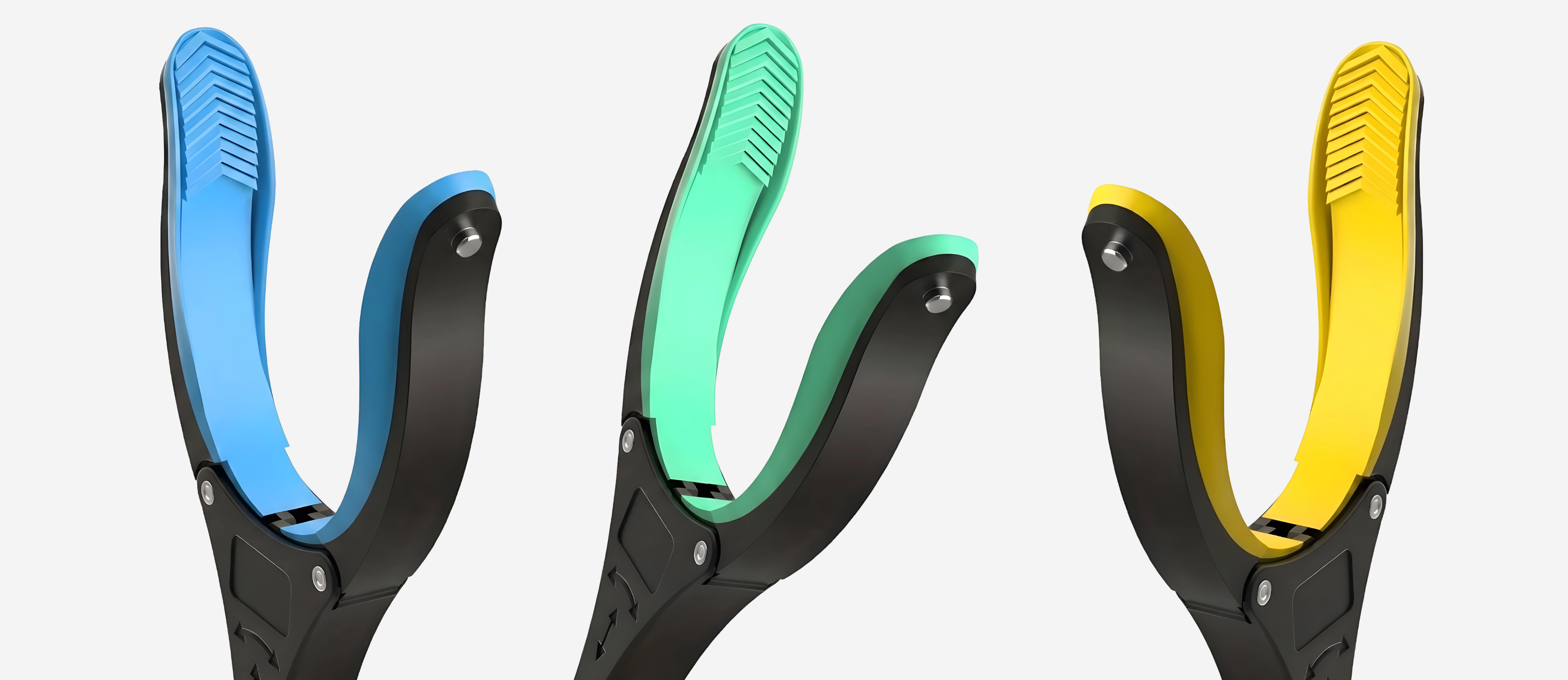
Most people do not initially think of a reacher grabber as a kitchen tool. GrabbersTool customers who use one in the kitchen report that it addresses a specific daily pattern: the items that create the most friction in kitchen use are the ones stored just beyond comfortable reach — the second shelf of upper cabinets, the back of a lower cabinet, the top of the refrigerator.
A 43" reacher on a kitchen hook resolves all upper cabinet access without a step stool. A 32" reacher handles lower cabinet retrieval without crouching. These two tools in the kitchen eliminate the bending and stretching that create pain or fall risk for the majority of overhead and low-level storage access tasks.
The Perching Stool: For Sustained Standing
A perching stool — a semi-seated position at counter height — is not a kitchen modification. It is a piece of furniture that costs under $100 and eliminates the sustained standing requirement for meal preparation. For users with joint pain, fatigue, or balance limitations that make 30-minute meal preparation difficult while standing, a counter-height perching stool shifts the energy cost dramatically while keeping the user at working height.
This is not in GrabbersTool's product range, but it belongs in any honest discussion of kitchen accessibility without renovation — and it is the most overlooked low-cost, high-impact intervention in this category.
When Structural Modification Is Actually Necessary
Non-structural adaptive tools and reorganization address most daily kitchen independence limitations. Structural modification becomes necessary when:
- The user is a full-time wheelchair user and counter heights are incompatible with seated reach
- The doorway to the kitchen is too narrow for a wheelchair to pass
- Faucet controls require grip strength beyond what any adaptive tool can bridge
- Appliance placement is fixed and inaccessible without physical relocation
For ambulatory users — those who walk with or without a cane — structural modification is almost never the first-line intervention. The adaptive tool and reorganization approach should be fully implemented and assessed before any structural modification is considered.
See also: Jar Opener for Arthritis: Why Grip Strength Is Not the Real Problem and Can a Grabber Tool Replace a Home Health Aide for Simple Daily Tasks for the broader independence context.


