

Section 01
Why Grabber Tool Length Actually Matters
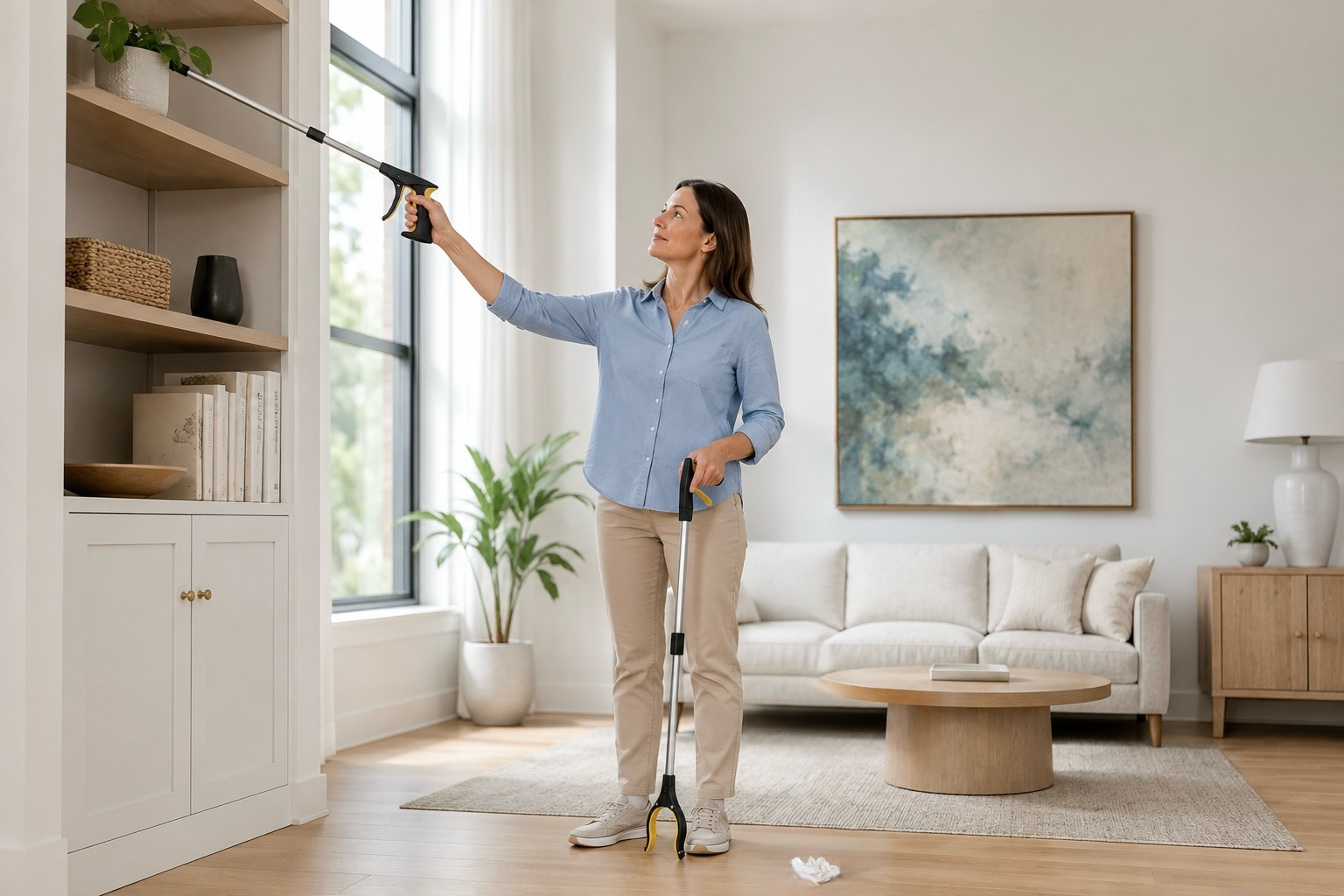
A grabber tool that is the wrong length for your body creates more strain than it relieves. Too short and you hunch forward to reach the floor — putting pressure on your lower back. Too long and it becomes unwieldy in tight spaces like kitchen drawers or under furniture.
Unlike walking canes where a centimetre matters, grabber tools are more forgiving — but the difference between 32 inches and 43 inches is significant enough to affect how you use the tool every single day. Getting the length right from the start means less fatigue, better posture, and more independence.

The gap between a 32" and 43" grabber is significant — roughly the difference between reaching mid-shin and touching the floor while standing straight.
After hip replacement surgery, bending past 90° is restricted. The right grabber length lets you maintain this precaution while staying independent.
Most users are well served by one of two lengths. Knowing which one fits your height and tasks is all the information you need.
Section 02
Grabber Tool Length by Height — The Reference Chart
Use this as your starting point. The chart below matches body height to the most suitable grabber length based on typical arm proportions and ergonomic reach. If you have specific mobility restrictions or use a wheelchair, scroll to Section 04 for use-case guidance.
The Standing Reach Rule. Stand upright with your arm at your side. The distance from your wrist to the floor is your minimum grabber length for floor-level tasks. Add 2–3 inches for comfortable grip without overstretching. For shelf tasks, measure from your comfortable reach height to the shelf.

| Your Height | Wrist-to-Floor | Recommended Length | Best For |
|---|---|---|---|
| Under 5'2" (157 cm) | ~26–27" | 32" | All general tasks; floor reach requires slight lean |
| 5'2"–5'6" (157–168 cm) | ~27–29" | 32" | Everyday use, shelves, countertops, light floor tasks |
| 5'6"–5'10" (168–178 cm) | ~29–31" | 32" or 43" | 32" works for most tasks; 43" for floor-level without any bending |
| 5'10"–6'2" (178–188 cm) | ~31–33" | 43" | Best ergonomics for floor, dressing, laundry tasks |
| Over 6'2" (188 cm+) | ~33"+ | 43" | Essential for floor reach; 32" will require constant bending |
If you are in the 5'6"–5'10" overlap zone, the deciding factor is usually how you plan to use the tool. If you mainly need to reach items on shelves and counters, the 32" is ideal. If picking things up off the floor is your main challenge — after surgery, for example — go with the 43".
Section 03
32-Inch vs 43-Inch Grabber Tool — Full Comparison
Both lengths are purpose-built. Neither is universally "better." The question is which one fits the tasks you do most often and the spaces you work in.

| Feature | 32" Grabber Tool | 43" Grabber Tool |
|---|---|---|
| Floor reach (standing) | Requires slight forward lean for most adults | Full floor reach with upright posture |
| Overhead reach | Excellent — lightweight, easy to angle | Possible but heavier to hold up |
| Tight spaces | Easier to manoeuvre (under sofa, narrow gaps) | Less flexible in confined areas |
| Post-surgery use | Suitable for waist-level and above tasks | Recommended for hip precaution compliance |
| Wheelchair use | Standard choice for seated reach | Depends on arm strength and chair configuration |
| Travel & storage | More portable, easier to pack | Longer to store; check foldable options |
| Weight | Lighter | Slightly heavier |
| Best user height | Under 5'7" | 5'7" and above (or limited bending ability) |
Still deciding between the two? Our dedicated comparison guide walks through real-world scenarios and reader questions to help you make the final call.
Read the 32" vs 43" full comparison →Section 04
Choosing Length by Use Case
Your height is the starting point, but your specific situation often determines the final answer. These are the most common scenarios and what each one requires.

After hip replacement surgery
A 43" grabber is strongly recommended. The extended reach allows you to pick items off the floor, retrieve shoes, and assist with dressing without violating the 90-degree hip flexion precaution. This is one of the most common clinical recommendations for post-op recovery.
Elderly users at home
Most seniors living independently benefit from a 32" grabber for general household tasks — reaching items on low shelves, picking up light objects from armchair height. Taller seniors or those with back pain often prefer the 43" for floor-level tasks without bending.
Wheelchair users
Seated reach is different from standing reach. A 32" grabber typically provides sufficient length from a wheelchair for most tasks. The key variables are arm strength and how far objects fall from the chair — test before committing to a longer model.
Picking up trash outdoors
Outdoor cleanup typically favours a longer tool — bending repeatedly for litter on uneven ground is tiring. A 43" grabber reduces that strain significantly over time. See our dedicated outdoor grabber comparison for full detail.
Picking up small items
Length matters less here than jaw design. If your main challenge is coins, pills, or keys, a precision grabber with a narrow jaw and magnetic tip is more important than total length. Both 32" and 33" precision models are available.
High shelves and overhead reach
Counter-intuitively, a 43" grabber is not always better for high shelves — it becomes heavy to hold overhead for extended periods. A 32" grabber angled upward is often more controllable for shelf and cabinet tasks above shoulder height.
Key insight
Most households benefit from one of each.
If you use a grabber tool daily across a variety of tasks, the most practical setup is a 32" tool for shelves and tight spaces, and a 43" for floor-level and dressing tasks. Both are affordable enough that owning two is a reasonable decision.
- Keep the 32" in the living area for everyday reach tasks
- Keep the 43" in the bedroom for dressing and morning routine
- A precision model handles small objects neither length grips reliably
Section 05
Recommended Grabber Tools by Length
All three tools below are available directly from GrabbersTool. Each is designed for a specific primary use case — choose based on your height and the tasks you do most often.


Not sure which to order? Browse the full collection including foldable and magnetic tip models, or read detailed comparisons in the GrabbersTool blog.
Browse all grabber tools →Section 06
Frequently Asked Questions
What length grabber tool do I need for my height?
For most adults under 5'6", a 32-inch grabber tool is sufficient for everyday tasks. For adults 5'7" and taller, or anyone who needs to reach the floor without bending, a 43-inch grabber tool provides better ergonomics and reduces back strain. If you are between 5'6" and 5'10", the deciding factor is your primary use case: shelf tasks favour the 32", floor tasks favour the 43".
What is the difference between a 32-inch and 43-inch grabber tool?
A 32-inch grabber is more compact and manoeuvrable — ideal for close-range tasks, narrow spaces, and shelves at shoulder height. A 43-inch grabber allows you to pick items off the floor, reach high shelves, and maintain upright posture during use, making it better for taller users or anyone with limited bending ability. The 11-inch difference is roughly the distance from mid-shin to the floor for an average-height adult — significant in practice.
Can I use a grabber tool after hip replacement surgery?
Yes. A grabber tool is one of the most recommended mobility aids after hip replacement surgery. It allows you to pick items off the floor and assist with dressing without bending past the 90-degree hip flexion restriction that applies during recovery. A longer grabber (43 inches) is typically recommended so you can reach the floor while standing fully upright. For specific post-surgery guidance, see our dedicated hip replacement grabber guide.
What grabber tool length is best for seniors?
Most seniors benefit from a 32-inch grabber for general use around the home — reaching items on counters, low shelves, and medium-height surfaces. For seniors with significant mobility limitations or who need to pick items up from the floor regularly, the 43-inch model offers greater reach without repositioning the body. A lightweight construction is important for extended daily use — fatigue accumulates over time with a heavy tool. See our guide to the best grabber tools for the elderly for a full breakdown.
Can a grabber tool pick up small items like coins or pills?
Standard grabber tools struggle with very small items — the jaw is designed for bottles, clothing, and similar objects. A precision grabber tool with a narrower jaw and magnetic tip is specifically designed for coins, pills, keys, and other small objects. The jaw design matters more than the total length for this type of task. Read our full guide on how to pick up small items with a grabber tool for technique tips.
Is a foldable grabber tool a good choice?
Foldable grabber tools are excellent for travel, storage in tight spaces, or carrying in a bag. The folding mechanism adds a small amount of bulk at the joint, but modern designs are robust enough for regular use. If you need a tool for travel or want to keep one in a handbag or car, a foldable model is worth considering. For permanent home use, a fixed-length tool is typically more durable. See the full foldable vs non-foldable grabber comparison.
Should I use a grabber tool for picking up outdoor trash?
Yes, and for outdoor litter picking, the 43-inch model is generally preferable. You will be bending repeatedly over uneven ground — a longer tool reduces that strain significantly over the course of a cleanup session. Look for a model with a wide jaw capable of gripping bottles, cans, and bags. Our outdoor grabber comparison guide covers the best options in detail.
How do I use a grabber tool correctly?
The most common mistake is gripping the trigger too tightly and too fast — this causes the object to slip or roll away. Approach the item from above rather than the side, position the jaw fully around it before squeezing, and squeeze steadily rather than sharply. For heavier objects, support the item with the jaw fully closed before lifting. For full technique guidance, see our 7 tips for using a grabber tool correctly.
Find the right grabber tool for your reach.
Browse the full range — 32", 43", and precision models available now.
Shop all grabber tools


